creative tool
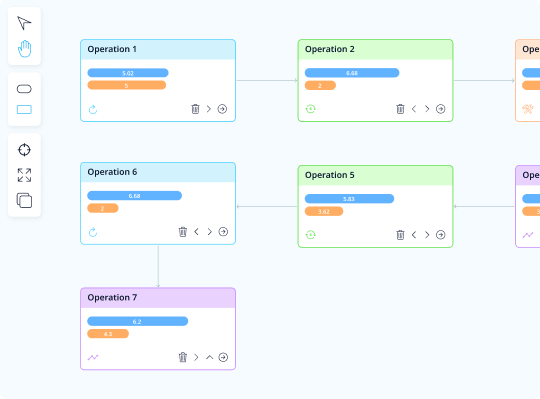
Process Functional Modeling (PFM) is an analytical tool to learn the process through modeling of different operations, solving problems, and defining ways to the improvement of any fabrication process. PFM is an extension of the System Functional Modeling (SFM) and it allows us to analyze the whole process vs one particular operation in the process.
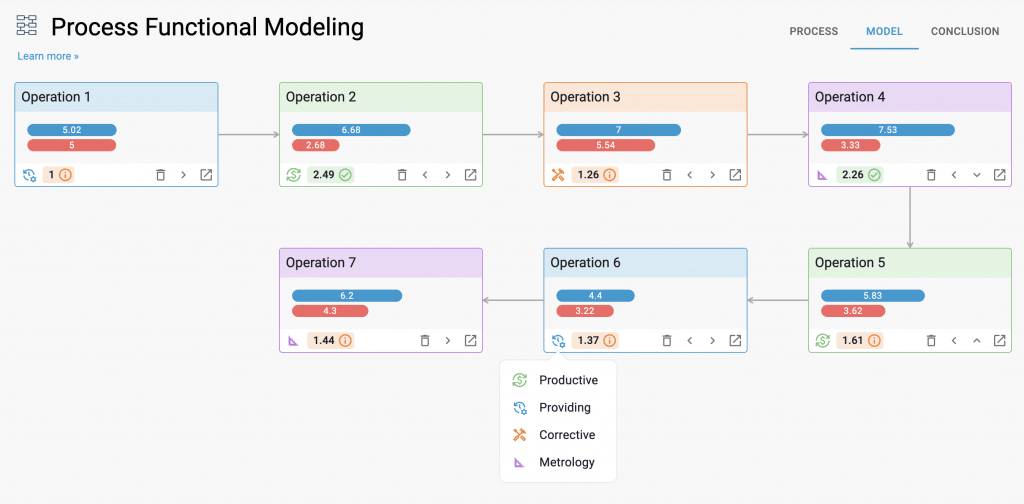
Among many cases when Process Functional Modeling is useful for us as problem solvers and innovators, we want to highlight just a few:
Implementing PFM can lead to significant improvements in operational efficiency. By breaking down each operation within a process, organizations can pinpoint specific areas that require enhancement. This detailed understanding helps in reducing bottlenecks, improving throughput, and ultimately increasing overall productivity. Additionally, PFM facilitates better communication among team members as it establishes a clear and common understanding of the process, ensuring everyone is aligned with the goals and objectives.
As technology continues to evolve, the integration of advanced tools such as artificial intelligence and machine learning with PFM is becoming more prevalent. These technologies can enhance the analytical capabilities of PFM, allowing for real-time monitoring and more accurate predictions of process performance. Additionally, the increasing adoption of digital twins—a virtual replica of physical processes—enables organizations to simulate and test process changes in a risk-free environment before implementing them in the real world. These trends are set to further revolutionize the way businesses optimize their processes.
This project investigates the nonuniform erosion of an expensive Ta sputtering target during Ta/TaN PVD. A deep racetrack groove forces target replacement while a significant amount of tantalum remains unused. Using PRIZ problem-solving tools, the project explores the system’s functions, identifies the root causes of localized erosion, and develops ways to improve target utilization without reducing deposition rate or production throughput.

The process is related to microelectronics - microchip manufacturing. The purpose of the process is to create a SiO2 layer on the surface of a Si wafer. Equipment: Vertical furnace to heat the wafers in the Q2 atmosphere and perform oxidation on the wafer surface. Process: The oxidation occurs on the front side and on the back side of the wafer Requirements: Create a SiO2 thin layer with a certain thickness and low sigma - low standard deviation of the thickness between the wafers and within the wafer Failure: Wafers from the lower zone have higher thickness and significantly higher within wafer sigma (standard deviation of the thickness within the wafer)

Wet cleaning is widely used in microchip manufacturing. Single wafer equipment is working as follows. A wafer rotates, and chemistry is poured from a movable nozzle. Water rinsing is performed at the end of the process. Loading of a new batch of the chemistry resulted in excursion - a strongly increased amount of defects was observed on the wafer after the processing. The project is dedicated to the failure analysis and creation of innovative solutions.
This project applies Functional Modeling to analyze the single-wafer wet etch process in semiconductor manufacturing. The model shows that wet etch defects are not caused only by chemistry, but also by interactions between the wafer, liquid flow, air, rotation, rinsing, drying, drain, and chamber environment. Key challenges include incomplete wetting, trapped air or bubbles, residue and particle redeposition, evaporation-driven watermarks, and contamination during rinse or drying. The project identifies improvement directions such as better wafer pre-wetting, controlled airflow, reduced evaporation, optimized rinse and drying conditions, and alternative chamber concepts such as face-down processing in a shallow liquid bath.
This project investigates particle-defect formation during SiO₂ dry etch. Functional modeling revealed that defects can be generated by two coupled mechanisms: chemical formation of SiO₂/SiOFₓ particles from SiF₄ interaction with moisture, and mechanical generation of particles by excessive ion bombardment and sputtering. The proposed improvement direction is to balance chemical etching and ion-assisted etching by properly adjusting the source and bias generators, reducing moisture, improving by-product evacuation, minimizing sputtering, and using pulsed or multi-step process recipes. The goal is to reduce particles and micromasking while maintaining etch rate, profile control, and process stability.
This project investigates how to increase the copper removal rate during Chemical Mechanical Planarization (CMP). Functional modeling revealed that increasing H₂O₂ alone is ineffective beyond an optimum level because rapid oxidation creates a thick, passivating Cu₂O/CuO layer that must be mechanically removed. The winning direction is to balance faster oxidation with stronger mechanical removal by optimizing pad speed, abrasive concentration, pressure, conditioning, and slurry transport.
Semiconductor devices are becoming more complex and expensive. But what exactly are we paying for when we buy a computer, cellphone, or any device containing a microchip? It’s not for radically new functions—the core components remain the same: transistors and interconnections. According to Moore’s law, transistors are getting smaller, with more interconnection layers added, making the manufacturing process longer and more costly. In reality, we’re paying for the inability of engineers to efficiently solve engineering challenges. This project leverages System Functional Modeling (SFM) to analyze the IC interconnection layer and Process Functional Modeling (PFM) to evaluate its manufacturing process. These analyses aim to deepen our understanding of both the device and the production process, generating innovative solutions for cost reduction and improved efficiency.
This project presents an innovative engineering solution for improving the corrosion resistance of dental implants. The proposed concept utilizes multi-layer ceramic and oxide coatings to provide long-term protection against corrosion, wear, and harsh oral conditions. By maintaining inner protective layers even after the outer layer degrades, the design aims to extend implant lifetime, improve reliability, and reduce the risk of implant failure. This concept was developed as part of the Engineering Thinking course in the Materials Engineering program.