

The Barrier Job Interview
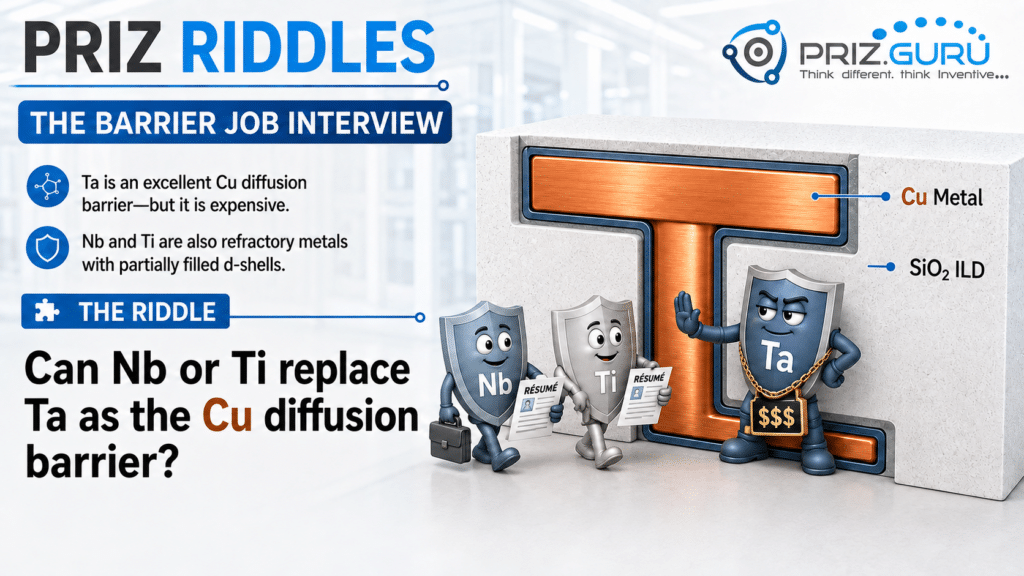
Copper interconnections require a barrier that prevents Cu from diffusing into the surrounding dielectric. Tantalum performs this job extremely well, but it is expensive. Niobium and titanium appear to be logical alternatives. They are also refractory metals with partially filled d-shells. Can either of them replace Ta?
The challenge
Can we replace Ta?
Why copper needs protection
Copper provides excellent electrical conductivity, but Cu atoms can diffuse into SiO₂ and low-k interlayer dielectrics.
Copper contamination can increase leakage, degrade insulation, and eventually cause device failure. A thin barrier must therefore completely separate the Cu interconnection from the surrounding dielectric.
Tantalum has the job
Ta-based barriers are widely used because they effectively block Cu diffusion and remain stable during semiconductor processing.
However, tantalum is expensive. Could another refractory metal provide the same function at a lower cost?
The candidates
Niobium and titanium appear suitable:
- Ta, Nb, and Ti are refractory metals.
- All three contain partially filled d-electron shells.
- All three can be deposited as thin films.
However, belonging to the same family does not guarantee the same barrier performance.
Your task
Can Nb or Ti replace Ta as the Cu diffusion barrier?
Think first.
Before you look
What’s your answer?
Writing down a hypothesis makes the reveal more satisfying—and your reasoning easier to compare.
Your guess stays private. No account required.
I’ll skip the guessAnswer revealed
The key parameter is the density of the barrier structure.
Copper atoms move through open spaces, defects, grain boundaries, and other weak paths in a material. A dense, continuous barrier provides fewer available paths for Cu diffusion.
The bulk densities show a significant difference:
| Material | Density |
| Ta | 16.7 g/cm³ |
| Nb | 8.6 g/cm³ |
| Ti | 4.5 g/cm³ |
Why Ta works
Ta has by far the highest density and can form a compact barrier structure with very few open diffusion paths.
The second important parameter is Cu solubility in the barrier. Cu has extremely low solubility in Ta, and the Cu–Ta system does not readily form stable intermetallic compounds.
The combination of a dense structure and very low Cu solubility makes Ta an excellent diffusion barrier.
What about Nb?
Nb is less dense than Ta, and Cu has limited but measurable solubility in it at elevated temperatures.
Nb may therefore be considered as a possible barrier material, particularly for processes with a limited thermal budget. However, it is not a direct replacement for Ta and requires careful qualification of the film structure, thickness, interfaces, and process conditions.
What about Ti?
Ti has the lowest density of the three metals. It also interacts with Cu and forms several Cu–Ti intermetallic phases.
Metallic Ti therefore cannot provide the same reliable isolation as Ta. It is better suited as an adhesion layer than as a standalone Cu diffusion barrier.
TiN is different: its dense nitride structure can strongly restrict Cu movement and may function as a diffusion barrier.
Why SiC and SiN can also work
For diffusion barriers, density does not mean only mass per unit volume. The most important factor is the density of the atomic network—a compact, continuous structure with minimal free space and few diffusion paths.
This is why dense covalent materials such as SiC and SiN can also act as effective Cu diffusion barriers, even though their bulk mass densities are lower than those of Ta, Nb, and Ti.
The verdict
| Material | Barrier potential |
| Ta | Dense structure, extremely low Cu solubility, proven barrier |
| Nb | Possible candidate, but requires process qualification |
| Metallic Ti | Lower density and strong interaction with Cu; not a reliable standalone barrier |
| TiN, SiC, SiN | Dense atomic networks that can effectively restrict Cu diffusion |
Why this works
Dense network structure + low Cu solubility = an effective Cu diffusion barrier.
Thinking principle: Similar materials do not necessarily perform the same function. The complete system interaction—not one property or one position in the periodic table—determines whether a material can do the job.
How did you do?
Your response helps us tune difficulty.