

The Cobalt Interconnect Paradox
Copper is one of the best electrical conductors. Cobalt has approximately 3.7 times higher bulk resistivity, yet cobalt has been used instead of copper in some of the smallest local interconnections. Why would the poorer bulk conductor become the better engineering choice?

The challenge
Why replace Cu with Co in BEOL
Copper became the standard material for semiconductor interconnections because of its excellent conductivity.
Copper is the standard material for chip interconnections because of its excellent conductivity. Cobalt seems like a poor replacement: its bulk resistivity is approximately 3.7 times higher than that of Cu.
Nevertheless, at the 10 nm generation, Co began to replace Cu in some local and lower BEOL interconnections.
Your task
Why can Co, the poorer bulk conductor, become the better choice for the smallest interconnections?
Don’t guess. Don’t search the internet; it cannot think for you. Think first!
Before you look
What’s your answer?
Writing down a hypothesis makes the reveal more satisfying—and your reasoning easier to compare.
Your guess stays private. No account required.
I’ll skip the guessAnswer revealed
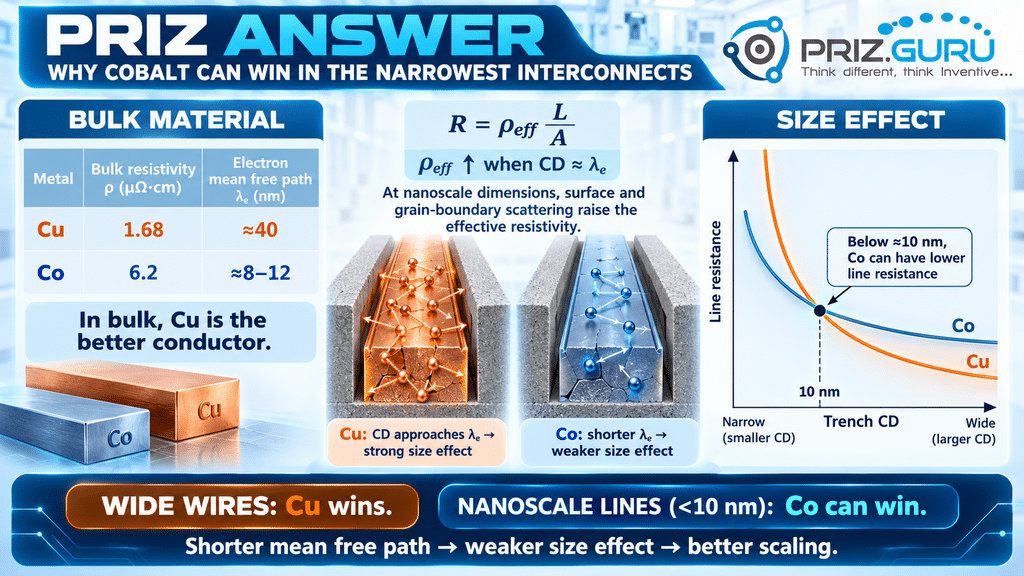
For wide interconnects, bulk resistivity is the main parameter, and Cu easily wins.
When the line width approaches the electron mean free path, electrons collide more frequently with surfaces and grain boundaries. Therefore, the resistivity becomes strongly dependent on the conductor dimensions.
For Cu, the electron mean free path is approximately 39–40 nm. Calculated values for Co are approximately 8–12 nm. Therefore, Cu begins suffering from strong size-dependent resistance earlier, while Co scales more gradually.
Cu also requires barrier and liner layers that consume an increasing fraction of a narrow trench. Co can use a thinner liner, leaving more cross-sectional area for conduction, while offering better electromigration resistance and lower via resistance.
This does not mean that Co is always intrinsically more conductive than Cu at 10 nm. It means that the complete Co interconnect can become more practical and reliable at extremely small dimensions.
Wide wire: Cu wins.
Nanoscale interconnect: the entire system decides.
Why this works
Technical basis: The resistance increase in narrow lines is controlled by surface scattering, grain-boundary scattering, and the product of bulk resistivity and electron mean free path.
Reported values are about 39 nm for Cu and 7.8–11.8 nm for Co from calculations, although experimentally fitted Co values can be higher. Intel introduced Co in its first two interconnect levels at the 10 nm node, accepting higher line resistance in exchange for improved electromigration reliability and lower vertical contact resistance.
Sources: Journal of Applied Physics and imec.
How did you do?
Your response helps us tune difficulty.