

Copper Interconnects
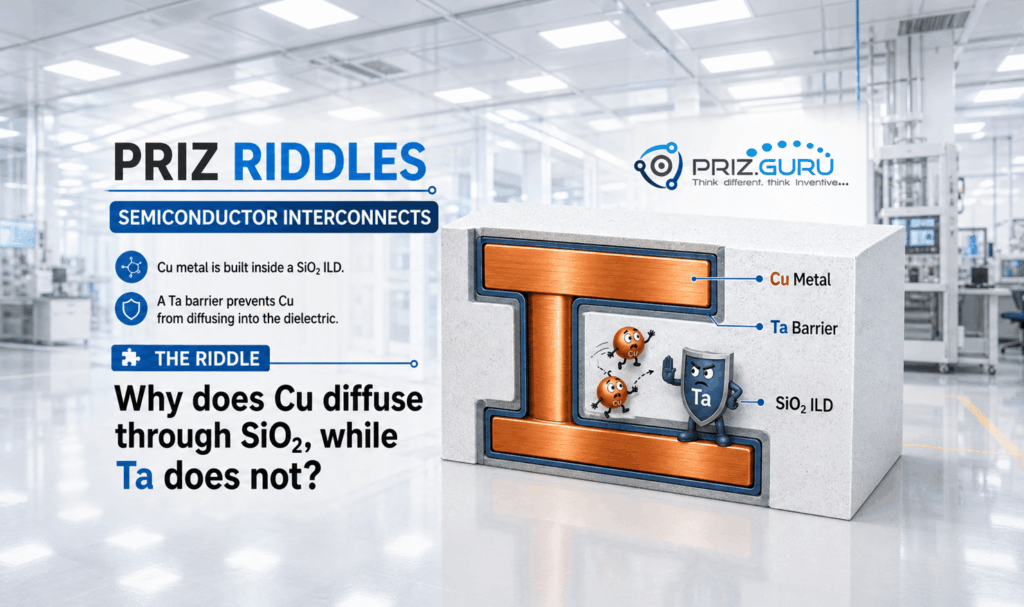
The back end of line (BEOL) connects the transistors formed in the chip’s front end of line (FEOL). The interconnect lines are built within an interlayer dielectric (ILD), typically based on silicon oxide. Copper is widely used for these interconnects because of its excellent electrical conductivity.
The challenge
Copper provides fast electrical connections inside a chip, but it can diffuse into the surrounding SiO₂ dielectric and degrade its performance. Therefore, a thin tantalum barrier is placed around the Cu lines.
Why does diffuse through while does not?
Your task
Why does Cu diffuse through SiO₂ while Ta does not?
Before you look
What’s your answer?
Writing down a hypothesis makes the reveal more satisfying—and your reasoning easier to compare.
Your guess stays private. No account required.
I’ll skip the guessAnswer revealed
The key difference is the electronic configuration.
Copper has the configuration:
When enters or , it can lose its single electron and become , retaining a filled shell. This closed shell has little tendency to participate in strong, directional bonding with the surrounding structure. The ion can therefore occupy interstitial or free-volume sites and hop from one site to another. Heat and an electric field accelerate this movement.
Tantalum is different:
Its partially filled states actively participate in bonding. Ta atoms are strongly bonded to one another and can also bond strongly with surrounding or atoms. Removing a atom from its position and moving it through the surrounding material therefore requires much more energy.
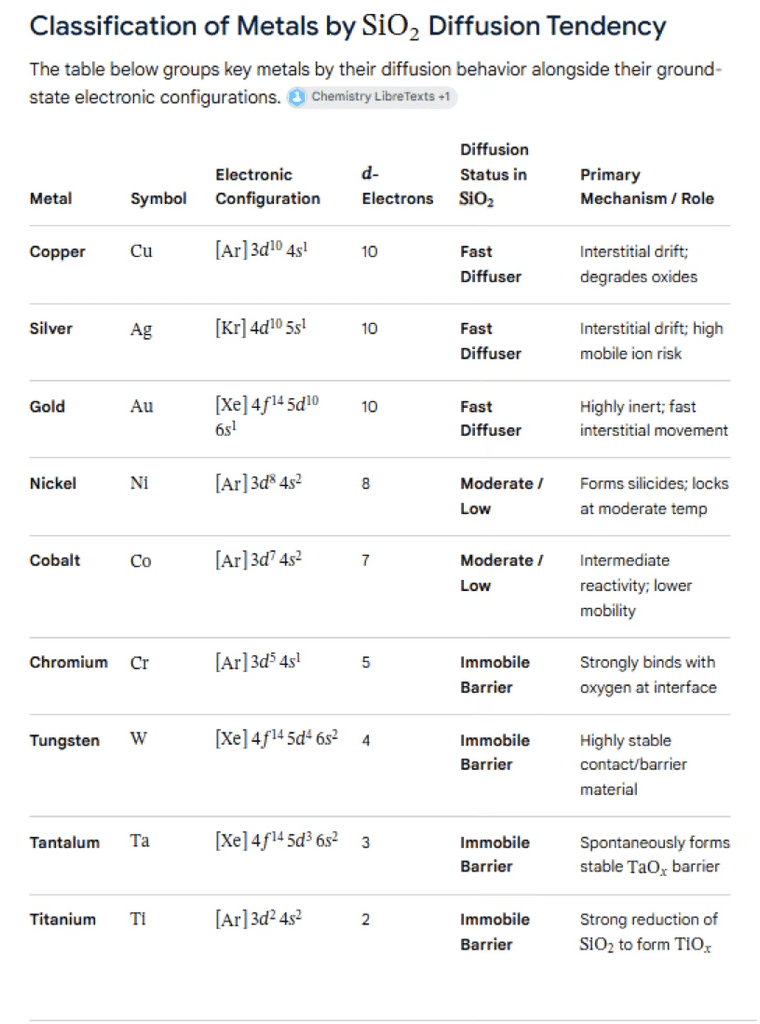
The table shows the general correlation:
- metals — , and — are highly mobile.
- Metals with configurations — and — have lower mobility.
- Metals with partially filled configurations — , , , and — are strongly anchored and act as barriers.
Other properties also influence diffusion, but electronic configuration is the root parameter because it determines bonding strength and, consequently, the migration-energy barrier.
Cu has an electronic passport and travels through the material.
Ta has an electronic anchor—and becomes the barrier.
How did you do?
Your response helps us tune difficulty.