

The Cobalt Plating Paradox
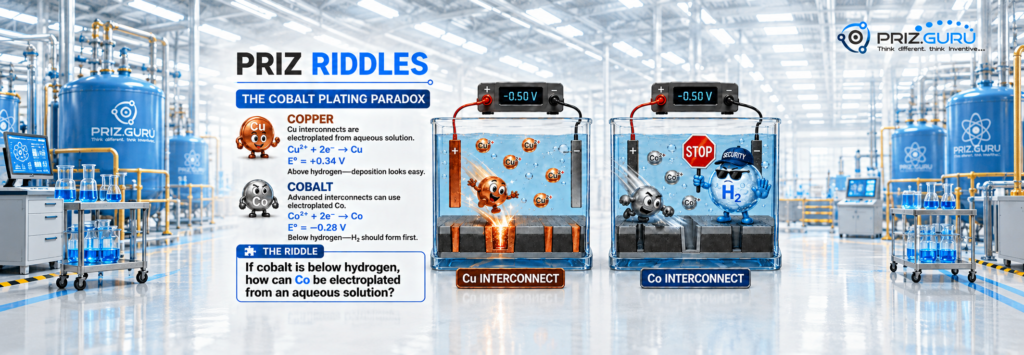
Copper can be electroplated from an aqueous solution. Cobalt is below hydrogen in the electrochemical series, yet cobalt can also be electroplated from water. How is that possible?
The challenge
Cu electroplating vs. Co electroplating
In advanced technologies, cobalt is starting to replace copper in some interconnections, using the same basic technology: electroplating from an aqueous solution.
For copper, everything looks logical:
— above the standard hydrogen potential of 0.00 V. Therefore, can be electrodeposited from an aqueous solution.
But cobalt is different:
— below the hydrogen. Hydrogen should be discharged first, so appears not to be allowed to deposit from an aqueous solution.
But it does. How is this possible?
Your task
How can cobalt be electroplated from an aqueous solution if its potential is below hydrogen?
Before you look
What’s your answer?
Writing down a hypothesis makes the reveal more satisfying—and your reasoning easier to compare.
Your guess stays private. No account required.
I’ll skip the guessAnswer revealed
Hydrogen overvoltage makes it possible!
Thermodynamically, hydrogen should be discharged before cobalt. But hydrogen evolution is a multistep process:
H⁺ discharge → H atoms → H₂ molecules → bubble formation → bubble growth and detachment
These steps require additional energy — the hydrogen overvoltage. It shifts practical hydrogen evolution to a more negative potential, allowing Co²⁺, Ni²⁺ , and similar metal ions to be deposited from aqueous solutions.
Cobalt deposition and hydrogen evolution occur simultaneously. The hydrogen bubbles must leave the cathode quickly: trapped hydrogen can create pores, pits, and defects that destroy the deposited Co layer.
The paradox is solved: thermodynamics predicts the possibility, but kinetics controls the real process!
How did you do?
Your response helps us tune difficulty.