

Two Transistors. One Inverter.
A digital inverter performs the simplest possible logic operation: it changes 1 into 0 and 0 into 1. So why does it need two transistors?
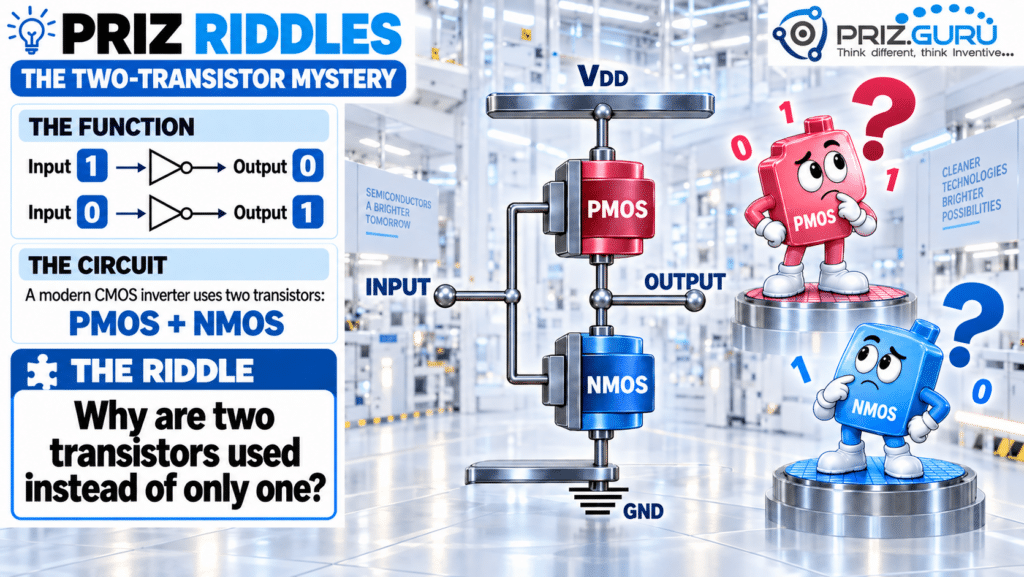
The challenge
Why two transistors are needed for a digital switch
The simplest logic gate
A digital inverter reverses its input signal:
- Input 1 → Output 0
- Input 0 → Output 1
A modern CMOS inverter contains two complementary transistors: one PMOS and one NMOS. Their gates receive the same input, and their drains are connected to the same output.
Your task
Why does a CMOS inverter use two transistors instead of only one?
Do not guess and do not search the internet. It can find information, but it cannot think for you.
Before you look
What’s your answer?
Writing down a hypothesis makes the reveal more satisfying—and your reasoning easier to compare.
Your guess stays private. No account required.
I’ll skip the guessAnswer revealed
Two transistors guarantee a clear answer for both possible inputs.
A single transistor behaves like one controlled switch:
- When it is ON, it connects the output to one voltage.
- When it is OFF, it disconnects the output.
But disconnection does not automatically create the opposite signal. Without another component, the output may be left floating—neither a reliable 0 nor a reliable 1.
A CMOS inverter solves this problem with two complementary transistors:
Input is 0
- PMOS switches ON and connects the output to the positive supply.
- NMOS switches OFF.
- The inverter produces a clear output 1.
Input is 1
- NMOS switches ON and connects the output to ground.
- PMOS switches OFF.
- The inverter produces a clear output 0.
The two transistors work like two doors: one opens the path to 1, while the other opens the path to 0. One door is always closed while the other is open.
Input 0 → definite output 1
Input 1 → definite output 0
This is why the CMOS inverter always gives a clear opposite answer while consuming very little power in a stable state.
Why this works
Thinking principle: If one element cannot provide both required states, add a complementary element that provides the missing state.
How did you do?
Your response helps us tune difficulty.