

The Chip Heat Mystery
A working chip contains billions of transistors and many layers of metal interconnections. When the chip becomes hot, where is the heat actually generated?
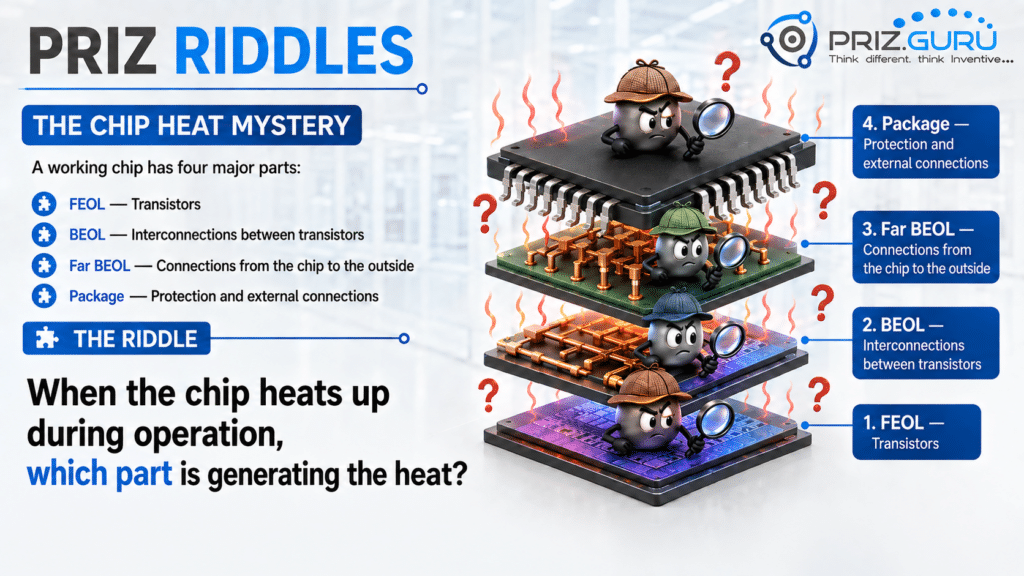
The challenge
Four suspects inside the chip
A simplified chip consists of four main parts:
- FEOL — the transistors that perform the logic operations.
- BEOL — the metal lines and vias connecting the transistors.
- Far BEOL — the upper interconnection layers carrying signals and power toward the chip’s external connections.
- Package — the structure that protects the chip, provides external connections, and helps remove heat.
In earlier technologies, the answer seemed clear-cut: because the transistors were the active devices, the FEOL was regarded as the primary source of heat.
However, modern transistors are now smaller and faster, while their interconnections have grown narrower and more resistive.
Your task
Which part of the chip actually generates the heat?
Do not guess and do not search the internet. It can find information, but it cannot think for you. Think first.
Before you look
What’s your answer?
Writing down a hypothesis makes the reveal more satisfying—and your reasoning easier to compare.
Your guess stays private. No account required.
I’ll skip the guessAnswer revealed
Yesterday FEOL. Today, FEOL and BEOL together!
At older technology nodes, transistors were relatively slow, while the delay of most interconnections was much shorter.
The FEOL transistors were therefore the principal source of chip heating.
Scaling changed the balance.
Transistors became smaller and faster, but BEOL metal lines also became narrower. Their resistance increased, while the capacitance between neighboring lines remained important.
As a result, BEOL () delay approached—and on some signal paths exceeded—the transistor delay.
Every transistor transition must charge and discharge the BEOL capacitance:
At the same time, the resistance of metal lines and vias converts part of this electrical energy into local heat:
Therefore, modern BEOL is no longer only a passive connection system.
It is a major contributor to power consumption, local heating, and—very importantly—chip delay.
Its low-k dielectric also makes heat removal more difficult.
One distinction is essential
If BEOL delay exceeds transistor delay, BEOL becomes the main speed bottleneck—but not necessarily the main heat generator.
Heat distribution also depends on switching activity, capacitance, voltage, frequency, leakage current and how resistance is divided between the transistor drivers and interconnections.
The verdict
🔥 FEOL usually remains the principal source of total chip heat.
🔥 BEOL has become a significant and growing heat source.
⏱️ BEOL can already be the dominant limitation on chip speed.
🌡️ In some interconnect-intensive regions, BEOL heating may locally dominate.
Why this works
As semiconductor technology scales, improving the transistor alone is no longer enough.
Narrower interconnections increase resistance, while interconnect capacitance remains important. Both affect power, local temperature, and signal delay.
That is why reducing interconnection resistance and capacitance has been essential for converting transistor scaling into real chip performance.
Thinking principle: The part of a system that limits its speed is not necessarily the part that generates most of its heat.
How did you do?
Your response helps us tune difficulty.