

The Tantalum Capacitor Paradox
Titanium oxide has a higher dielectric permittivity than tantalum oxide. So why are porous electrolytic capacitors made from tantalum rather than titanium?
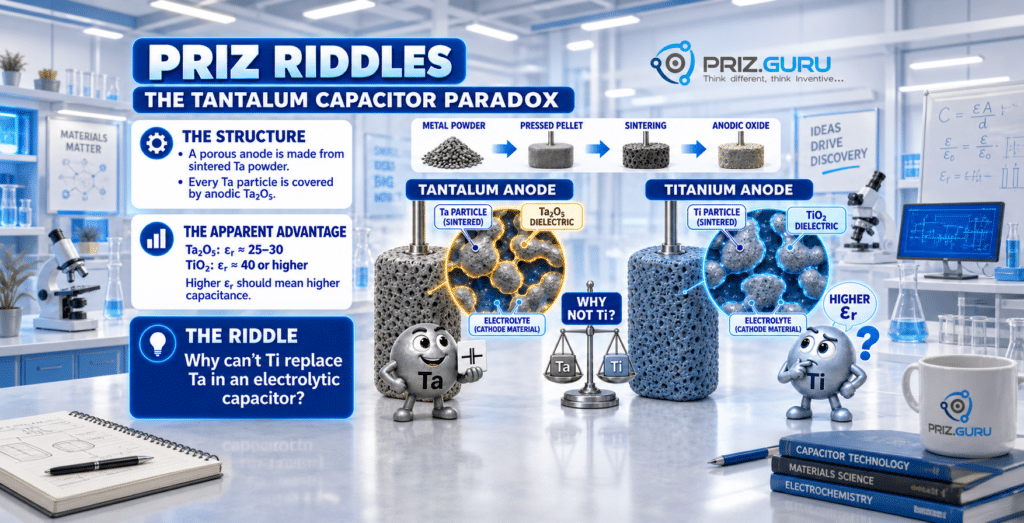
The challenge
A large surface inside a small capacitor
The anode of a tantalum capacitor is produced by pressing and sintering fine Ta powder.
The resulting pellet is highly porous. Although the capacitor is small, the interconnected particles create a very large internal surface area.
During electrochemical oxidation, also called anodic formation, part of the tantalum surface is converted into a thin dielectric film:
Every accessible Ta particle surface becomes coated with amorphous Ta₂O₅.
The capacitance is described approximately by:
where A is the internal surface area, d is the dielectric thickness and εᵣ is the relative dielectric permittivity.
Titanium appears better
has a relative dielectric permittivity of approximately 25–30.
Anodic can have a considerably higher value. A higher dielectric permittivity should provide greater capacitance for the same area and oxide thickness.
Titanium can also be formed into a porous sintered anode and oxidized electrochemically.
Everything appears to favor titanium, but conventional porous titanium electrolytic capacitors are not used as replacements for tantalum capacitors.
Your task
Why can’t Ti replace Ta in an electrolytic capacitor?
Do not guess and do not search the internet. It can find information, but it cannot think for you. Think first.
Before you look
What’s your answer?
Writing down a hypothesis makes the reveal more satisfying—and your reasoning easier to compare.
Your guess stays private. No account required.
I’ll skip the guessAnswer revealed
The key difference is electrical conductivity.
Amorphous is a stable, highly resistive dielectric. It allows electrical polarization but strongly blocks the flow of electrons, so the capacitor can store charge with very low leakage.
Stoichiometric can also behave as a dielectric, but it has a strong tendency to lose oxygen and become nonstoichiometric:
Oxygen loss creates vacancies, converts some into and may produce lower oxides such as . These defects introduce electronic states inside the bandgap through which electrons can move.
The titanium-oxide film therefore becomes partially semiconductive. Across the enormous internal surface of a porous anode, these conductive paths produce unacceptable leakage current and increase the risk of dielectric breakdown.
reliably stores charge. tends to lose oxygen and conduct it away.
Why this works
reliably stores charge. tends to lose oxygen and conduct it away.
Thinking principle: A high dielectric constant is useful only when electrical conductivity remains extremely low.
How did you do?
Your response helps us tune difficulty.