

Water in the Light Path
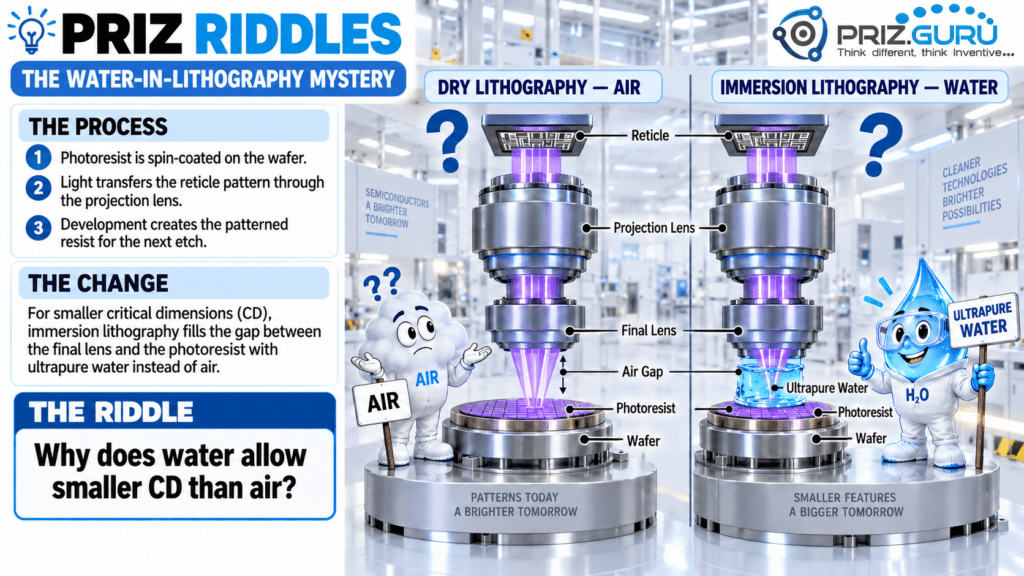
The light source is unchanged. The reticle is unchanged. The projection lens is unchanged. Only air is replaced with water, yet smaller features can be printed.
The challenge
Why switch from air to water
In optical lithography, light transfers a reticle pattern through a projection lens onto photoresist covering the wafer.
In dry lithography, air fills the gap between the final lens and the photoresist. In immersion lithography, this gap is filled with ultrapure water.
The exposure wavelength remains at 193 nm, but the achievable critical dimension decreases.
Your task
Why does water allow lithography to print a smaller CD than air?
Do not guess and do not search the internet. It can find information, but it cannot think for you.
Before you look
What’s your answer?
Writing down a hypothesis makes the reveal more satisfying—and your reasoning easier to compare.
Your guess stays private. No account required.
I’ll skip the guessAnswer revealed
The key is the refractive index
Lithography resolution is described by the Rayleigh equation:
The numerical aperture is:
where:
- - This determines the smallest details that can be reliably printed in manufacturing
- - Represents the process capability
- - is the exposure wavelength in vacuum
- - is the refractive index between the final lens and he photoresist
- - is the maximum angle of light accepted by the optical system
For air:
For ultrapure water at 193 nm:
Replacing air with water increases the numerical aperture. The optical system can therefore capture higher-angle diffraction components carrying information about finer features.
The wavelength inside the medium is also shorter:
The laser still operates at 193 nm in vacuum, but light propagates with a shorter wavelength inside water.
Why this works
Water changes how light travels between the final lens and the photoresist:
Higher refractive index → higher numerical aperture → better resolution → smaller CD.
Thinking principle: Improve the environment, not necessarily the tool.
When a system reaches its apparent limit, examine the medium through which its useful action is delivered. Changing the medium may improve performance without changing the source.
How did you do?
Your response helps us tune difficulty.