Tantalum enables smaller electronics, reliable medical devices, corrosion-resistant equipment, advanced optics, powerful acoustic filters, jet engines, and even longer-lived quantum circuits. Yet instead of developing more applications for this exceptional metal, many industries are investing in ways to eliminate it. Why?
The name tantalum comes from Tantalus, the figure from Greek mythology who could see water and fruit but could never reach them. The name originally referred to the extraordinary resistance of tantalum compounds to chemical attack. Today, the same story has acquired a new meaning: tantalum continues to tantalize engineers with remarkable possibilities, while its price and complicated supply chain keep those possibilities just out of reach.
Tantalum’s central paradox is that its exceptional properties make it valuable, while its cost and complex supply chain drive industries to replace it.
Tantalum is one of the most capable engineering materials available, but the world uses only a few thousand tonnes per year. The market grows slowly, many traditional applications are being miniaturized, and companies frequently invest in replacing tantalum instead of expanding its use.
The problem is not simply that tantalum is rare. The deeper problem is that the industry has accepted an old, complicated, expensive processing system as if it were a law of nature.
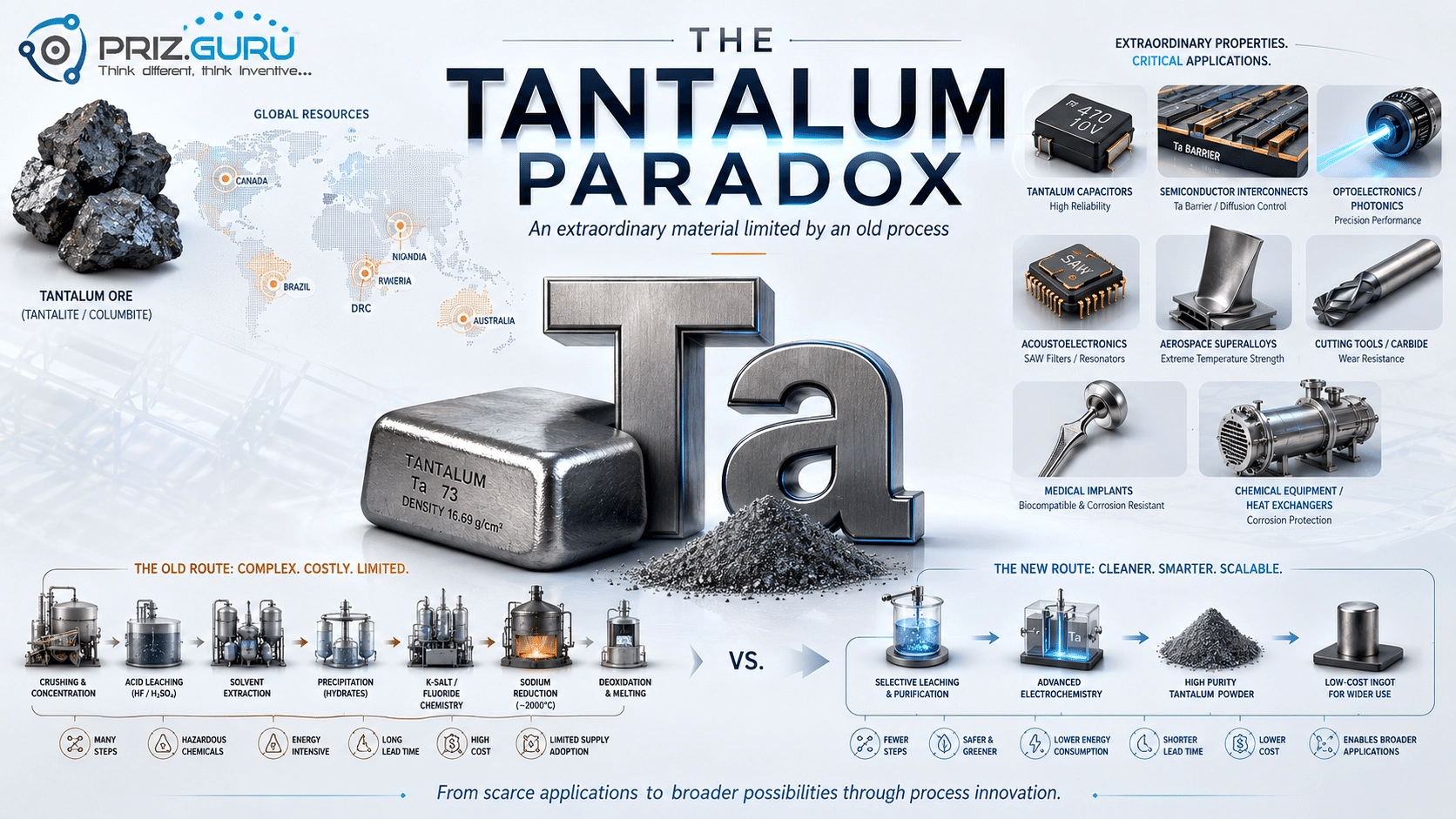
Tantalum is a dense, ductile refractory metal with a melting point of approximately 3,020°C. It is highly resistant to many acids, conducts heat and electricity, forms an extremely stable dielectric oxide, can be manufactured as metal, powder, wire, foil, carbide, oxide, nitride, and numerous chemical compounds, and is highly biocompatible.
These properties create an impressive combination:
These properties suggest the foundation of a major industrial market.
However, the global tantalum industry is extremely small. USGS estimates indicate that world mine production reached approximately 2,500 tonnes of contained tantalum in 2025. The Democratic Republic of the Congo accounted for about 1,300 tonnes, followed by Rwanda, Nigeria, Brazil, China, and Australia.
For comparison, the world produces tens of millions of tonnes of aluminum and copper every year. Tantalum production is not measured in millions of tonnes. It is measured in thousands.
That small scale affects everything: prices, investment, technology development, availability of market information, processing capacity, qualification procedures, and the willingness of customers to design new products around tantalum.
Tantalum is not normally found as a native metal. It occurs in complex minerals, often together with niobium, tin, lithium, and other elements. Important mineral groups include columbite–tantalite, commonly called coltan, and microlite.
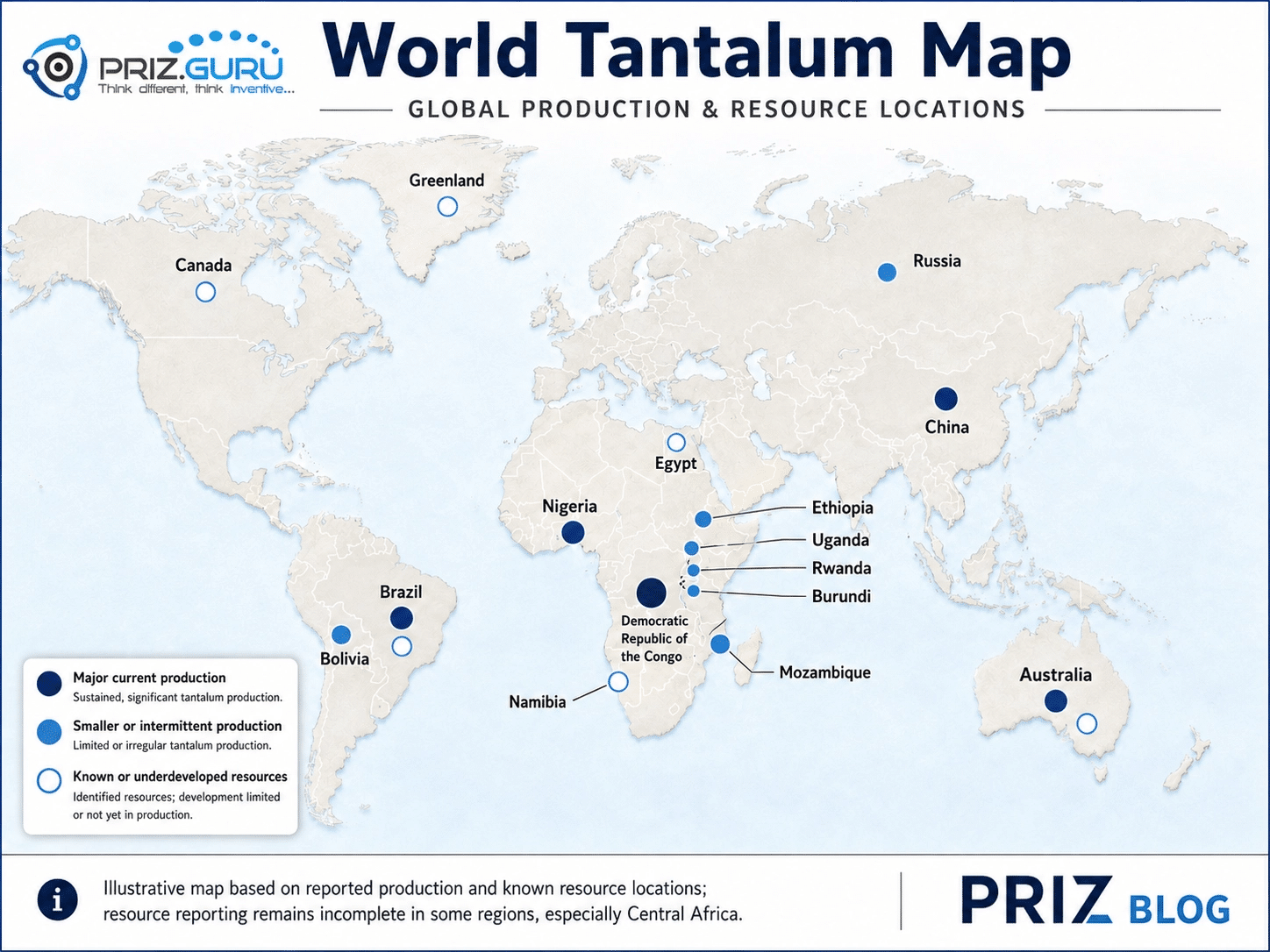
Significant tantalum resources are distributed across Australia, Brazil, Canada, China, the Democratic Republic of the Congo, Nigeria, and Rwanda. Additional occurrences are known in countries including Mozambique, Ethiopia, Uganda, Burundi, Namibia, Greenland, Egypt, Bolivia, Russia, Saudi Arabia, Finland, and the United States. Data for many regions—particularly Central Africa—remain incomplete.
The most important current sources of tantalum production currently include:
Smaller or intermittent quantities have also come from Mozambique, Ethiopia, Uganda, Burundi, Russia, and Bolivia.
A considerable share of African tantalum comes from artisanal and small-scale mining. In contrast, much of the tantalum produced in Australia, Brazil, and Canada is recovered as a co-product or by-product of lithium, tin, or other mining operations. This means that tantalum supply does not always respond directly to tantalum demand. A lithium mine may increase tantalum output even when the tantalum market is weak, while a tantalum-bearing deposit may remain undeveloped when the economics of its primary product are unattractive.
The question “How much tantalum exists on Earth?” does not have one useful numerical answer.
Tantalum’s average abundance in the continental crust has been estimated at approximately 0.7 parts per million, but most of this tantalum is too dispersed to be economically recovered. The quantity physically present in the Earth is therefore very different from the quantity contained in identified deposits, and both are different from economically recoverable reserves.
An older industry assessment identified approximately 260,000 tonnes of tantalum resources, although the underlying information was incomplete and was not consistently prepared according to modern JORC or NI 43-101 reporting standards. Central African resources were also believed to be substantially underreported. Depending on the dataset and definition used, known tantalum resources have been estimated as sufficient for approximately 100 to 350 years of consumption at present rates.
Tantalum is geologically uncommon, but identified resources may support roughly 100–350 years of consumption at current rates.
The more relevant limitations are:
The tantalum problem is not simply a shortage of atoms. It is a shortage of economically accessible, responsibly sourced, efficiently processed tantalum.
Tantalum market statistics must be treated carefully. Mine output, processor shipments, recycled material, tantalum pentoxide content, and finished tantalum products are different measurements. Because contracts are private and the supply chain is opaque, published numbers do not always agree.
Nevertheless, the overall picture is clear: this is a small and historically slow-growing market.
| Year | Mine production, tonnes of Ta | Annual change |
|---|---|---|
| 2016 | 1,684 | — |
| 2017 | 1,906 | +13.2% |
| 2018 | 2,020 | +6.0% |
| 2019 | 1,846 | −8.6% |
| 2020 | 2,102 | +13.9% |
| 2021 | 2,051 | −2.4% |
| 2025 estimate | Approximately 2,500 | — |
The annual values fluctuate, but the longer trend is modest. Industry analysis estimated that primary tantalum supply grew at only about 1.5% annually between 2010 and 2020, remaining within approximately ±10% of two thousand tonnes of tantalum per year. Processor demand actually declined at an estimated compound annual rate of 2.7% during that decade, although the processor demand in 2020 was strongly affected by the aerospace downturn during the pandemic.
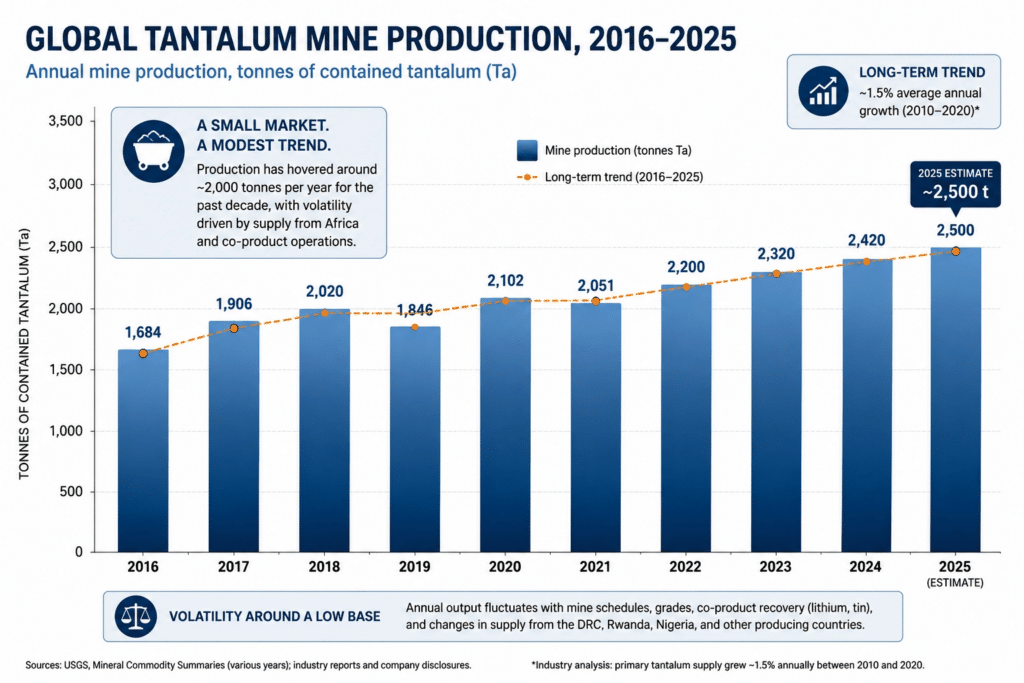
The 2025 production estimate is higher, but this does not necessarily mean that a wave of new applications has appeared. Much of the increase comes from changes in African output and from tantalum recovered alongside expanding lithium and tin operations.
This distinction is central to the paradox: supply can increase without a corresponding revolution in tantalum use.
An industry breakdown for approximately 2019–2020 divided tantalum consumption as follows:
| Application | Approximate share |
|---|---|
| Capacitors | 36% |
| Tantalum chemicals and oxides | 23% |
| Superalloys | 17% |
| Semiconductor sputtering targets | 12% |
| Mill products | 7% |
| Cemented carbides | 5% |
The exact percentages change from year to year, but electronics remain the largest overall consuming sector.
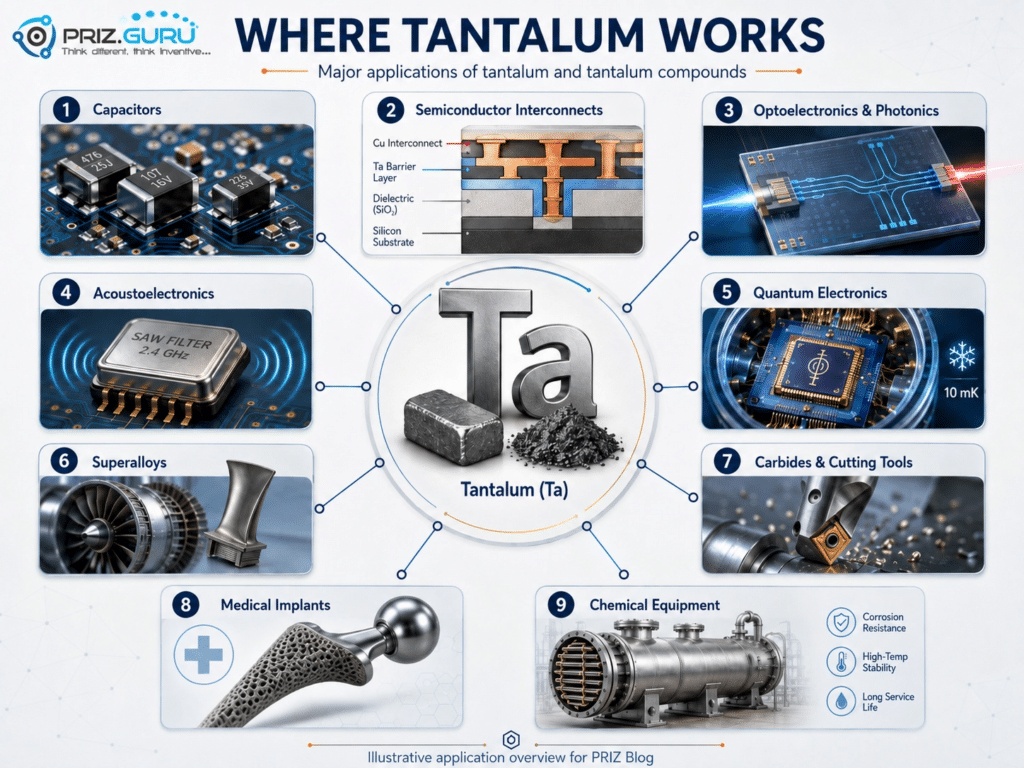
Tantalum powder can be sintered into an extremely porous anode. A very thin tantalum pentoxide layer formed on this surface acts as the dielectric.
The combination of a large internal surface area and a thin, stable dielectric makes it possible to achieve high capacitance in a small component. Tantalum capacitors are therefore attractive where reliability, volumetric efficiency, temperature stability, and long service life are important.
Applications include:
Copper is widely used for electrical interconnections inside semiconductor devices, but copper atoms can diffuse into surrounding dielectric materials and damage device performance.
Thin tantalum and tantalum nitride layers deposited by physical vapor deposition are used as barriers and liners between copper and the dielectric. These layers help prevent copper diffusion and support reliable copper metallization.
Tantalum therefore performs an invisible but essential function inside billions of semiconductor devices.
Tantalum pentoxide is a high-refractive-index optical material. Modern low-loss Ta₂O₅ films are being investigated for integrated optical resonators, nonlinear photonics, frequency-comb generation, supercontinuum generation, and other compact photonic systems.
Tantalum compounds may therefore play a role not only in conventional optical glass but also in future photonic chips.
Lithium tantalate is a piezoelectric crystal widely used in surface acoustic wave devices. These components convert electrical signals into controlled acoustic waves and back again.
Surface acoustic wave filters based on lithium tantalate are especially important in radio-frequency communication systems, including mobile devices and telecommunications infrastructure. Recent research continues to improve lithium-tantalate filters for demanding frequency bands and wider bandwidths.
Tantalum has also attracted interest in superconducting quantum circuits. Researchers have reported exceptionally long coherence and relaxation times after replacing conventional capacitor metals in transmon qubits with tantalum.
The exact behavior depends strongly on tantalum’s surface and oxide chemistry, but the result illustrates an important point: applications for tantalum have by no means been exhausted.
Tantalum is added to nickel-based superalloys used in aircraft engines and industrial gas turbines. It contributes to high-temperature strength, microstructural stability, oxidation resistance, and creep performance.
Some aerospace superalloys contain several percent tantalum, making the use of tantalum in superalloys one of the most important metallurgical applications.
Tantalum carbide is extremely hard and stable at high temperatures. It is used in cemented carbides for cutting tools, wear-resistant parts, and components operating under severe mechanical and thermal conditions.
Tantalum is biocompatible and highly resistant to body fluids. Porous tantalum structures can support bone ingrowth, while tantalum markers, implants, and surgical components benefit from the metal’s stability and radiopacity.
Tantalum is used in vessels, tubes, linings, valves, condensers, and heat exchangers handling aggressive chemicals. Its exceptional resistance to many hot acids can provide long equipment life in environments where stainless steels, nickel alloys, and even some nonmetallic materials may fail.
A technical clarification is important here. Tantalum is sometimes described as the only metal capable of containing molten sodium in nuclear systems. That statement is too strong. Sodium-cooled fast-reactor structures and heat-transfer systems commonly use specially qualified stainless steels and ferritic–martensitic alloys. For example, 316FR stainless steel, modified 9Cr–1Mo steel, and the advanced stainless Alloy 709 are important candidates for sodium-reactor service.
Tantalum remains an exceptional material for severe corrosion conditions, but its strongest established heat-exchanger applications are found primarily in highly corrosive chemical and pharmaceutical processing rather than as the only possible container for liquid sodium.
With so many valuable properties, one could expect companies to be continuously searching for new tantalum applications.
Instead, a large share of research and development is directed toward reducing or eliminating tantalum use.
Multilayer ceramic capacitors, aluminum electrolytic capacitors, conductive-polymer capacitors, and niobium-based technologies can replace tantalum capacitors in certain applications. As MLCC production expanded, many filtering, bypass, and hold-up applications moved from tantalum to ceramic capacitors.
At the same time, tantalum capacitor technology has become more efficient. Manufacturers produce more capacitors while using less tantalum in each device. Miniaturization is technically successful—but it limits growth in tantalum demand.
As copper interconnect dimensions shrink, conventional Ta/TaN barrier layers occupy an increasingly large fraction of the available conductor cross-section. Because tantalum and tantalum nitride are more resistive than copper, the barrier itself begins to limit electrical performance.
Researchers are therefore developing ultrathin barriers, tantalum sulfide layers, ruthenium, molybdenum, cobalt, and even barrierless metallization concepts. The objective is not to increase tantalum use. It is to find a way around it.
This is not because tantalum performs badly.
It is because excellent performance becomes difficult to justify when the material is expensive, processing is complicated, supply is concentrated, and every new use creates qualification and sourcing risks.
The market is sending engineers a clear message:
Tantalum is technically attractive, but economically dangerous. Use as little as possible—or find another material.
That is the tantalum paradox. Industry is not primarily developing applications for tantalum. Industry is developing strategies for avoiding tantalum.
It would be convenient to explain tantalum’s price with one sentence: “Tantalum is rare.”
But tantalum’s rarity alone does not explain its high price.
Known resources are sufficient for many decades, and probably centuries, at present consumption. The annual market is very small, however, and the supply chain is geographically concentrated, difficult to trace, technically demanding, and opaque.
Unlike copper, aluminum, nickel, or gold, tantalum is not traded on a major metals exchange. There is no single official world price. Prices are negotiated privately between buyers and sellers, and long-term contracts are usually confidential. Public historical spot indications for tantalum pentoxide ranged from approximately $165 to $310 per kilogram over the five years covered by a major 2022 market assessment.
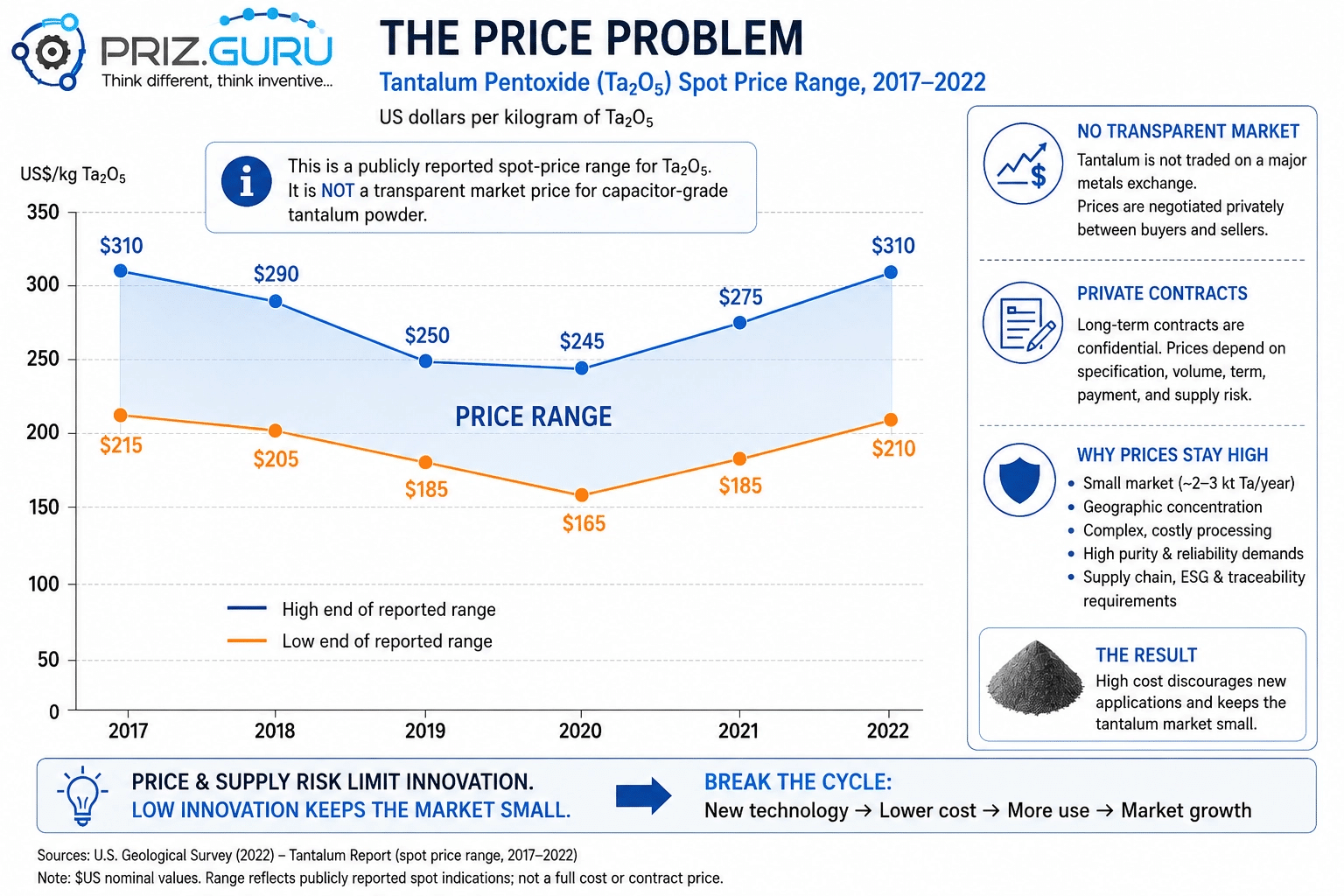
A reliable public year-by-year price chart for high-purity or capacitor-grade tantalum powder is difficult to produce because those products are qualified for specific customers and sold through confidential contracts.
This absence of transparency is itself part of the problem. Customers perceive price and supply risk, while potential technology developers cannot easily calculate the return on investment from a radically improved process.
However, the price is not determined by geology and market opacity alone.
It is also built into the processing route.
The conventional tantalum process begins with a difficult raw material. Tantalum and niobium have very similar chemical properties and normally occur together. Separating them while meeting semiconductor, capacitor, optical, or aerospace purity requirements is not simple.
A widely used conventional route may include:
HF–H₂SO₄ digestion, solvent extraction, oxide precipitation, and sodium reduction of K₂TaF₇ are established process steps — they are established industrial and research routes.
The problem is the logic of the entire system.
The first operations introduce fluorine-containing chemistry and complex liquid streams. The extraction process introduces organic phases and multiple contacts. Precipitation introduces additional reagents and washing requirements. Calcination can change agglomeration and surface properties. K₂TaF₇ is sensitive to preparation and storage conditions and may contain or form tantalum oxyfluoride phases.
Oxyfluorotantalates such as K₃TaOF₆, K₂TaOF₅, and K₂Ta₂O₃F₆—often associated with Marignac-type chemistry—can influence the morphology and properties of powder produced during sodium reduction.
The sodium-reduction process then creates tantalum powder together with large quantities of potassium fluoride and sodium fluoride salts. The powder must be washed and purified. Oxygen introduced or retained during precursor production, reduction, washing, and thermal processing may later require a separate deoxidation treatment, often involving magnesium, followed by another acid washing, drying, and thermal-treatment cycle.
The industry solves the problem by adding another operation.
Then it solves the new problem by adding another operation.
Each corrective step requires:
The final tantalum product may be excellent. The engineering skill required to achieve that quality is considerable.
But one uncomfortable question remains:
Why are we celebrating our ability to remove contaminants that our own process helped introduce?
The industry has become highly skilled at correcting the defects created by its established flowsheet.
That is not the same as eliminating their root causes.
It is tempting to claim that refiners and tantalum producers prefer high prices and therefore avoid technological change.
The reality is more complicated.
A very small market discourages large capital investments. Customers demand extremely high purity and consistency. New processes can require years of testing and qualification. Producers may fear that a radical flowsheet change will create quality risks, while customers may be unwilling to qualify material made by an unfamiliar route.
Many tantalum operations are also linked to lithium or tin economics rather than to tantalum demand itself. Furthermore, confidential contracts and uncertain raw-material supply make it difficult to justify major technology programs.
Therefore, the problem should not be described simply as bad intentions.
This creates a systemic contradiction in the tantalum market:
Every participant behaves rationally within the existing system, yet the system produces an irrational result.
The objective should not be to make each conventional operation slightly more efficient.
The objective should be to reconsider why each operation exists.
A functional analysis of the conventional tantalum process would reveal both useful and harmful functions.
Once these functions are visible, a different set of questions becomes possible.
Alternative approaches are already being investigated, including alkaline decomposition, pressure leaching, fluoride-reduced separation systems, ion exchange, selective crystallization, magnesium reduction of tantalum oxide, molten-salt electrochemistry, and new recycling routes. Not every alternative is ready for industrial adoption, but their existence proves that the current process is not the only imaginable process.
The challenge is to stop treating individual symptoms and start redesigning the system.
Tantalum manufacturing scrap is valuable and is commonly recycled because it is relatively pure, concentrated, and easy to collect.
Recovering tantalum from finished consumer products is much more difficult. The amount of tantalum in each telephone, computer, or electronic device is small. Components must be identified, dismantled, concentrated, and processed, often at a cost greater than the recovered material’s value.
As a result, most recycled tantalum comes from manufacturing scrap, superalloy scrap, and intermediate process materials rather than from end-of-life consumer electronics. Secondary material accounted for approximately 21% of processor raw-material supply in 2020.
Future tantalum innovation must therefore include both sides of the life cycle:
Imagine that an advanced process dramatically reduces:
The price of tantalum products falls.
Supply becomes more predictable.
Customers become less afraid to design tantalum into new systems.
Then engineers can stop asking:
“How can we replace tantalum?”
Engineers can begin asking:
“What new function can only tantalum or a tantalum compound perform?”
That question could open new directions in:
The greatest tantalum opportunity may not be a new mine.
It may be a new process.
Tantalum is an extraordinary element trapped inside an ordinary industrial logic.
The industry has learned to accept expensive digestion, multiple liquid–liquid extraction stages, repeated precipitation and washing, difficult fluoride chemistry, sodium reduction, deoxidation, and additional thermal treatment.
These operations can produce excellent material, but at a cost that discourages the creation of new markets.
As a result, the world uses tantalum only where its performance is already difficult to replace. Everywhere else, engineers are encouraged to reduce it, miniaturize it, or remove it.
I believe this can change.
One day, innovative engineers, scientists, and managers will take the entire tantalum process into their hands—not merely one reactor, one extraction stage, or one furnace – and ask what every operation contributes, what problem it creates, and whether it should exist at all.
They will develop a modern, intelligent, high-technology process that prevents contamination instead of correcting it, reduces the number of operations instead of adding more, and produces tantalum at a dramatically lower cost.
When that happens, tantalum will no longer be a metal that tantalizes us with possibilities we cannot afford.
Tantalum will become a platform for applications we have not yet imagined.
The tantalum paradox will end when the industry stops treating high cost as an unavoidable property of the element, and starts treating the process itself as the problem.