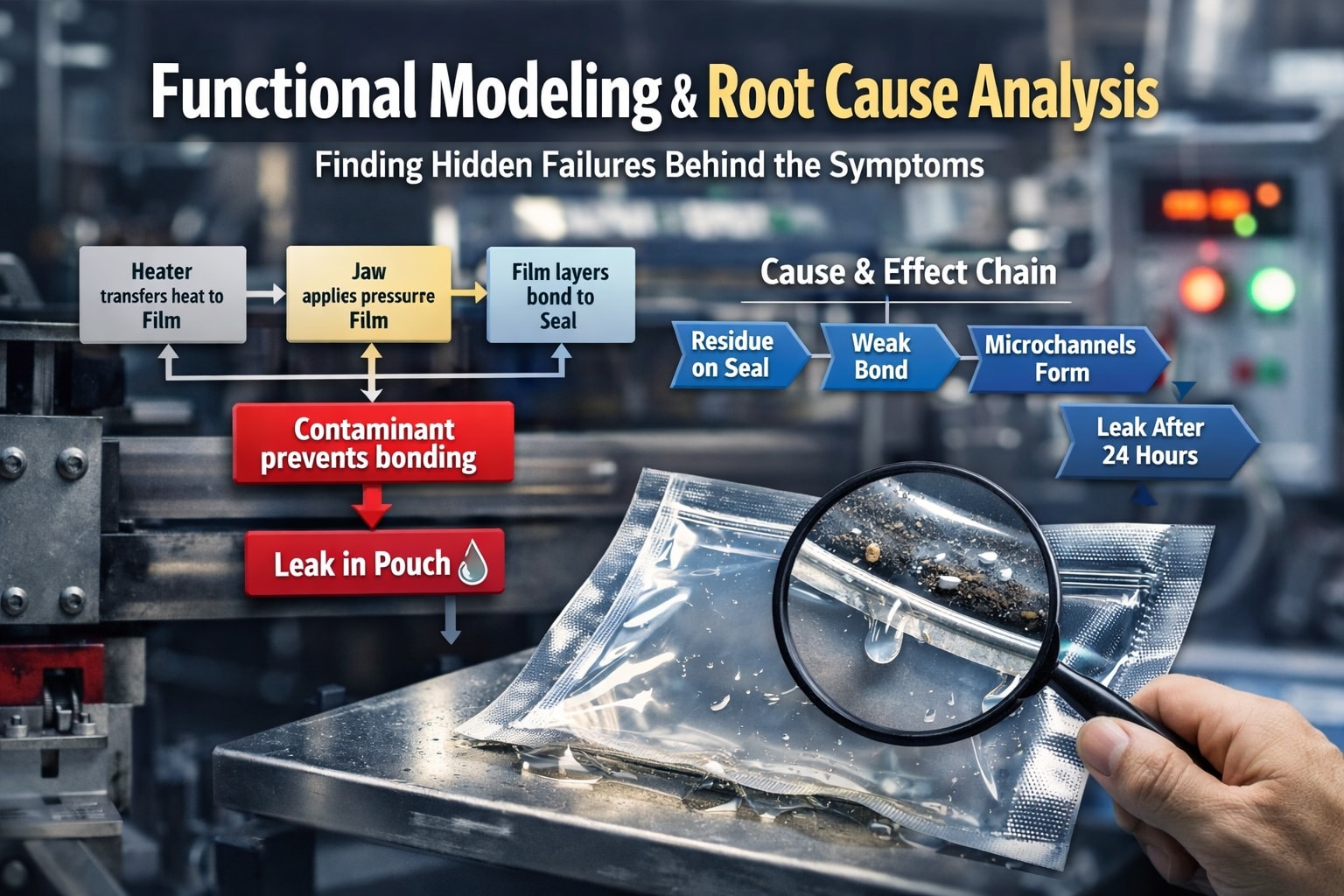
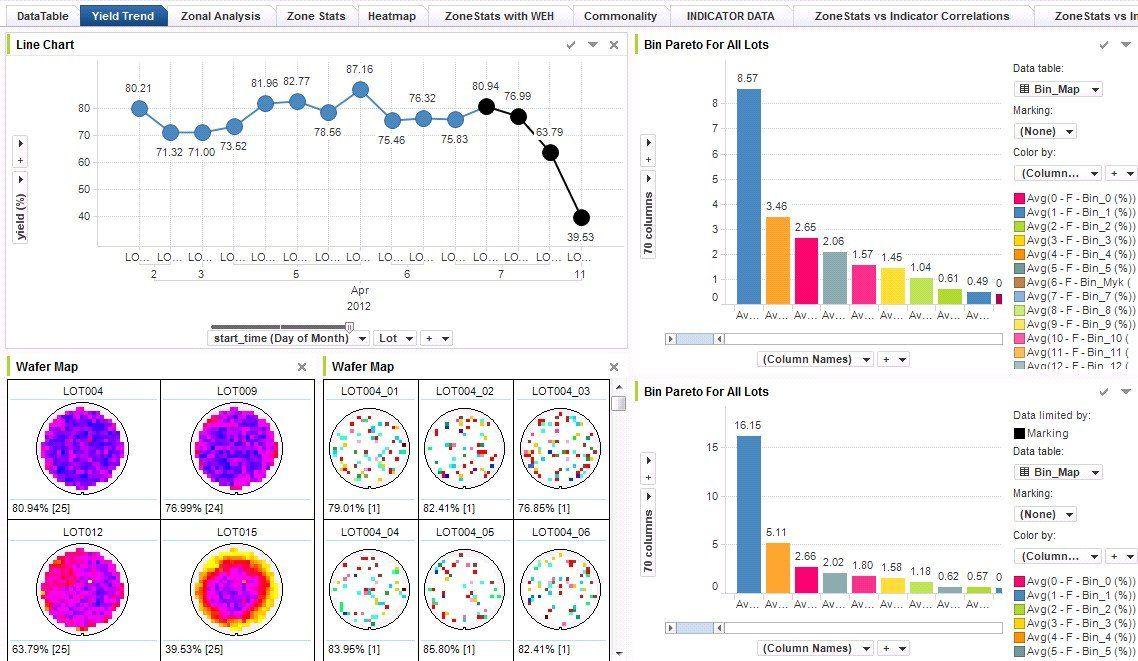
An engineer spends the afternoon working through an unusual yield excursion with an AI assistant. The conversation begins with a familiar suspicion about one process tool. Then a comparison changes the direction of the investigation: the earliest sign of drift appears upstream of that tool. The assistant helps identify which lot histories would test the new explanation.

It is a useful afternoon. The engineer has found a better question to investigate. Then another meeting starts, the chat moves down the history, and nobody else knows that the question exists.
The discovery has not necessarily been deleted. It has simply failed to become part of the organization’s work.
One hidden cost of AI at work is losing valuable reasoning inside individual conversations. A useful hypothesis, a missing comparison, or an early warning can remain invisible to the team even when the chat is saved. The value is preserved only when someone captures the relevant evidence and uncertainty, gives the discovery an owner, and brings it into a workflow where it can be reviewed and acted upon.
In the previous article on AI’s attention bottleneck, I argued that generating another explanation has become easy, while deciding which explanation deserves engineering effort remains difficult. There is another complication. Even when the engineer makes that decision, the result can stay trapped in the conversation where it emerged.
Consider a hypothetical semiconductor investigation. A yield engineer asks an AI assistant to help examine a recurring edge-related defect pattern. The initial suspicion is a particular process chamber. As the discussion progresses, the engineer notices that a similar pattern appeared on a lot that never visited the suspected chamber. The model proposes checking the timing of a preceding process step against the first affected lots.
That suggestion is not a root cause. The underlying data has not established a causal mechanism, and the AI has not verified anything. But the investigation has advanced. The engineer now knows which comparison could challenge the leading assumption before the team spends days working from it.
The important outcome may fit in two sentences. Getting to those two sentences took 40 minutes of context, discarded possibilities, and corrections. If they remain buried in the transcript, colleagues will need to reconstruct the reasoning before they can use it.
Most AI tools allow conversations to be saved or revisited. That benefits the person who conducted them, but it does not inherently make the output usable for an engineering team.
A transcript is organized around the sequence of prompts and responses. Engineering work needs a different structure. Someone reviewing a possible excursion wants to know what was observed, what was inferred, what has already been checked, and what evidence would change the current interpretation. They should not have to read an entire conversation to determine whether a claim is well supported.

Context also has a half-life. After a shift change, the original engineer possibly remembers why a hypothesis sounded convincing, but a colleague reading the same dialogue will most likely miss the qualification buried 20 messages earlier. A manager may see a polished summary while remaining unaware that the supporting comparison has not been performed.
This creates a subtle failure mode: a good conversation produces a weak handoff. The engineer has learned something, yet the team’s shared understanding has barely changed.
This matters because AI-generated reasoning needs scrutiny. The US National Institute of Standards and Technology identifies confabulation—confidently presented but false or inconsistent content—as a risk of generative AI, particularly in consequential settings.[1] Preserving a suggestion without preserving its uncertainty can make an attractive idea look like a verified finding.
Of course, the most obvious loss is time. When the same issue returns, another engineer will repeat the initial investigation because the earlier reasoning is difficult to find or cannot be evaluated without its author, and often the author is not very helpful. The team pays again to rediscover the question it had already reached.
The greater cost arises when the missed question might have redirected the work. In a fab, an incompletely understood excursion can trigger containment and an urgent investigation. If an engineer has already found a comparison capable of eliminating a popular explanation, that insight is valuable before the team commits scarce equipment or analytical capacity. Hidden in a personal chat, it has no dependable route into that decision.
The problem grows with adoption. Picture a manufacturing organization where hundreds of people use AI as a nornal course of work. Some conversations are routine and should remain routine. Others contain a useful challenge to an assumption, an emerging technical signal, or a practical idea for improving a process. Managers cannot, and should not, read everyone’s transcripts to discover the difference.

This is why counting AI conversations is the wrong metrics tell an organization how much knowledge it has gained. The critical question is whether valuable conclusions and open questions reach the people who can test them or decide what happens next.
Not every plausible AI suggestion deserves a formal record, much less a project. If organizations capture everything, they reproduce the same overload inside another system.
The key question is whether the conversation has produced anything that could change an engineering decision. Perhaps someone noticed something that challenges the current explanation, or suggested a comparison that could resolve a lingering uncertainty. Even a seemingly minor recurring signal might deserve closer attention if it points to a problem with broader implications.
A useful handoff preserves three things:
These are more important than the length or elegance of the original AI conversation. A short, candid account that points to the next discriminating check is often more valuable than a comprehensive summary that makes every possibility sound equally credible.
A discovery begins to acquire organizational value when it can survive a handoff. That does not mean immediately launching root cause analysis or starting a major project. The first task is to shape the finding into something another person can understand and evaluate.
For our yield engineer, this could begin with documenting the recurring defect signature alongside the lot comparison that weakened the chamber hypothesis. Together, these observations raise a question about the upstream process that deserves further investigation. The engineer would capture the reasoning behind that question and the evidence still needed to answer it, while also considering the potential production impact and urgency if additional lots are likely to be affected.
This is a different kind of output from a chat transcript. It is a reviewable Engineering Opportunity: a technical condition framed around what is known, what remains uncertain, and the value that might be recovered or protected by pursuing it.
There is an important boundary here. Capturing an opportunity does not verify its cause or guarantee that the work should proceed. Formal problem-solving guidance from the American Society for Quality begins with defining the problem and collecting supporting facts before root-cause diagnosis and solution work.[2] The same discipline should apply when the initial thinking happened with AI.
Managers can then make a decision proportional to the evidence. They may ask for the missing comparison, combine the opportunity with an existing investigation, or approve further work. The value of the handoff is that those choices become possible without asking everyone to begin the reasoning again.
PRIZ is designed to support structured engineering thinking and the work that follows a technical signal. Its Shape Investigation and Problem Candidate workflow provides a practical example of the handoff described here.
A task-force leader can bring selected notes and investigation context into PRIZ, where AI helps organize an editable draft. The engineer reviews and corrects the technical framing, keeping the evidence separate from the proposed explanations. The resulting Problem Candidate represents an Engineering Opportunity for management review. A manager can request clarification, approve, merge, reject, or archive it before any approved candidate is converted into a project.
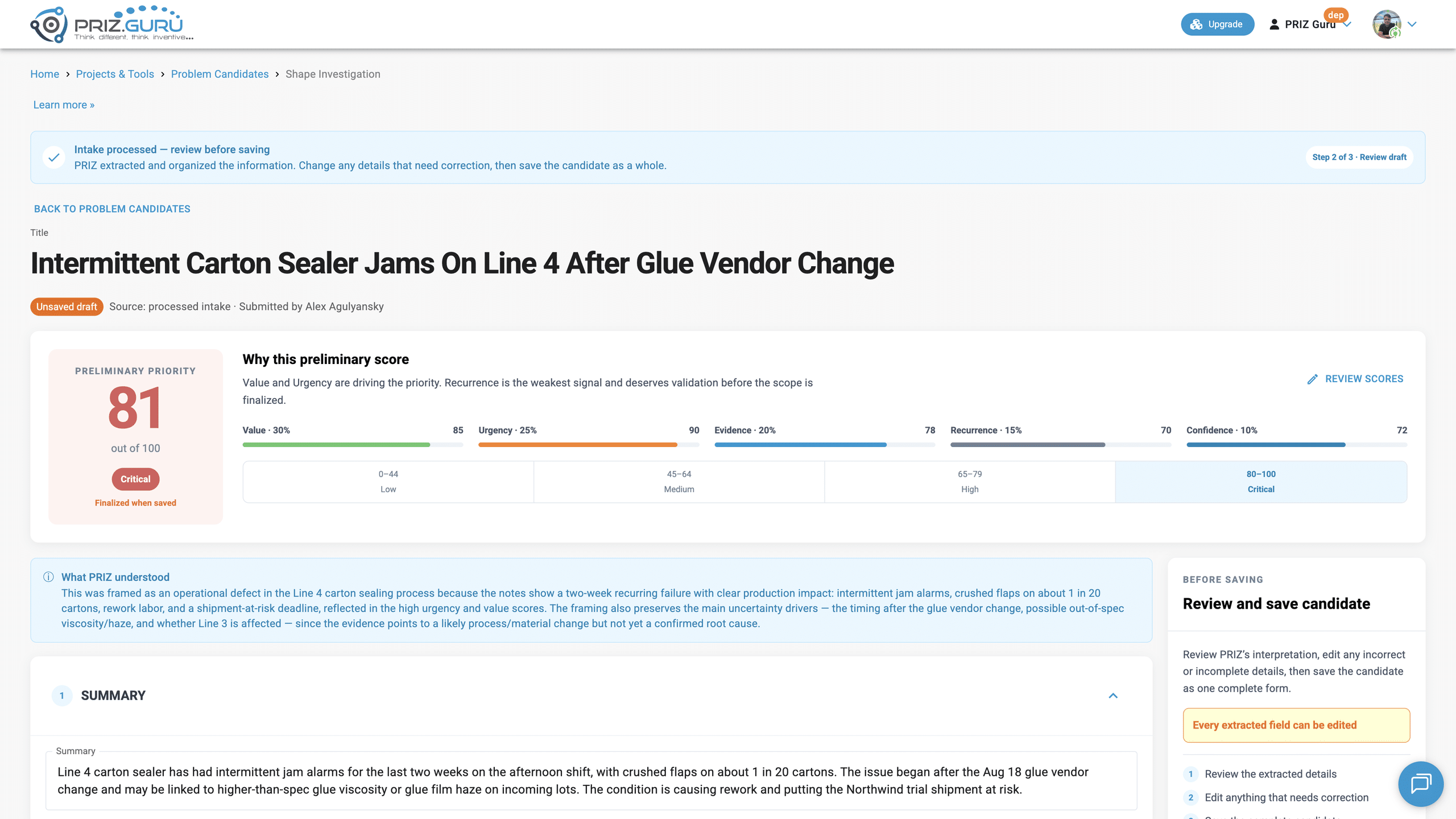
Technical judgment remains with the engineer, while management decides where to commit resources. PRIZ connects individual discoveries to the broader engineering workflow, preserving continuity while complementing the systems that manage the underlying manufacturing data.
Importantly, this does not require every AI conversation to enter PRIZ. The meaningful moment is when someone recognizes a signal or insight that deserves to survive the conversation. Today, that means selecting and submitting the relevant material; the principle applies regardless of which general-purpose AI was used during exploration.
At the end of a substantive AI investigation, pause long enough to ask a simple question: Did we discover something that someone else should be able to use?
If the answer is yes, record the observation and the reasoning that made it significant. Preserve the unanswered question and point to the original evidence. Share only material that is authorized for the destination system, especially when manufacturing data or customer information is involved.
Then make the handoff explicit. The next action might be another data check rather than a new project. That is still progress. The organization has gained a question it can test, instead of another transcript it is unlikely to read.
AI is becoming a natural place to explore difficult problems. As that happens, we need to be more deliberate about what leaves the conversation and enters the organization. The greatest loss may be the valuable idea that was discovered, understood for a moment, and never given a chance to matter.
[1] National Institute of Standards and Technology (NIST). Artificial Intelligence Risk Management Framework: Generative Artificial Intelligence Profile, NIST AI 600-1 (2024). See the discussion of confabulation.
[2] American Society for Quality (ASQ). What Is Problem Solving? Steps for defining a problem, diagnosing root cause, implementing a solution, and sustaining results.