How “what the system does” exposes root causes that symptoms hide.
Most teams don’t solve problems. They negotiate with symptoms.
A leak shows up, so we crank up the pressure. A yield dip hits, so we tighten inspection. A motor overheats, so we bolt on “just one more” fan. It feels productive. It even works sometimes. Until the same failure returns, wearing a slightly different hat.
Functional Modeling is how you stop playing whack-a-mole. Instead of staring at the symptom and guessing which part is guilty, you map what the system does: who acts on whom, and how. That sounds simple (and it is), but it forces a brutally useful question: which function became insufficient (or harmful), and what enabled that change?
In this article, we’ll show how functional modeling (and functional cause analysis) turns RCA from “strong opinions + weak evidence” into a mechanism-based investigation. You’ll see a concrete example of breaking a sealing system into functions, pinpointing the failing function, and tracing it to a root cause that symptoms don’t naturally reveal.
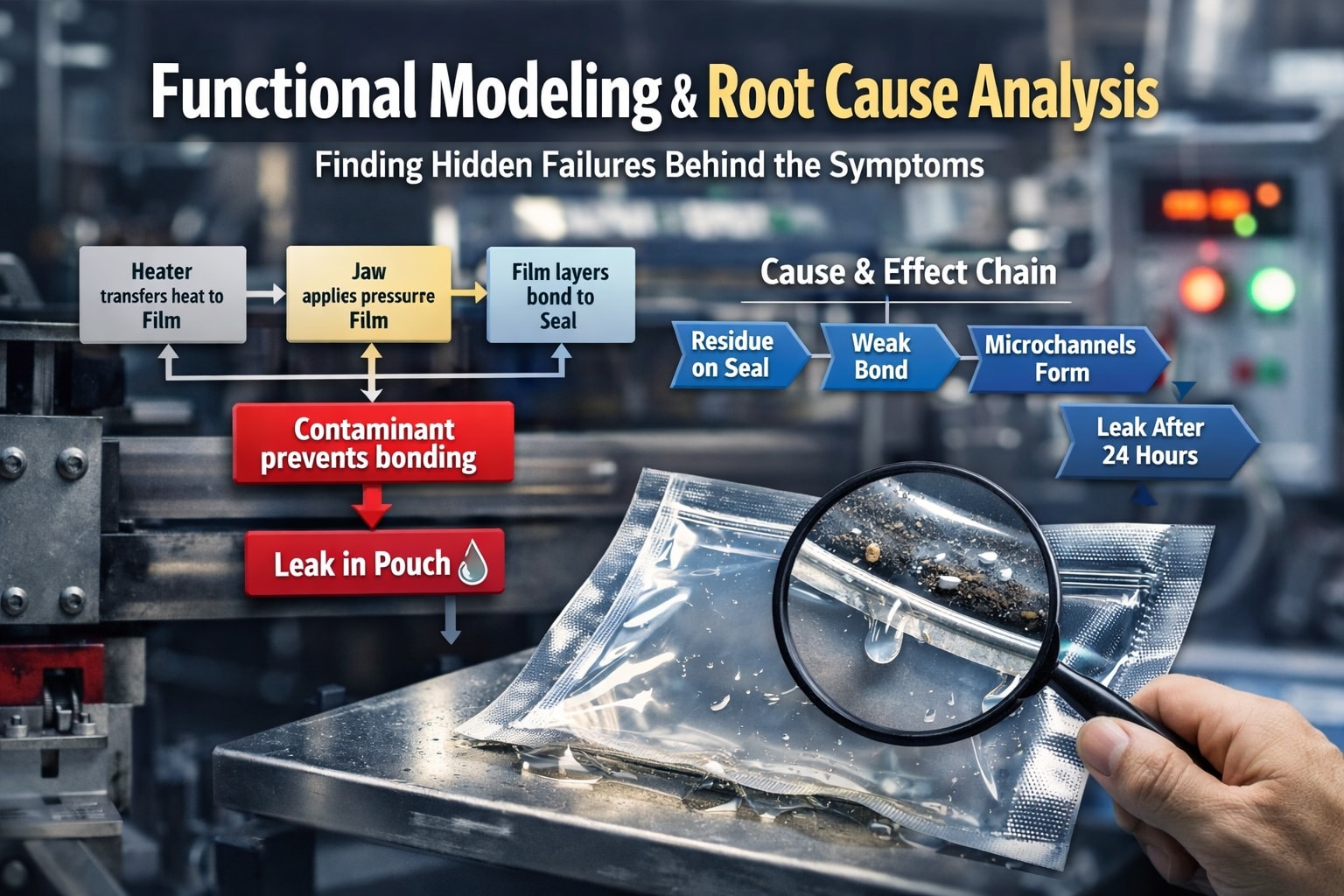
Functional Modeling describes a system in terms of actions between elements: a doer, an action, and a receiver.
Not what the system is, but what it does.
A heater transfers heat to. A jaw applies pressure. A controller regulates the temperature of the heater. A seal stops the contents from leaking. When you lay these interactions out, you get a map of the system’s cause-and-effect “physics”, even when the physics are chemical, electrical, or informational.
This is also why Functional Modeling is so powerful for RCA: it forces you to model the interactions that must succeed for the system to work, and the interactions that can fail in non-obvious ways.
Symptoms tend to point to the last observable event in a chain. Functions point to the interaction that actually created the failure.
Take an example of a “leak”. Teams often treat it like a single problem. But a leak is typically the final result of a barrier function failing. The barrier might not have formed, might have formed weakly, might have degraded over time, or might be intact while a different interaction created a new path. If you don’t explicitly model the barrier function and its dependencies, it’s easy to “fix” the leak by brute force (more temperature, more pressure) and accidentally create other defects (wrinkles, burn-through, reduced throughput).
Functional Modeling doesn’t guarantee the right answer, but it dramatically improves the quality of hypotheses. It gives you a structured way to ask: Which interaction failed? How could it fail? What upstream interactions could have caused that failure?
Imagine a packaging line where pouches pass visual inspection but increasingly fail leak testing a day later. Many teams immediately reach for parameter changes: seal temperature, dwell time, pressure, and line speed. Sometimes that helps briefly. Often it doesn’t, because the symptom is late and the cause is earlier.
Functional Modeling starts by defining a sensible boundary: the heat-seal station, the pouch film, and the nearby upstream/downstream interactions that can influence sealing. Then you express the system as functions:
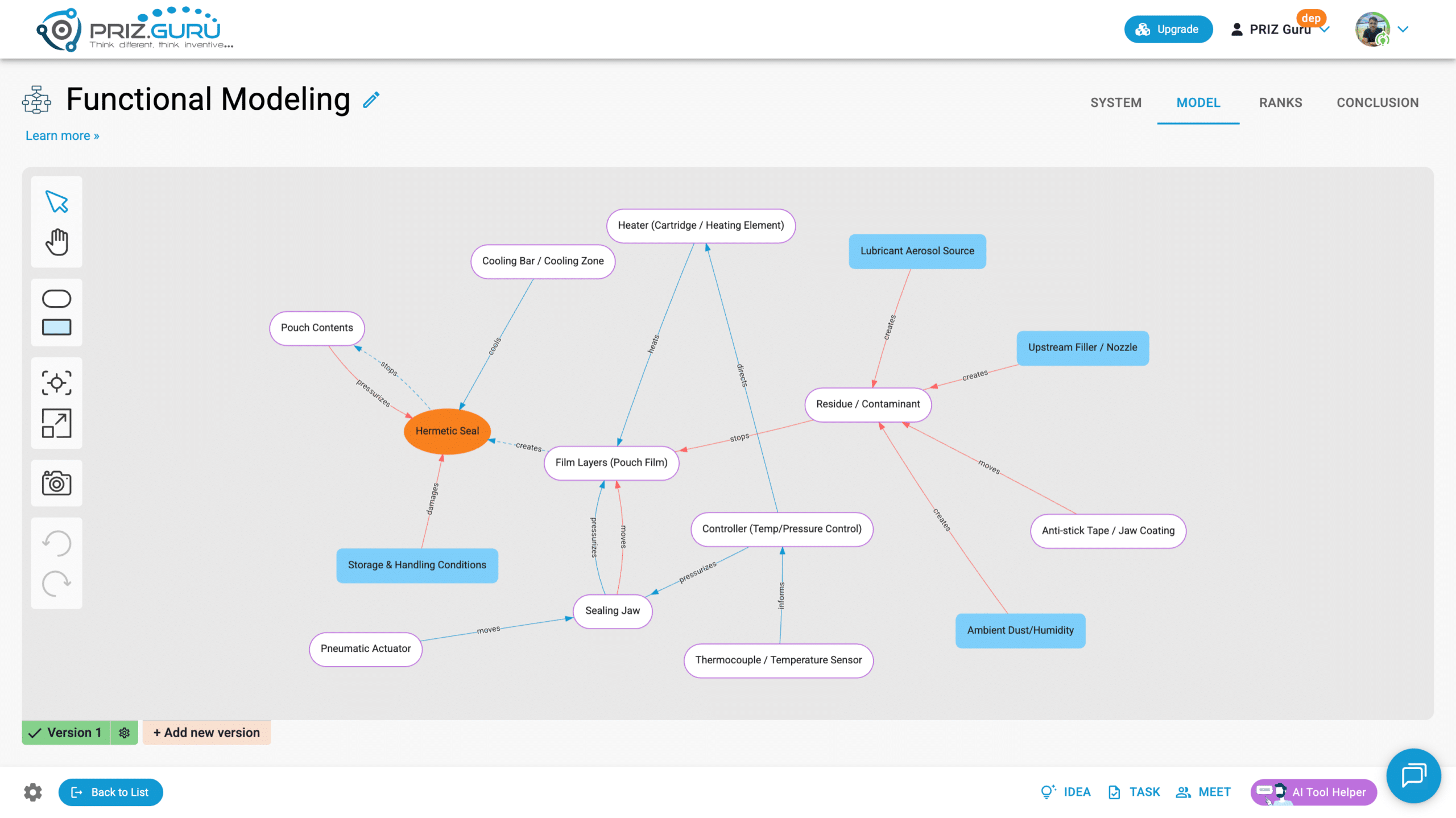
The heater transfers heat to the film. The jaw applies pressure to the film. The film layers bond to each other to create a seal. Cooling removes heat to stabilize the bond. The controller regulates temperature. Pneumatics move the jaw.
Now, the symptom, “leak after 24 hours”, gets translated into a functional failure: the sealing function produced a bond with insufficient margin.
That single translation changes the investigation. “Leak” is vague. “Bonding became insufficient” is specific enough to branch intelligently.
At this point, you’re doing functional cause analysis: you’re not asking “why leak”, you’re asking “why did the bonding function become insufficient?”
In practice, that question usually points you toward a few mechanism-level branches. Either the energy delivery was insufficient somewhere (heat transfer non-uniform), the force delivery was insufficient or uneven (pressure distribution), the surfaces weren’t bondable (contamination, film surface condition), or the bond formed but later degraded (stress, chemical attack, cooling instability).
Notice what you didn’t do: you didn’t immediately blame the sealing jaw, the operator, or the film supplier. You created a small set of mechanism candidates that can be tested.
Let’s say the logs show temperature and pressure “in spec”, jaw calibration checks out, but failures are worse on one edge and spike after changeovers. Microscopy reveals tiny unbonded islands near that edge. This pattern often fits contamination or surface condition issues more than raw heat/pressure settings.
Functional Modeling naturally asks the next question: What interaction could prevent bonding at the interface?
That points to another function: a contaminant prevents bonding of film layers.
Then you chase the source using the same interaction logic. Which nearby elements could deposit residue on the seal interface? Anti-stick tape degradation, adhesive mist, product splash, airborne lubricant, fibers from cleaning cloths, or worn jaw coatings. Any of these can create a microscopic barrier that doesn’t look dramatic on day one but becomes a leak path over time and stress.
A plausible cause chain becomes straightforward to articulate and validate:
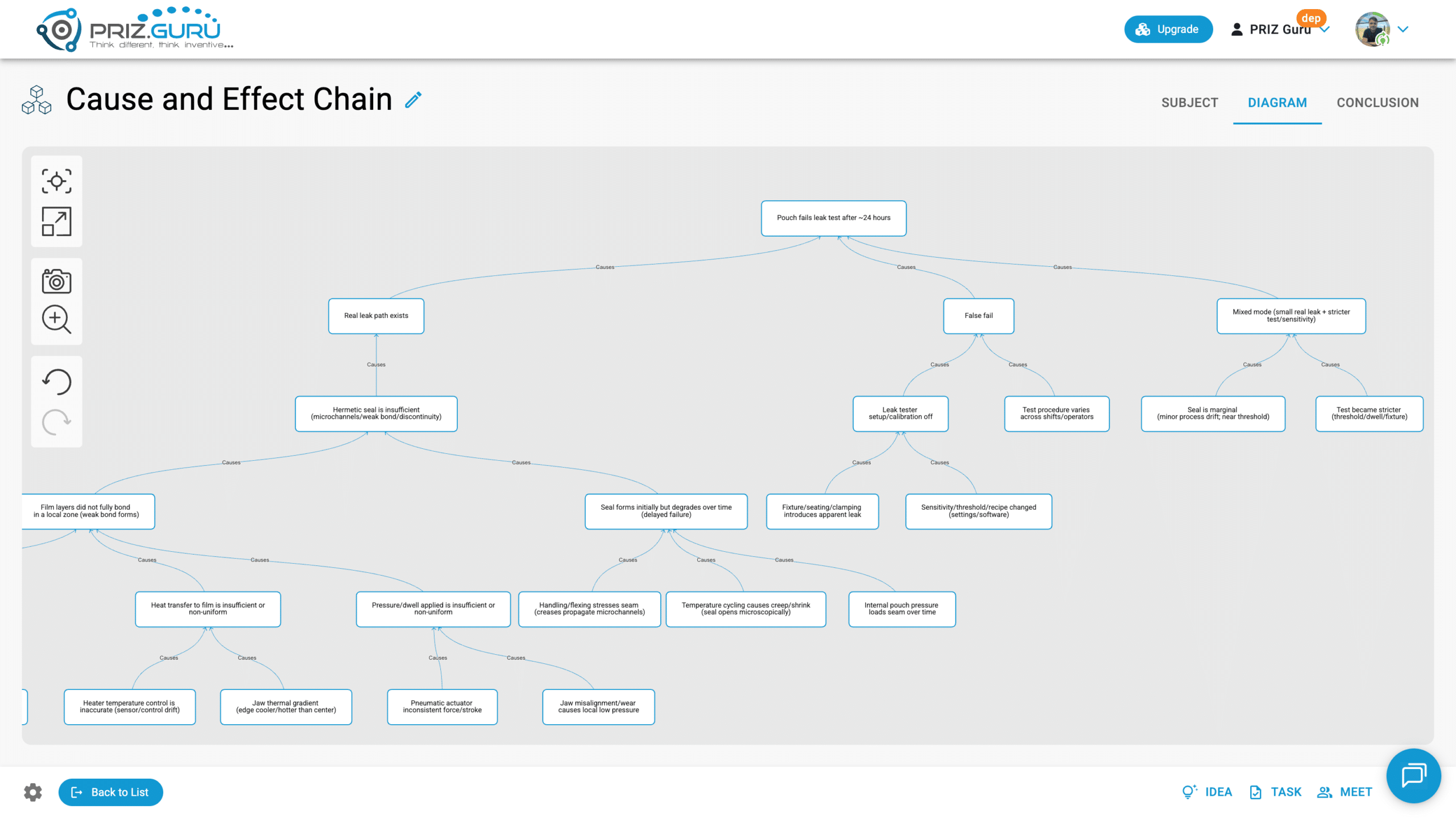
Jaw edge surface degrades → residue transfers to film → bonding becomes insufficient locally → microchannels form → leak appears after 24 hours.
Now, corrective actions stop being blunt force. Instead of “increase temperature,” you target the mechanism: improve jaw surface stability, control residue transfer, modify changeover cleaning standards to focus on the critical interface, and add a fast verification step that detects contamination before it becomes leakage.
That’s the real value: Functional Modeling turns an argument about settings into a testable mechanism story.
Functional Modeling doesn’t replace RCA tools like Cause & Effect Chains, 5 Whys, or fault trees. It makes them better.
Without a functional view, 5 Whys often collapses into shallow narratives (“operator error”, “lack of training”, “didn’t follow SOP”). Cause & Effect Chains can become symptom chains rather than mechanism chains. Fault trees can become component lists.
With a functional model, RCA becomes anchored to something concrete: the failed interaction. You’re not just asking “why did this happen”; you’re asking “why did this function become insufficient or harmful, and what changed in the system to make that possible?”
That framing improves completeness, reduces premature conclusions, and makes it harder to declare victory with a patch.
Start with the outcome you want and the harm you observe. Define a boundary that includes the elements that can realistically influence the outcome. Then describe the core interactions as verb-object statements: what acts on what, and how.
Once you have the main interactions, look for functions that could plausibly be insufficient, excessive, or harmful. Pick the function that best matches the failure pattern (timing, location, conditions, recurrence), and only then dive deeper with cause analysis.
Finally, validate aggressively. Functional Modeling creates hypotheses efficiently; evidence selects the right one.
The biggest mistake is treating Functional Modeling as a diagramming exercise instead of an investigation tool.
If the model doesn’t help you generate better mechanism hypotheses, it’s too abstract. Use crisp verbs. Prefer interactions you can measure or test. Include environmental influences when they can realistically affect the function. And don’t stop at “component failed”, translate it into the function that the component was supposed to deliver, because functions explain why the component matters.
When teams only chase symptoms, they spend time and money on actions that look busy but don’t reduce recurrence. When teams chase failed functions, they build fixes that actually change the system behavior.
Functional Modeling is one of the fastest ways to move an RCA from “we think it’s this” to “this mechanism explains the pattern, and this change removes it”.
And that’s the point of problem solving: not activity, but elimination of recurrence.