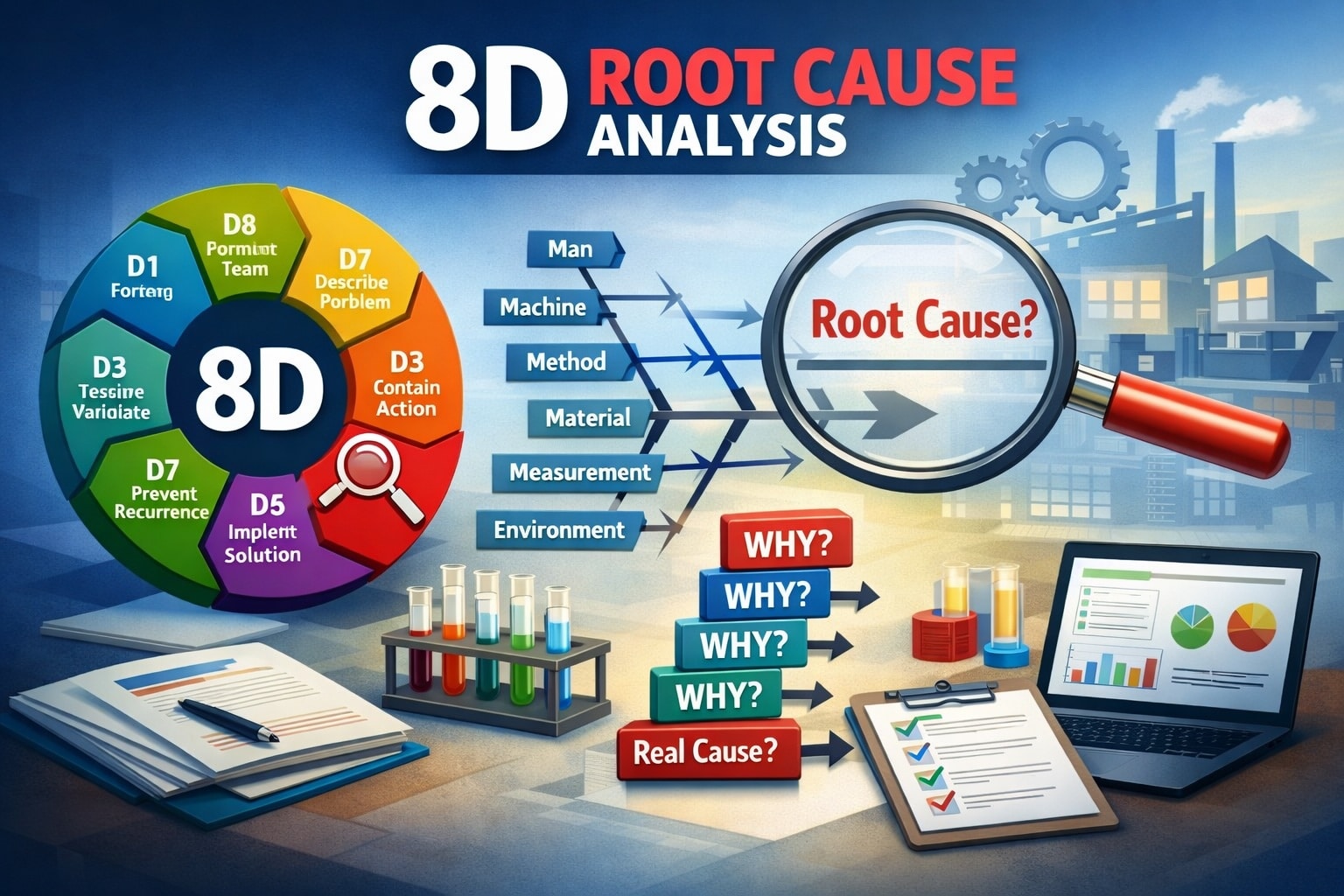
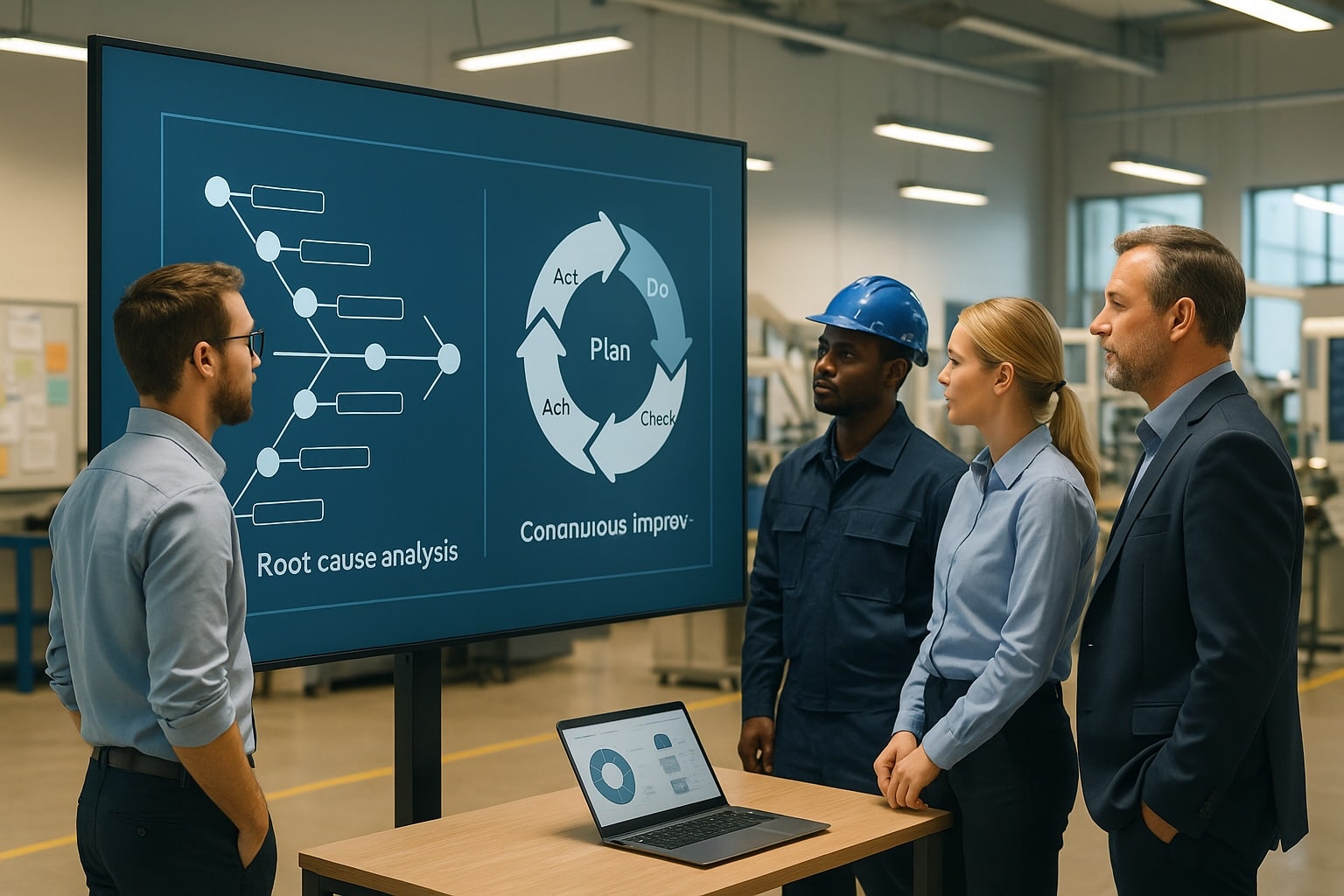
Complex failures travel through a system before they surface. A defect shows up as a customer complaint, a yield dip, a field return, or a safety incident, then the investigation begins in a single department, using a single data slice, with a single vocabulary. Collaborative root cause analysis (RCA) upgrades that pattern. It gathers the people who each hold a piece of the mechanism, builds one shared causal model, verifies it with evidence, and converts it into actions that stick.
This article offers a practical way to run team root cause analysis across design, manufacturing, quality, supplier, and customer-facing teams, especially across remote and hybrid environments, and shows how PRIZ supports the workflow through shared Cause-and-Effect Chain diagrams, guided facilitation, idea capture, and task tracking inside one workspace.
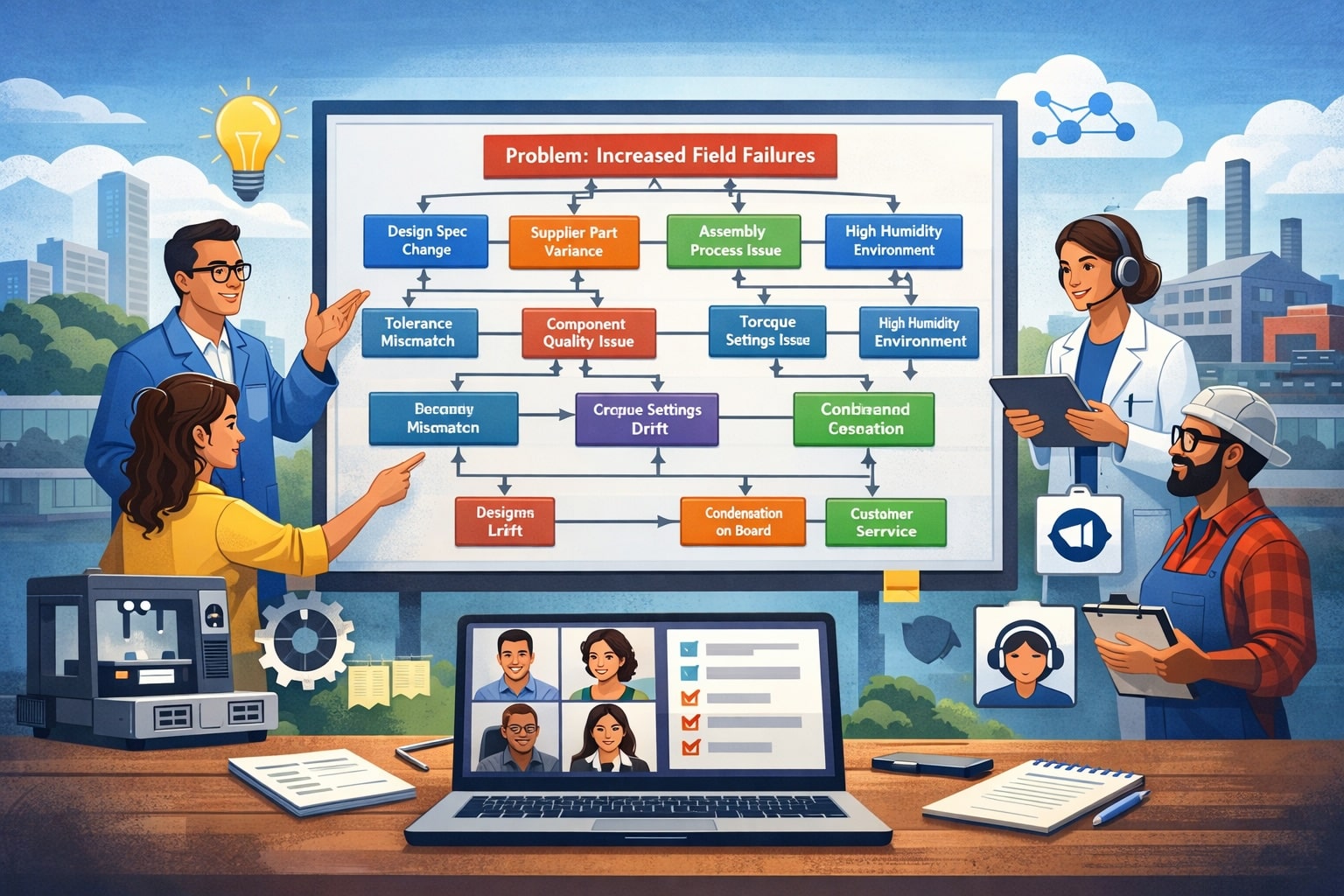
Collaborative problem solving improves RCA quality for three concrete reasons.
First, evidence coverage expands. Each function owns a distinct layer of truth: design owns intent and tolerances; manufacturing owns process capability; quality owns controls and escape points; customer service owns symptom patterns and usage context. The 8D framework places “Establish a team” at the start for that exact reason: complex problems require multiple disciplines to resolve and verify causes with real proof.
Second, causal modeling improves through structured challenge. A cause-and-effect diagram works best with a knowledgeable group, because brainstorming gains structure when ideas sort into causal categories and then drill deeper into mechanisms.
Third, implementation accelerates through shared ownership. When the same cross-functional team agrees on the causal story, corrective actions map cleanly to owners and timelines.
Collaborative RCA performs best when the team design mirrors the system that produced the failure.
A strong core team typically includes a process owner with authority, a design or systems representative, a manufacturing or process engineering representative, a quality representative, and a customer-facing representative (support, field service, or applications). Add a facilitator and a scribe/modeler to keep pace and preserve reasoning.
This structure aligns with how formal RCA teams operate in high-stakes environments: leadership assigns members who attend meetings, conduct research, interview staff, identify contributing factors, and write the report.
Specialists enter when the model reaches their mechanism: reliability, supplier quality, test engineering, firmware, tooling, metrology, logistics, or EHS. Their role centers on fast validation: confirm, refute, or refine a branch with data.
Collaborative RCA sessions succeed through preparation that creates a shared frame.
8D’s problem definition discipline calls for a quantifiable description: who/what/where/when/how/ how many. The effect statement becomes the anchor for every causal branch.
Example:
A field return rate for Module X rose from 0.3% to 2.1% over six weeks, concentrated in high-humidity regions, with failure signature Y during power-on.
Cross-functional teams move faster when the timeline sits in front of everyone and evidence stays linked to claims.
The facilitator protects the method and flow; the scribe keeps the causal model coherent; an evidence steward tracks what supports each claim; an action owner captures decisions, owners, dates, and validation criteria. These roles prevent drift and preserve traceability.
The flow below works in a single 90-minute session for smaller problems and as a repeating cadence for complex ones.
Teams share better details when the meeting reinforces blameless learning and focuses on future prevention.
Distributed teams gain depth when they confirm the timeline together and align on the incident story before debating causes.
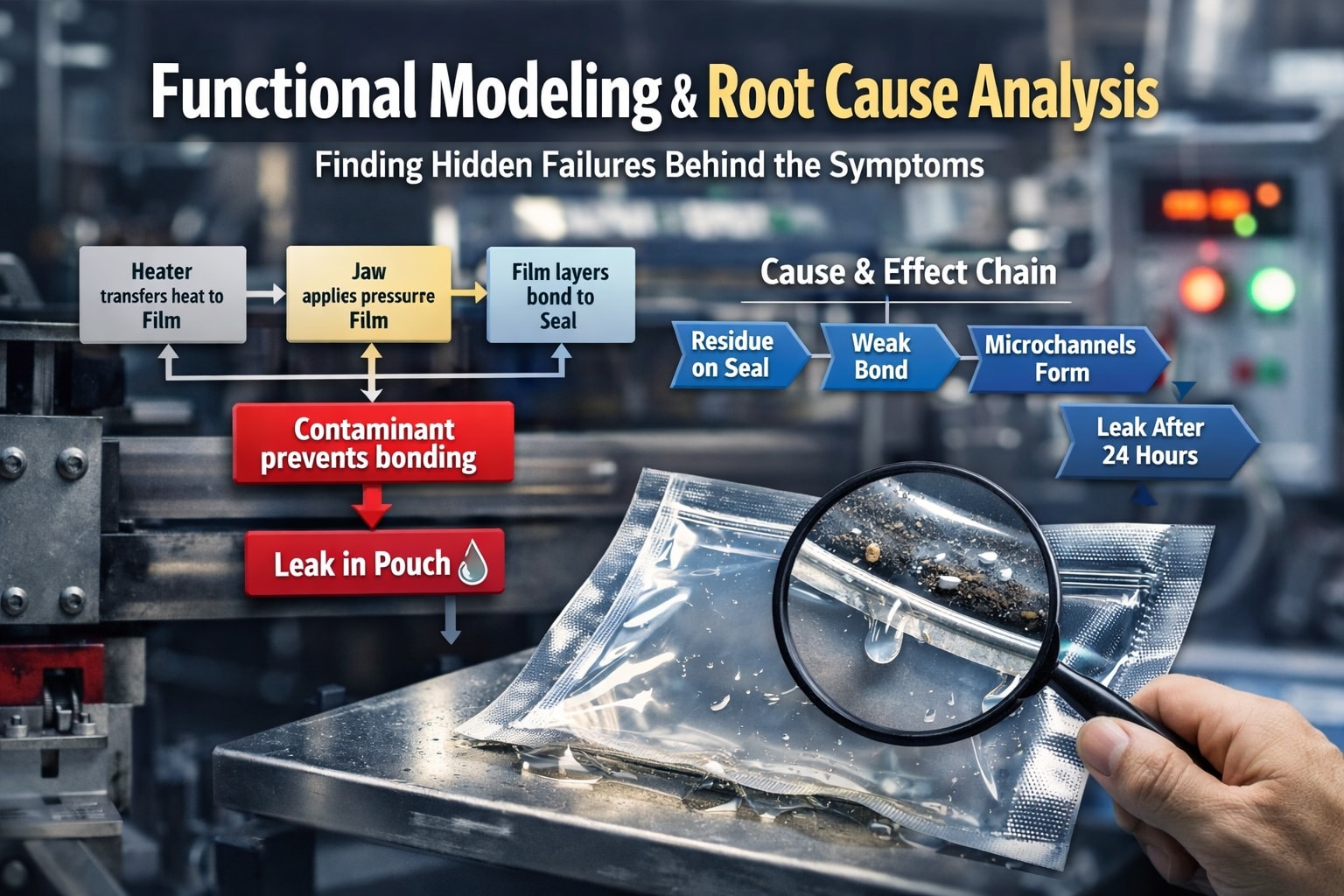
Build the causal model as a Cause-and-Effect Chain anchored at a single root effect. Each function adds first-layer causes from its domain knowledge, then the team drives depth by applying 5+ Whys along every meaningful branch, turning each “why” into a concrete mechanism statement the team can verify with data or tests. The questioning continues until the chain reaches a controllable cause where a specific process, design parameter, condition, or decision point explains the effect with evidence.
For each major branch, define the evidence that would strengthen it: reproduction test, teardown confirmation, metrology evidence, designed experiment, trend analysis, or removal-and-confirmation trial. 8D frames this as verification: causes earn acceptance through proof, then corrective actions follow verified causes.
Cross-functional RCA reaches prevention when the team explains how the defect passed through controls. 8D explicitly calls for identifying why the problem went unnoticed when it occurred.
Action quality improves when each action maps to a verified mechanism and includes a validation check under real conditions.
End with a short story that every function endorses:
effect → key causal chain(s) → escape point(s) → actions → owners → dates → validation metrics.
Distributed RCA benefits from tools that support real-time collaboration plus evidence management. NASA described building a web-based Cause Analysis Tool to support real-time collaboration, brainstorming, evidence management, and depiction of causal relationships.
A simple operating rhythm supports remote teams: asynchronous input before the meeting, a shared live model during the meeting, then a visible action ledger that tracks owners, due dates, and validation. Postmortem practice at Atlassian emphasizes video-based group review, confirming the timeline, confirming root causes, and generating preventive actions with accountable follow-through.
A practical warning comes from a qualitative study of RCA team members: people reported value in the review process and also raised concerns about workload and limited impact when follow-through weakens. Strong action tracking and visible validation criteria address that impact gap.
PRIZ supports cross-functional team root cause analysis by keeping context, causal logic, evidence, decisions, and follow-up connected inside one workspace.
PRIZ’s Cause and Effect Chain tool organizes work into three connected spaces: Subject, Analysis, and Conclusion, so teams keep the system context close to the causal model and capture conclusions in a structured artifact. The diagram supports a single root node (the failure) and expanding cause nodes to build a tree that represents causal relationships.
This structure matches how cross-functional teams think: design and manufacturing add branches for mechanisms; quality adds branches for control failures; customer-facing teams add branches for usage and environment; the group converges on verified chains.
PRIZ’s guided facilitation is a method-first way to lead teams through a structured problem-solving process, standardizing each step from problem framing to decision-making, with an optional assistant for speed. For cross-functional RCA, that standardization creates shared language, consistent artifacts, and repeatable session flow.
PRIZ’s idea management is a transparent and collaborative idea generation with decisions documented and accessible across the project lifecycle. In practice, this keeps solution ideas attached to verified causes, which preserves rationale and improves implementation alignment across departments.
During Cause-and-Effect work, PRIZ includes controls that support “Record an Idea” and “Create New Task”, enabling teams to capture follow-ups at the moment a verification step or corrective action becomes clear. This reduces the loss between meeting insight and execution.
A product experiences intermittent power-on failures after delivery in cold weather. Customer service brings symptom clustering and environmental context. Design engineering brings the intended power sequence constraints. Supplier quality brings the lot history and second-source substitutions. Manufacturing engineering brings assembly process variation and tooling changes. Test engineering brings control limits and test conditions.
The team builds the causal chain rooted at the measured effect. Branches capture mechanisms: cold-start voltage ramp behavior, component tolerance interactions, grounding resistance variance, and test conditions that fail to activate the failure mode. The group assigns verification moves: reproduce under cold-soak conditions, measure ramp profiles with real loads, characterize component ESR across lots, and compare grounding resistance distributions across torque settings. The team also maps the escape point: end-of-line tests run under benign conditions and miss the failure mode.
Corrective actions map directly to verified causes: component equivalency rules tied to ramp sensitivity; torque control updates plus verification checks; test recipe updates that mirror field conditions; monitoring triggers that detect drift early. The session closes with one shared story and an action ledger with owners, dates, and validation metrics.
Collaborative RCA creates a capability that compounds. Teams build shared language, consistent artifacts, and a repeatable way to move from symptoms to verified causes to prevention. When the workflow lives in one shared workspace with causal modeling, evidence, ideas, tasks, and conclusions connected, cross-functional teams gain speed, clarity, and durable learning.