Manufacturing problem analysis software helps semiconductor fabs cut scrap by shortening the path from abnormal signal to containment, root cause, corrective action, and verified prevention. In a fab, delay is expensive. A weak signal can lead to lots of exposed tools, tool downtime, missed shipments, quality escapes, or a recurring CAPA that everyone recognizes by a new name.
The reason is simple: semiconductor manufacturing is too complex for investigation-by-spreadsheet. NIST describes semiconductor process flow as involving 1,000+ process steps, 70+ masks, hundreds of materials, and hundreds of different tools. It also cites a Micron smart-factory example with 470,000 sensors, 13 terabytes of data, and 15.6 million wafer images per week. That is a lot of signal. The hard part is turning it into the right action quickly.
Direct answer: Manufacturing problem analysis software cuts fab scrap by reducing the time it takes to detect, understand, contain, and prevent process problems. It connects manufacturing analytics, quality control software, RCA workflows, lot genealogy, CAPA records, and action tracking so teams can move from “something drifted” to “this mechanism caused the loss, these lots are exposed, and this action prevents recurrence.” The best systems do not replace MES, SPC, FDC, metrology, inspection, or yield-management tools. They make the reasoning and closure work after detection more disciplined.
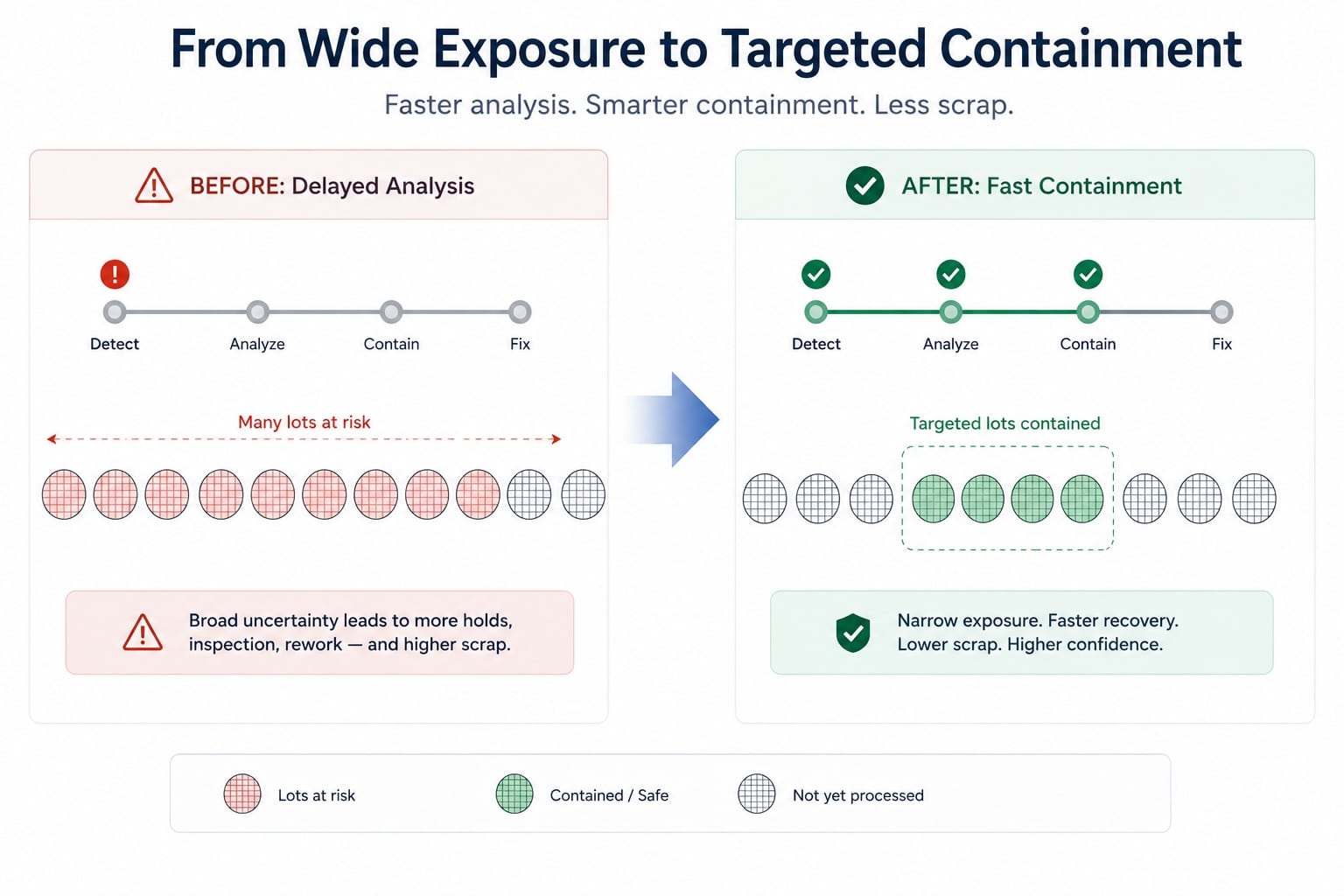
Fab scrap is rarely caused only by the first bad wafer. The larger loss often comes from the wafers that continue moving while the team is still figuring out what happened.
Problem analysis software helps reduce that exposure by linking abnormal signals to lot, tool, chamber, recipe, shift, maintenance, and inspection context. That makes it easier to answer the containment question fast: what else is at risk?
KLA’s process-control guidance for automotive fabs makes this point clearly. More inspection and metrology coverage helps fabs find excursions sooner, reduce lots at risk, quarantine affected wafers, and simplify root-cause investigation by narrowing the range of possible sources.
For fab leaders, this is the first scrap-reduction mechanism: fewer lots exposed to unresolved uncertainty. That is where factory downtime reduction and scrap rate reduction begin.
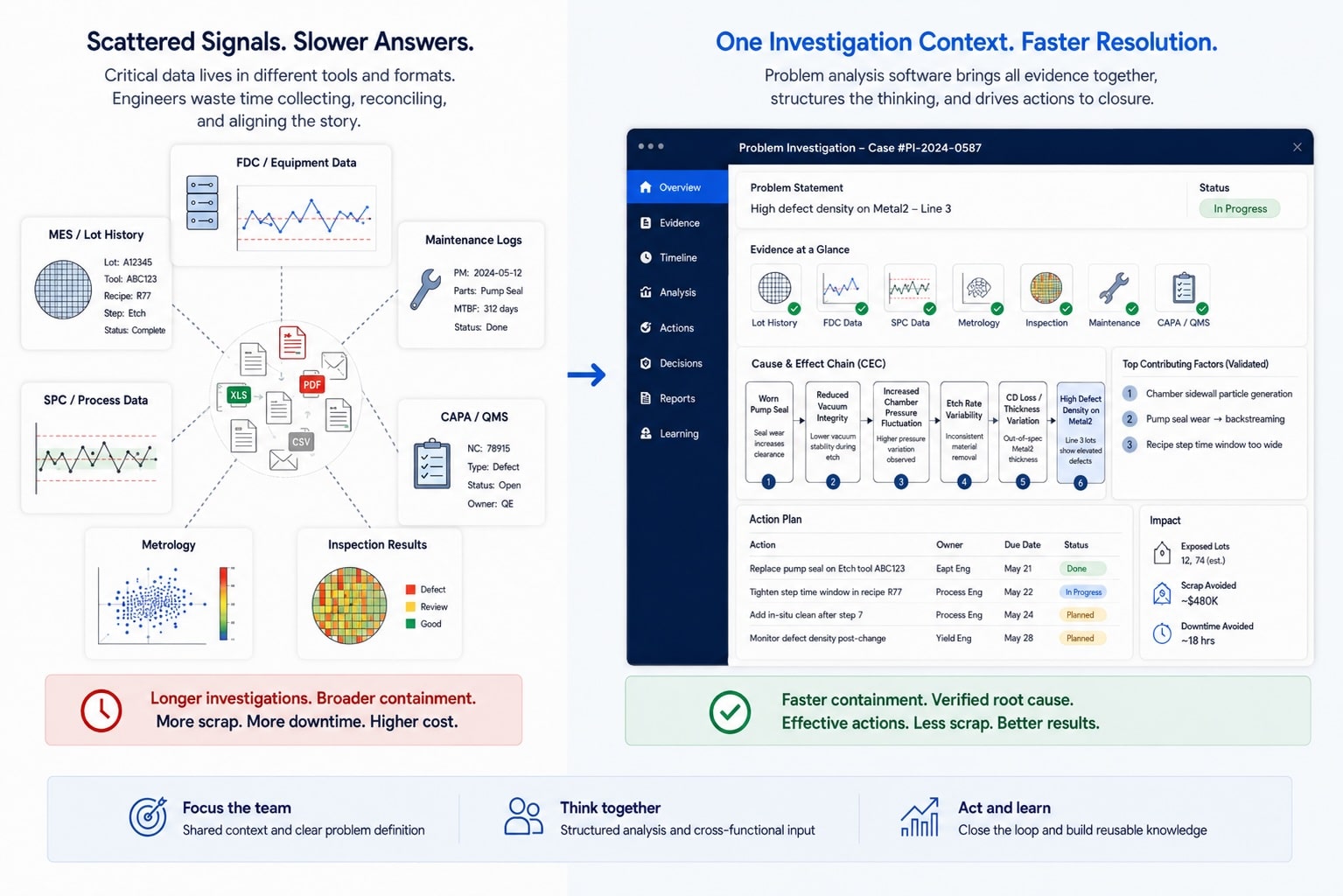
Fabs already have signals. They have alarms, SPC charts, FDC traces, inspection maps, metrology data, test results, MES records, maintenance history, and engineer notes.
The problem is that these signals often live in different places.
SEMI’s preventive maintenance automation paper highlights the same pattern in maintenance data. It notes that equipment status variables, component usage history, and PM execution records often remain fragmented and inconsistently exposed, which undermines the reliability and scalability of predictive maintenance models.
Manufacturing problem analysis software helps by organizing the investigation around the problem, not around the database where each clue happens to live. That matters because a yield excursion does not respect departmental boundaries. It may touch process engineering, equipment engineering, yield, quality, maintenance, suppliers, and operations in one afternoon.
A good analysis workflow gives those teams a shared case file: evidence, hypotheses, suspects, actions, decisions, and closure criteria. Without that, “root cause analysis” becomes a series of meetings with attachments.
A fab under pressure will always want containment first. That is normal. The risk starts when containment becomes the solution.
ASQ defines root cause analysis as a set of approaches, tools, and techniques used to uncover the causes of problems. It also emphasizes that RCA must be part of a broader problem-solving effort to create quality improvement.
In semiconductor work, that distinction matters. A cleaning step, requalification loop, extra inspection, or tighter hold rule can protect the next shipment. It does not automatically explain the mechanism. If the causal model is weak, the same issue can and will return through a different tool, layer, product family, or operating window.
Problem analysis software helps by forcing the investigation to separate evidence from assumptions. It can structure the team’s thinking around cause-and-effect chains, 5 Whys, change analysis, process functional models, or 8D logic. The immediate benefit is fewer unsupported conclusions. The long-term benefit is fewer repeat excursions.
When a defect is found, the fab needs two answers. First: why did it happen? Second: where did the impact travel?
That second question is often where scrap cost expands. If traceability is weak, the safe answer becomes broad containment. Hold more material. Inspect more wafers. Rework more lots. Slow down more production.
Problem analysis software reduces that uncertainty by connecting analysis with genealogy. Instead of treating the excursion as a general event, the team can trace affected lots, tools, chambers, recipes, and process paths. That does not eliminate the pain, but it can make the containment boundary sharper.
ISO 9001 also reinforces this logic. Clause 8.7 covers control of nonconforming outputs, while Clause 9.1 focuses on monitoring, measurement, analysis, and evaluation. In practical terms, fabs need evidence that nonconforming output was identified, controlled, evaluated, and acted on.
Better traceability turns containment from a broad defensive move into a more precise engineering decision.
Unplanned tool downtime is not only a maintenance issue. In a fab, it can disrupt WIP flow, create queue-time risk, force tool substitutions, delay qualification, and expose wafers to process variation.
McKinsey reports that predictive maintenance typically reduces machine downtime by 30% to 50% and increases machine life by 20% to 40% across manufacturing. In semiconductor fabs specifically, McKinsey also notes that one hour of planned maintenance can typically save three to four hours of unplanned maintenance, and identifies short-loop RCA as part of a best-in-class maintenance program.
The software implication is important: predictive maintenance creates value when it connects tool condition to production decisions. A warning alone is useful. A warning tied to wafer exposure, known failure modes, prior incidents, and corrective-action history is much more so.
That is where manufacturing analytics and problem analysis need each other. Analytics can detect the risk. Structured problem analysis helps the organization decide what to do, why, and how to verify whether the decision worked.
Virtual metrology and advanced process control help fabs act earlier, especially when physical metrology is expensive, delayed, or sampled. NIST identifies predictive maintenance, advanced process control, fault detection and control, root-cause analysis, virtual metrology, and automated inspection as important use cases in existing semiconductor facilities. The same NIST report notes that metrology can represent up to 40% of total manufacturing cost in a semiconductor operation.
That creates a powerful scrap-reduction opportunity: detect drift before bad material accumulates.
Still, prediction is only part of the workflow. If a virtual metrology model flags risk, the fab still needs to decide whether to hold, reroute, inspect, rework, adjust, monitor, or continue. The wrong response can create unnecessary scrap or hide the real issue.
Problem analysis software helps by documenting the reasoning behind those decisions. It can connect model output to engineering judgment, known mechanisms, confidence limits, containment logic, and verification criteria. That makes the control loop more explainable to yield leaders, quality teams, and auditors.
CAPA fails when it becomes administrative cleanup after the real engineering work is over.
The HubSpot-cited Bizzmine article names common CAPA weaknesses: skipped root-cause analysis, fragmented documentation, unclear ownership, siloed processes, missing effectiveness checks, and weak reporting visibility. It argues that structured CAPA software improves traceability, accountability, audit readiness, and continuous improvement.
For semiconductor fabs, the lesson is bigger than compliance. A CAPA record should prove that the team understood the problem, acted on the verified cause, and checked whether the action prevented recurrence. Closing a CAPA because the action was completed is risky. Closing it because effectiveness was verified is much stronger.
ISO 9001 Clause 10.2 follows the same logic: when something goes wrong, the organization must react, deal with the impact, evaluate what went wrong to prevent recurrence, update risks and opportunities, and keep records.
Problem analysis software supports that discipline by tying the RCA, action plan, owners, evidence, approval path, and effectiveness review into one closed loop.
Every fab has solved problems that later get solved again.
Sometimes the earlier solution is buried in an old report. Sometimes it is in an engineer’s memory. Sometimes the same mechanism returns under a different product name, recipe, chamber, or customer complaint. The organization pays twice when the learning does not become reusable.
This is one of the less obvious ways problem analysis software cuts scrap. It preserves the reasoning, not only the final action. Future teams can see the symptom pattern, the discarded hypotheses, the verified cause, the containment boundary, the permanent fix, and the effectiveness evidence.
ASQ’s 8D guidance emphasizes containment, verified root cause, permanent correction, validation, and preventive measures to stop recurrence. It also notes that 8D is useful when root cause is not immediately apparent or when the issue crosses departments.
That is exactly the world of semiconductor yield excursions. The same learning that prevents one recurrence also improves production efficiency, quality control, and engineering response time.
If you are evaluating manufacturing problem analysis software, do not start with the dashboard. Start with the failure pattern you want to eliminate.
The strongest use cases usually fall into three groups:
The buying question is not “does the software have RCA?” Many tools say yes.
The better question is: does it improve the quality of engineering reasoning when the answer is unclear, the evidence is scattered, and the cost of delay is rising?
That is the moment where fabs need more than manufacturing analytics. They need structured problem analysis.
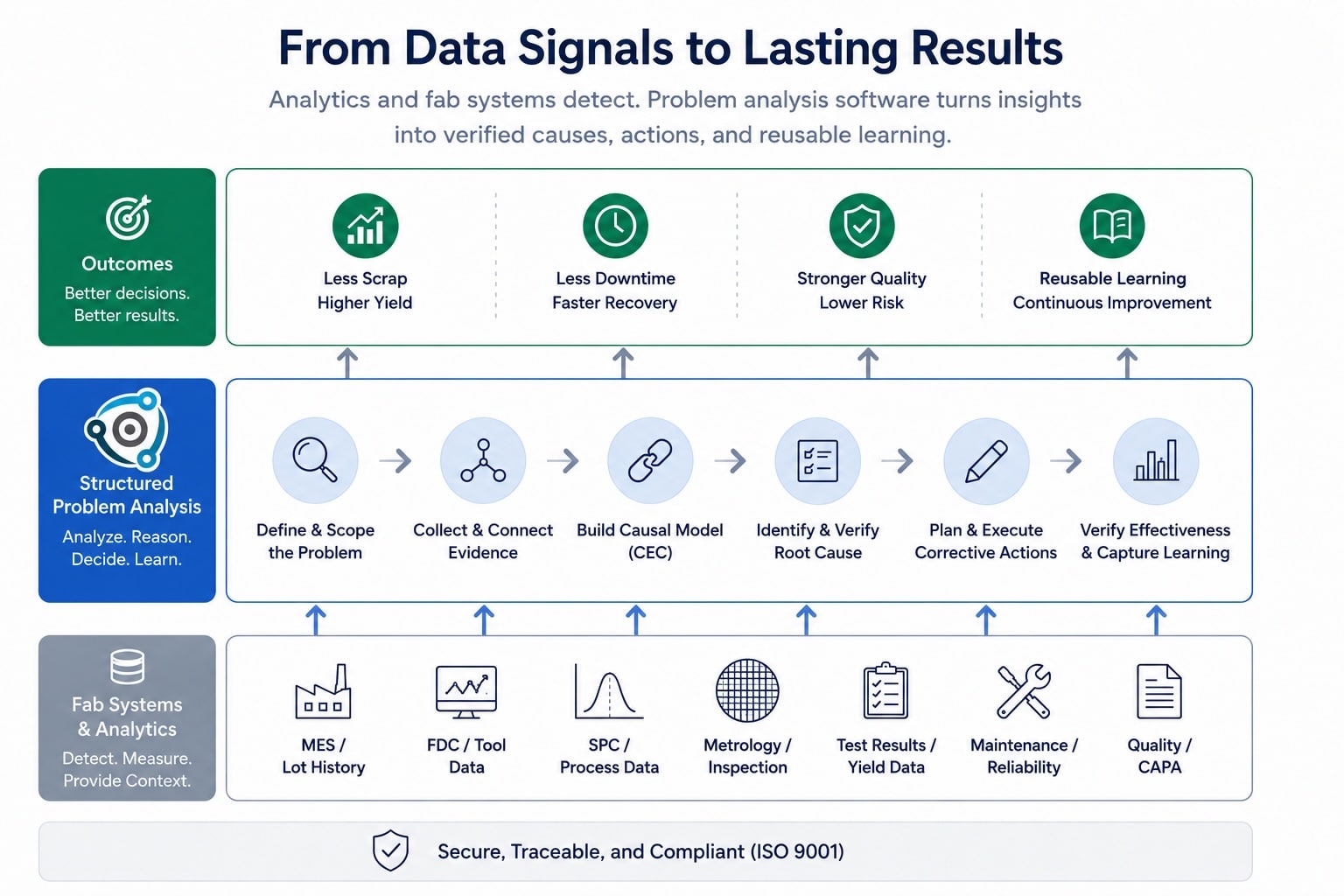
PRIZ fits as a structured problem-analysis and engineering-thinking workflow layer. It complements MES, FDC, SPC, metrology, inspection, test analytics, manufacturing analytics, yield-management systems, and quality systems.
Those systems help reveal signals, deviations, genealogy, and context. PRIZ helps teams reason through those signals, build shared models, verify causes, choose actions, document decisions, and preserve learning.
In a fab excursion, that means PRIZ is not the tool that replaces your process-control stack. It is the layer that helps the team move from signal to mechanism to preventive action, with enough structure that the learning can be reused the next time pressure rises.