Walk into any plant, lab, or engineering war room the morning after a failure, and you’ll see the same ritual.
A graph dipped. A customer complained. A yield number embarrassed someone important. So a team is assembled, a template is opened, and “Root Cause Analysis” is declared.
A few hours later, the RCA is “done.”
The problem, however, is not.
If that sounds familiar, you’re not alone. Even in industries that are serious about quality and safety, RCA often fails to produce durable, systems-level fixes, especially when the process turns into paperwork, blame, or a race to closure.
This article is a practical field guide to the most common root cause analysis mistakes, the patterns that explain why RCA fails, and the habits that reliably prevent those failures.
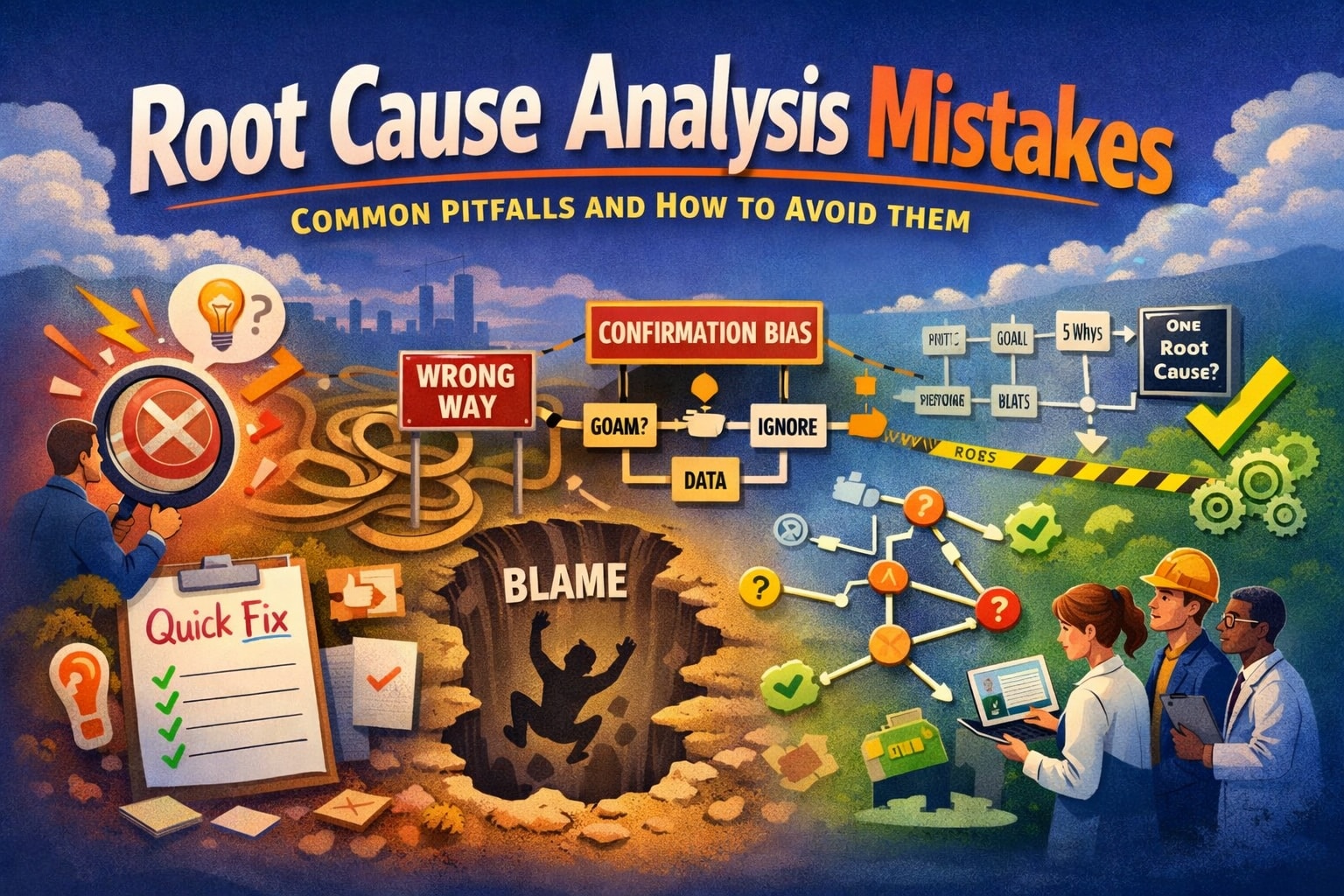
A good RCA is supposed to do one job: identify the underlying conditions that make the failure likely, so you can change those conditions and prevent recurrence. That “systems approach” is a core idea behind RCA in high-risk domains, specifically to avoid the trap of focusing only on individual mistakes.
But RCAs become ineffective when they produce weak actions (training, reminders, “be careful”), don’t validate causes with evidence, and don’t translate analysis into strong system changes.
So let’s talk about the traps.
This is the most expensive shortcut in engineering: deciding the fix before you’ve proven the cause.
It usually sounds like:
Sometimes you’ll even be right. The problem is: you don’t know that yet. And when you’re wrong, you don’t just lose time, you bury the real mechanism under a shiny new band-aid.
How to avoid it
Write the problem statement first, in measurable terms, with deviation and impact. Then forbid solution talk until you’ve mapped at least one cause chain and identified what data would confirm or falsify it.
PRIZ Guru’s own RCA material pushes the same discipline: define the issue with data, then collect evidence before you “pick” causes.
If your problem statement could fit 30 different failures, your RCA will “explain” none of them.
Bad: “Low yield.”
Better: “Yield for Product X dropped from 92% to 78% over 10 days after tool PM, driven by defect type Y at step Z.”
Why this matters? The more specific the effect, the easier it is to identify a plausible physical mechanism and eliminate fantasy causes.
How to avoid it
Anchor the problem in time, location, signature, and boundary conditions:
This “define the deviation, then investigate” style is consistent with how PRIZ frames RCA in manufacturing contexts.
A symptom is not a cause. It’s a description of pain.
Examples of symptom-labeling disguised as RCA:
Those words can be useful as intermediate nodes. But they are not root causes until you explain why that condition existed in your process and why it persisted long enough to create the failure.
The classic “5 Whys” reminder is blunt: what you think is the cause may be another symptom.
How to avoid it
Every time you write a cause, add the next sentence:
“This leads to the effect because…”
If you can’t explain the mechanism, you’re not deep enough yet.
Reality is often branching, not linear.
Even the IHI’s 5 Whys guidance explicitly notes there may be multiple root causes, and different people see different parts of the system.
When teams demand “the one root cause,” they tend to:
How to avoid it
Treat your RCA as a cause network, then decide where to intervene.
This is where PRIZ Guru’s Cause & Effect Chain is quietly powerful: it’s designed as a tree-like diagram with multiple branches, because systems don’t fail in a straight line.
Confirmation bias is the tendency to search for or interpret information in a way that supports existing beliefs, often by ignoring conflicting evidence.
In RCA, confirmation bias shows up as:
How to avoid it
Make falsification a ritual:
If your RCA process doesn’t force you to confront disconfirming evidence, it’s basically a storytelling contest with a spreadsheet.
If your RCA ends with “operator didn’t follow procedure,” you didn’t complete an RCA, you completed a blame assignment.
The point of a systems approach is to ask why the system made that failure likely: confusing interface, impossible takt time, ambiguous work instruction, poor fixture design, missing poka-yoke, noisy alarms, etc.
How to avoid it
When a human action is involved, keep going:
Then design countermeasures that reduce reliance on perfect human behavior.
Many RCAs fail because they default to weak actions (education, warnings, enforcing existing policy) rather than reengineering the system.
The VA’s RCA guidebook explains an “Action Hierarchy”: actions are stronger when they depend less on human attention (forcing functions, interlocks, standardization, simplification), and weaker when they rely on vigilance (training, labels, double-checks).
How to avoid it
Don’t ban weak actions, just don’t let them be the only actions.
A solid action plan includes at least one intermediate or stronger system change.
RCA meetings are full of statements that sound factual but are actually assumptions:
Those can be valid hypotheses. But if you don’t label them, the team starts treating them as proven.
How to avoid it
Use a simple language rule:
This “hypothesis until evidence” discipline is explicitly emphasized in structured RCA approaches, including PRIZ’s cause-chain framing.
Some teams do a beautiful analysis, then skip the only part that matters: verification.
If you didn’t test the suspected causes (by data, controlled change, experiment, or at least a strong before/after signal) your “root cause” is a guess with better formatting.
How to avoid it
Build verification into the workflow:
The VA RCA guidebook also stresses outcome measures tied to actions and a reasonable timeline – accountability, not “we’ll get to it.”
If every RCA lives in a different slide deck, your organization is paying for amnesia.
Patterns across incidents – same failure mode, same hidden condition, same weak action – only become obvious when your RCAs are searchable and comparable.
PRIZ’s own manufacturing/Kaizen RCA writing calls out this exact idea: RCA becomes powerful when it moves from isolated incidents to systemic learning across cases.
How to avoid it
Treat RCA as a knowledge asset:
That’s also where a structured platform helps, not because it “stores documents,” but because it forces a consistent thinking process.
Most RCA failures aren’t caused by bad intentions. They’re caused by bad defaults.
PRIZ Guru’s RCA tooling pushes better defaults in three practical ways:
It’s methodology first (AI optional), and the structure does what structure always does: it keeps you honest.
RCA isn’t failing because people are lazy. It fails because the process is too easy to cheat.
If your RCA process allows:
…then it will produce exactly what it’s designed to produce: repeat failures with new filenames.
Root cause analysis works when it behaves like engineering: mechanisms, evidence, branching logic, strong countermeasures, and measurable outcomes.