Modern software teams ship fast, run distributed systems, and learn through incident reviews. Root cause analysis (RCA) turns an outage, a recurring defect, or a failed release into durable improvements in reliability and delivery confidence.
This guide walks through a practical RCA workflow for software bugs and project failures, then shows how PRIZ supports the work from evidence capture through implementation planning.
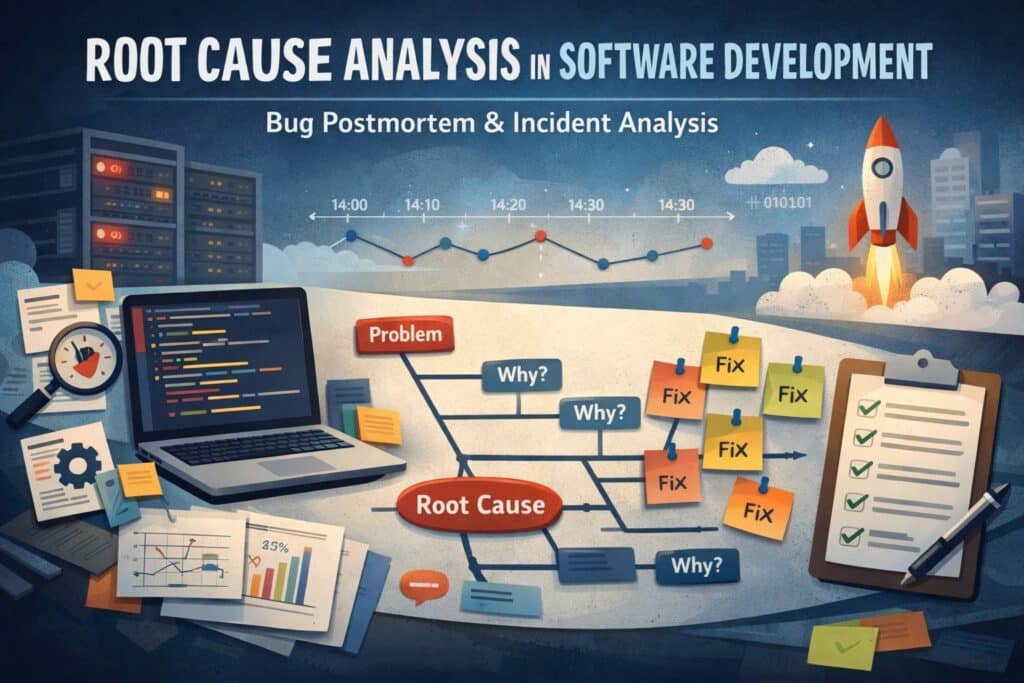
In software operations, RCA typically lives inside an incident postmortem: a written record of the incident, its impact, the actions taken, the root cause(s), and the follow-up actions that prevent recurrence. That definition aligns with the SRE framing from Google and the incident-management practices described by Atlassian.
RCA produces value when it delivers three outcomes:
Write the problem as a user-visible or system-observable result: elevated error rate, failed deploy, corrupted data, missed SLO, broken checkout. Keep it measurable: “During the 14:05–14:32 UTC deploy window, 38% of requests to /checkout returned 500.”
Collect logs, traces, dashboards, alerts, deploy metadata, feature-flag changes, and chat timestamps. A timeline supplies the factual backbone that keeps the analysis grounded and makes the postmortem reusable.
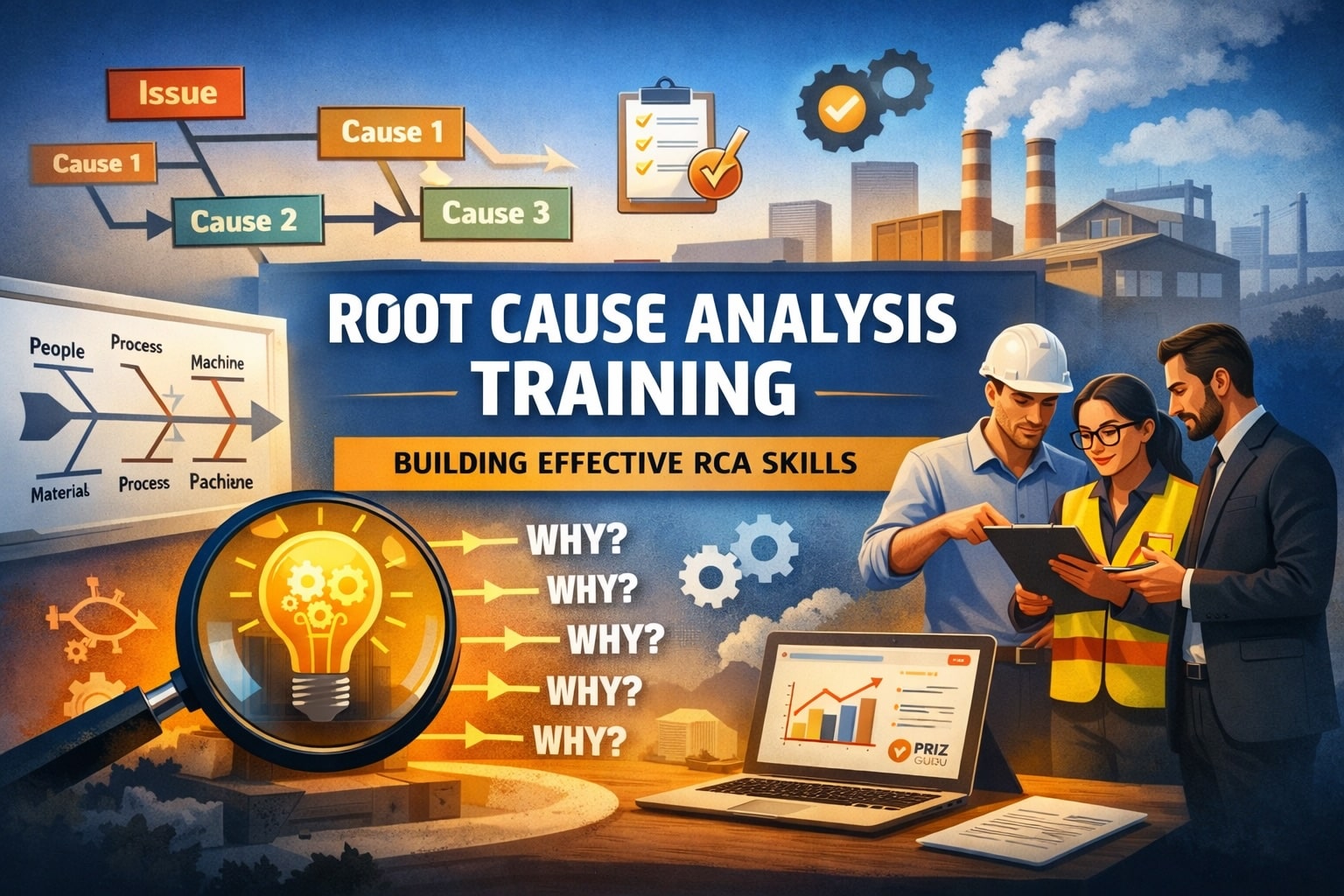
The Five Whys technique drills down from symptom to deeper causes. ASQ describes it as a questioning process that peels away layers of symptoms. The method has roots attributed to Sakichi Toyoda and Toyota.
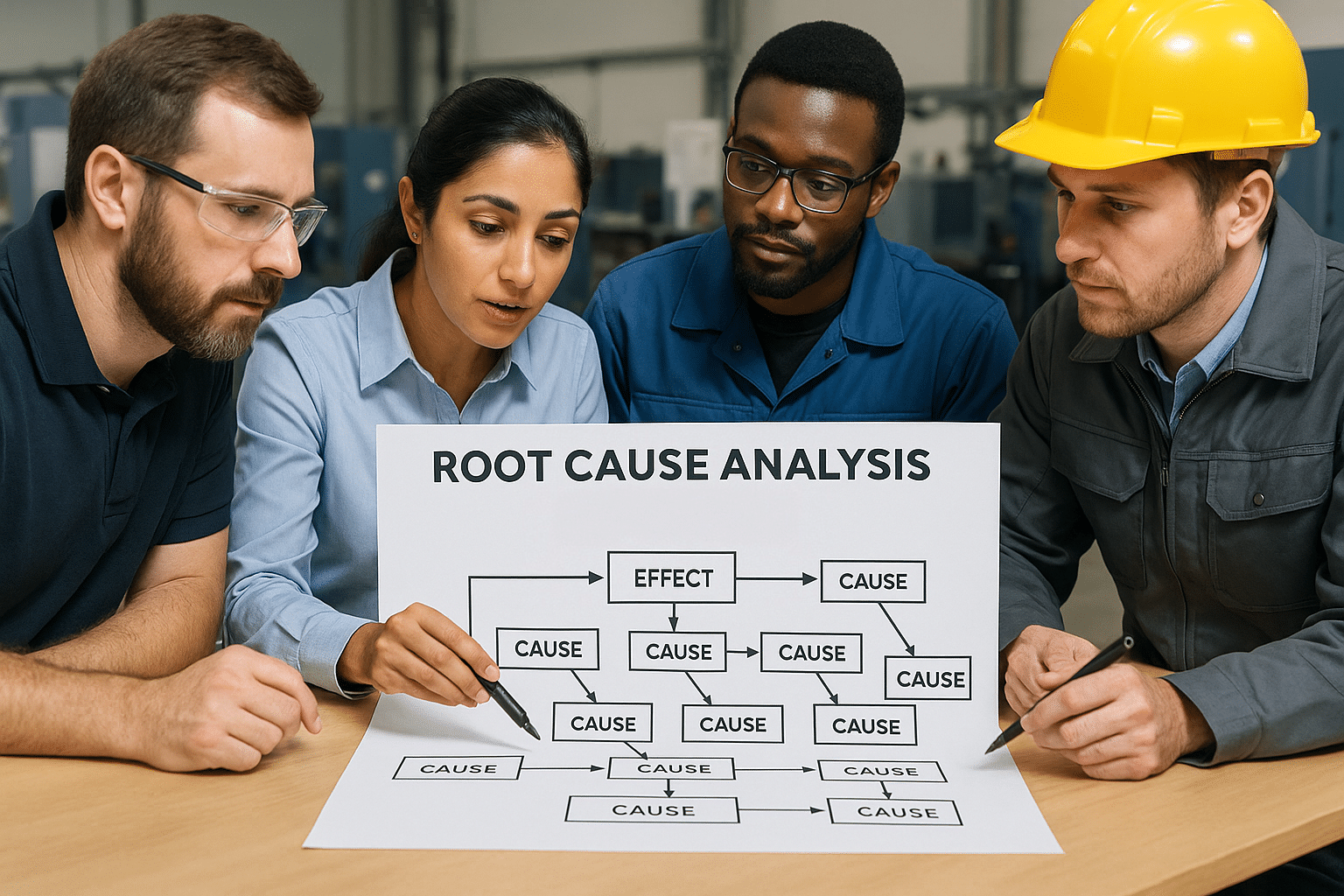
Five Whys works well when the causal path stays linear. Complex incidents often include multiple contributing conditions, so teams gain leverage from a branching causal map that keeps parallel paths visible.
Failure: After a deploy, the API returned 500 errors for 27 minutes.
Why 1: Instances restarted continuously because startup checks failed.
Why 2: Startup checks failed because Redis authentication failed.
Why 3: Authentication failed because endpoint and secret values rotated, and production used stale values.
Why 4: Stale values reached production because the pipeline lacked an automated configuration verification gate.
Why 5: The release process relied on a manual checklist, and config governance ownership remained unclear.
This chain points to concrete leverage: a CI gate for configuration validation, a safer secret-rotation workflow, clearer ownership, and a rollback playbook tested in drills. The same pattern appears in many software defect RCAs, where the deepest leverage often sits in delivery controls and system design decisions rather than a single line of code.
Action items determine whether an RCA changes reality. Google’s follow-up research on postmortem action items focuses on designing high-quality actions and executing them reliably. Atlassian operationalizes follow-through with ownership and tracks “priority actions.”
For the example above, high-quality actions map to causal nodes and read like engineering work:
Many tech organizations treat postmortems as a learning ritual; Etsy helped popularize the blameless postmortem approach for complex systems work. Define verification signals: reduced recurrence, lower time to detection, improved deploy success rate, improved SLO attainment, and smaller incident blast radius. Publish the postmortem and link it to the tracked actions so future teams can discover patterns and reuse solutions.
Software RCA often spreads across tickets, docs, dashboards, and chat. PRIZ consolidates the work into a single project and guides the team from problem definition through causal modeling, decision-making, and implementation planning.
PRIZ projects provide a dedicated space to capture system context, screenshots, runbooks, log excerpts, and links, keeping the “written record” close to the causal model.
PRIZ’s Cause-and-Effect Chain (CEC) models causal relationships as a tree, supporting branching analysis where multiple conditions interact. PRIZ’s CEC is a reasoning system for understanding how events, actions, and conditions influence one another over time.
In software, CEC fits incidents where causes span layers: deploy automation, configuration drift, workload patterns, dependency behavior, and human coordination. A clear chain makes contributing factors visible and keeps the discussion specific.
PRIZ extends Five Whys into 5+ Whys by allowing any depth that yields leverage and by distinguishing Auxiliary Reasons (levers that reduce the current problem) from Fundamental Reasons (structural constraints that shape the system).
In the deployment example, “pipeline lacks config verification” becomes an Auxiliary Reason with an immediate engineering countermeasure. “Config governance ownership remains unclear” becomes a deeper lever that shapes many incidents and benefits from an organizational decision, plus tooling support.
PRIZ connects causal nodes to solution ideas and supports ranking and selection, so teams leave the RCA with a clear sequence of interventions. This structure aligns with the SRE emphasis on action items and execution discipline.
Corrective actions often touch production risk: new checks, new gates, new workflows. PRIZ’s Change Flow Thinking maps an implementation path as steps with risks and resources, helping teams compare rollout options such as feature flags, canaries, staged migrations, and runbook updates.
PRIZ turns completed RCA projects into a searchable knowledge base, so future on-call engineers can reuse causal patterns and validated countermeasures.
We published an analysis of Ariane 5, highlighting how software reuse and type conversions can trigger catastrophic behavior when operating conditions shift. The lesson transfers cleanly to modern software: hidden assumptions about ranges, load profiles, and data contracts become latent hazards as systems evolve.
RCA at this level captures the failure mechanism, traces the enabling decision, and encodes a prevention pattern into the delivery system: precondition checks, safe conversions, telemetry counters, automated gates, and runbooks.