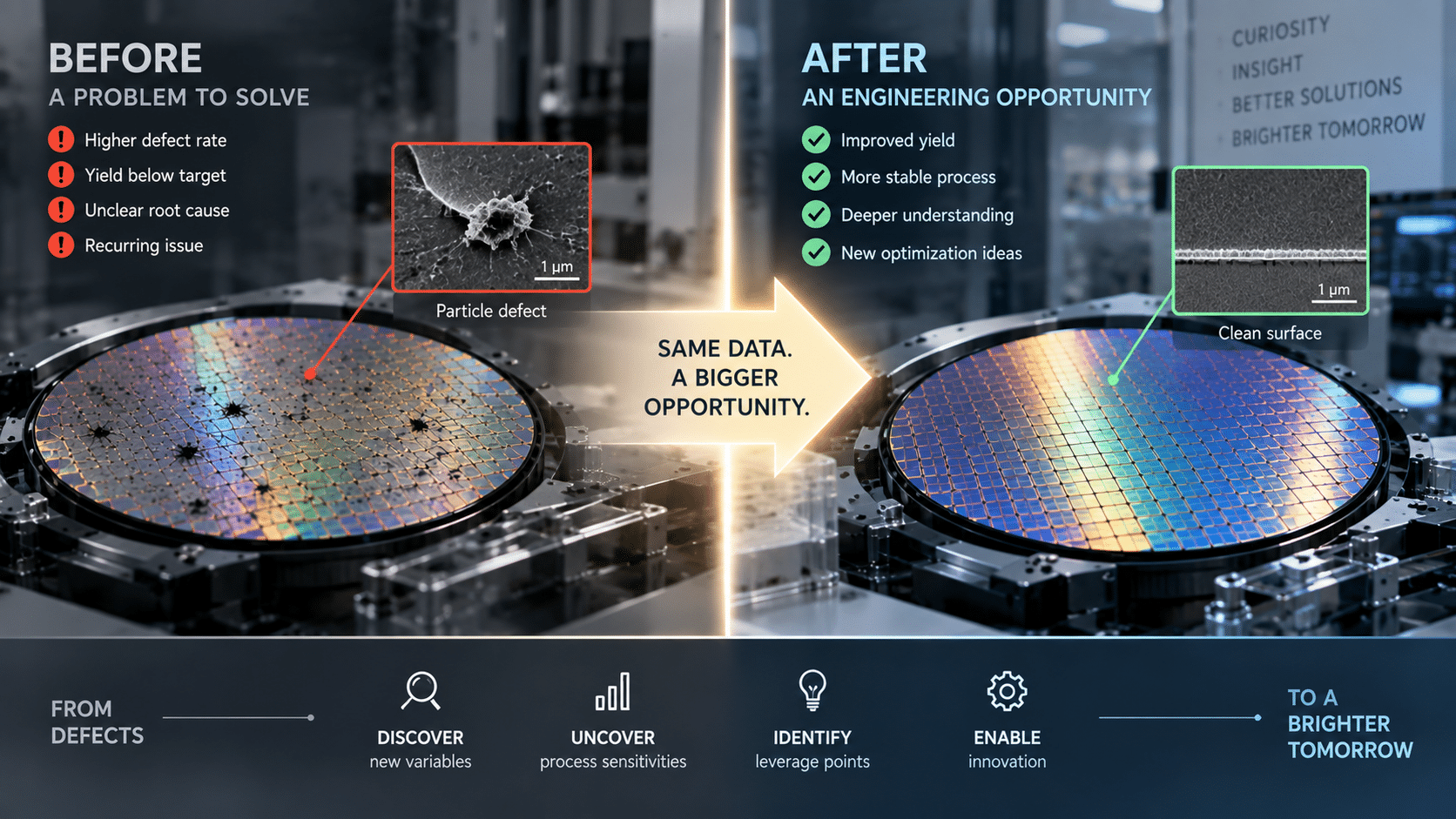
A yield excursion, recurring defect, or process instability reveals more than something to fix. It reveals value your engineering team may be able to recover, protect, or create.

Three product lots have dropped to 87% wafer-test yield. The previous 20 comparable lots averaged about 94%. Failures are concentrated near the wafer edge.
The task force already has several leads. Nineteen of the 24 lowest-yield wafers passed through etch chamber E2, although the normal E2 routing rate is still unknown. Two affected lots show slightly larger edge-to-center film variation, still within specification. Cleaning the probe contacts changed yield by less than half a percentage point. Physical failure analysis is pending. Six more lots are scheduled for next week.
Management wants action, so the familiar instruction arrives: Start the root cause analysis.
The team has plenty of technical material. It still needs an answer to two questions:
What exactly are we asking the team to investigate? And what opportunity could the company capture by acting on it?
A problem is the signal. The Engineering Opportunity is the value that becomes available when the organization understands that signal, commits the right resources, and improves the system.
The step before root cause analysis is shaping the Engineering Opportunity: organizing early evidence into a clear, bounded, reviewable case for what can be improved, what value is at stake, what remains uncertain, and why the work may deserve resources.
The underlying discipline has several established names, including Problem Finding, Problem Framing, Problem Exploration, Problem Definition, and Problem Shaping.
Problem Finding asks: What condition deserves attention?
Problem Shaping asks: What do we know, how should we frame the condition, where are its boundaries, and what remains uncertain?
Opportunity Shaping asks: What can the organization recover, protect, improve, learn, or create by addressing it?
Root cause analysis asks: What mechanism produced the defined condition, and what change can prevent recurrence?
The complete value path is:
Technical Signal → Problem Finding and Shaping → Engineering Opportunity → Resource Decision → Root Cause Analysis → Captured Value
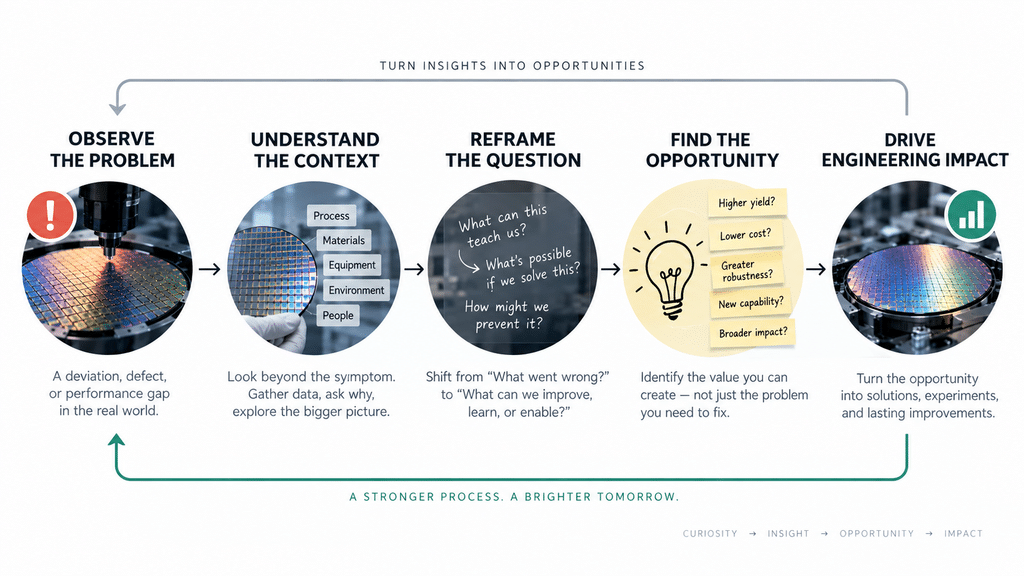
See how technical signals become opportunities worth pursuing.
Researchers have studied the distinction between finding a problem and solving it for decades. In 1975, Jacob Getzels described problem finding as a distinct part of creative work. Later engineering-design research used related language such as problem exploration and framing. A 2018 study of 252 design problems identified 32 patterns of problem exploration and found that their presence was associated with designs selected as competition finalists. (Getzels, 1975; Studer et al., 2018)
Formal quality guidance follows the same order. ASQ describes problem solving as defining the problem, diagnosing its root cause, implementing a solution, and sustaining the result. Its first stage calls for facts, supporting data, affected processes, timing, magnitude, and a specific description of what happened. (ASQ: What Is Problem Solving?)
This established discipline gives us technical clarity. Opportunity language adds the business meaning. For example, it connects a recurring defect to recoverable yield, an equipment failure to available capacity, a reliability issue to avoided warranty cost, and an engineering investigation to visible organizational learning.
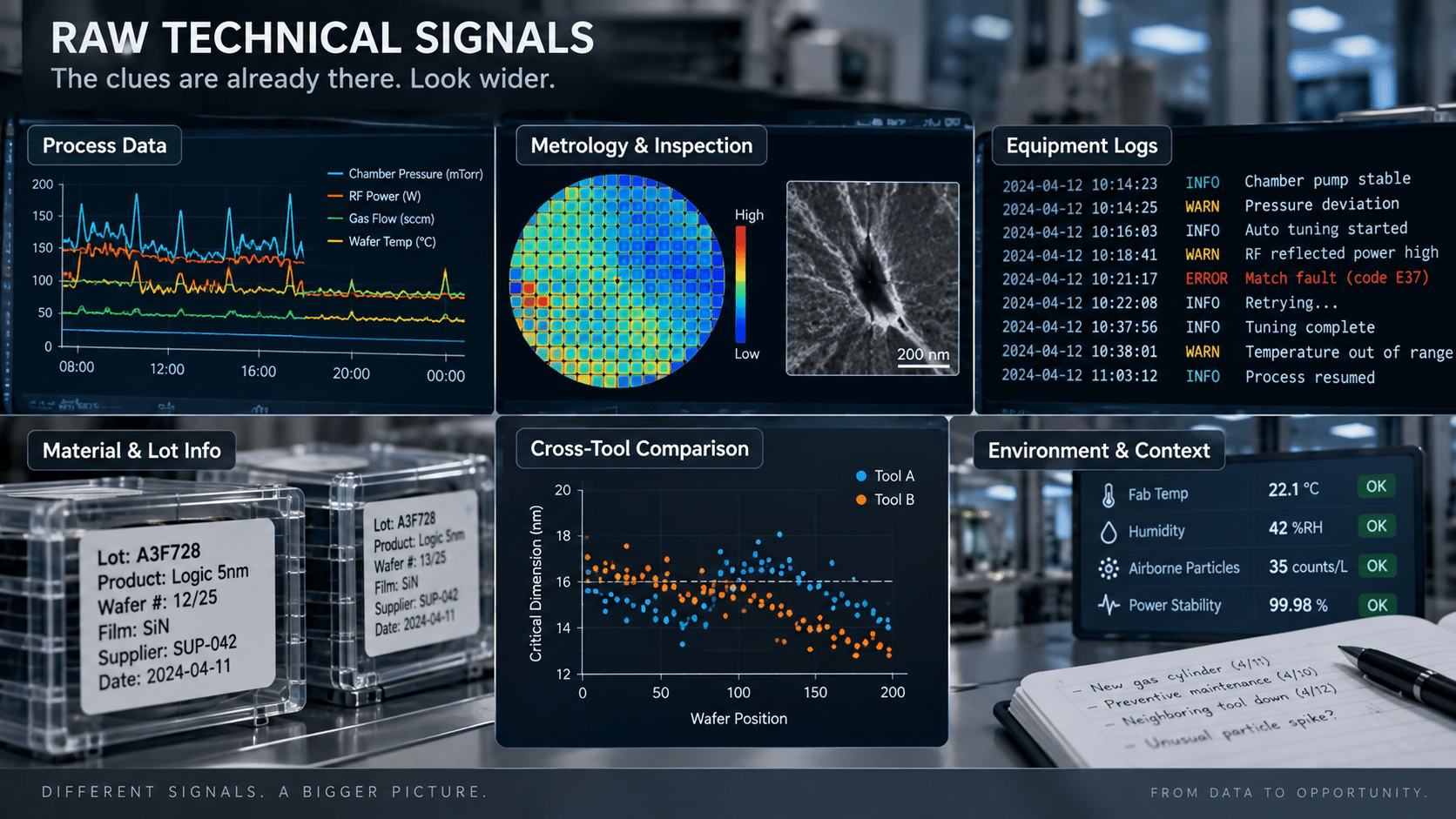
A fab excursion rarely shows up as a neatly defined opportunity. It usually takes shape gradually, scattered across email threads, SPC charts, tool histories, meeting notes, and screenshots. Along the way, teams try corrections and form competing explanations, while conclusions often begin circulating before the evidence behind them has fully caught up.
Several kinds of information often get mixed:
That material is the very beginning of an opportunity. The task-force leader still needs to organize it, separate observation from interpretation, preserve uncertainty, define scope, and express the potential value in terms management can evaluate.
Consider the statement “E2 caused the edge-yield loss.” It sounds decisive enough to become a project title, but it also embeds a conclusion that the available evidence cannot yet support.
Nineteen low-yield wafers passed through E2, but the team still lacks the routing denominator and comparable routes from unaffected lots. Maintenance had been performed before the first affected lot, and although qualification initially passed, the symptom reappeared after cleaning. A possible interaction with the film profile remains under consideration, while failure analysis is still in progress.
An “E2 root cause” project would carry that assumption into its scope, ownership, experiments, and meeting agenda. Every subsequent tool, 5 Whys, fishbone diagrams, cause-and-effect chains, fault trees, or DOE, would start from a constrained premise.
The opportunity is broader and more honest:
Close Product’s seven-point yield gap while protecting the next six lots, then determine what is driving the recurrence by bringing together evidence from wafer history, routing, equipment behavior, film profile, test results, and failure analysis.
That framing gives engineers room to investigate and gives management a reason to care.
An Engineering Opportunity is a structured, reviewable case built around observed technical evidence. It shows where performance can be improved, value recovered, losses reduced, risks brought under control, or useful knowledge gained, and provides a clear basis for deciding whether the work deserves resources.
An Engineering Opportunity should make the following visible:
At PRIZ, we represent a structured Engineering Opportunity as a Problem Candidate. The name describes its workflow status: the technical condition has been shaped into a reviewable candidate, while approval and resource commitment remain human decisions.
Every Problem Candidate represents an Engineering Opportunity.
Shape Investigation turns the selected technical context into an editable draft that the task-force leader can review and refine. The goal is to make sure the investigation is framed clearly, supported by the available evidence, and focused on the right scope, while also capturing its potential value, key unknowns, ownership, and an initial sense of priority. Once saved, the candidate moves to the Problem Candidate Inbox for management review, where it can be advanced, sent back for more information, combined with another candidate, rejected, or archived.
Before shaping, the Product task force is working with fragmented input from across the organization, including Yield, Etch, Equipment, Deposition, Test, Failure Analysis, QA, and Production. What they have so far points to a recurring edge pattern and several plausible causes, but the picture is still incomplete: probe cleaning did not resolve the issue, key comparisons are missing, and six lots are already nearing completion.
After shaping, management sees one Engineering Opportunity:
Recover Product wafer-edge yield and prevent recurrence.
The PRIZ platform stores it as Recurring Wafer-Edge Yield Loss in Product, a Problem Candidate with Needs review status. It records 87% observed yield against the 94% reference, keeps the E2 and film-profile explanations open, separates containment from recurrence investigation, assigns the Integration Engineer as accountable owner, and identifies the missing evidence.
Across the three affected lots, the seven-percentage-point yield gap represents an estimated 7,875 fewer passing dies against the reference yield. This estimate describes potential value exposure. Six upcoming lots increase the urgency.
The appropriate management decision is Ask for more information. Before moving forward, the manager requests the missing E2 routing denominator and comparable routes from unaffected lots, along with better alignment between wafer maps and maintenance history. The review should also include the completed physical analysis, a comparison of test-program versions, and evidence showing whether film-profile variation is actually connected to the observed edge pattern.
The opportunity becomes clearer while the technical uncertainty remains visible.
The workflow keeps three responsibilities clear:
This separation protects engineering judgment and management accountability. It also creates a record of what was known, what remained open, what value was expected, and why the organization chose to invest. (PRIZ Problem Candidate Inbox)

Root cause analysis remains one of engineering’s most valuable disciplines. Its quality depends on the technical question placed at its starting line. Its business value depends on the opportunity surrounding that question.
For engineering organizations, the sequence becomes:
This sequence gives engineers a clearer investigation, gives managers a stronger basis for allocating scarce resources, and gives the organization a visible connection between technical work and business performance.
Every problem consumes attention. A shaped Engineering Opportunity shows what that attention can produce.