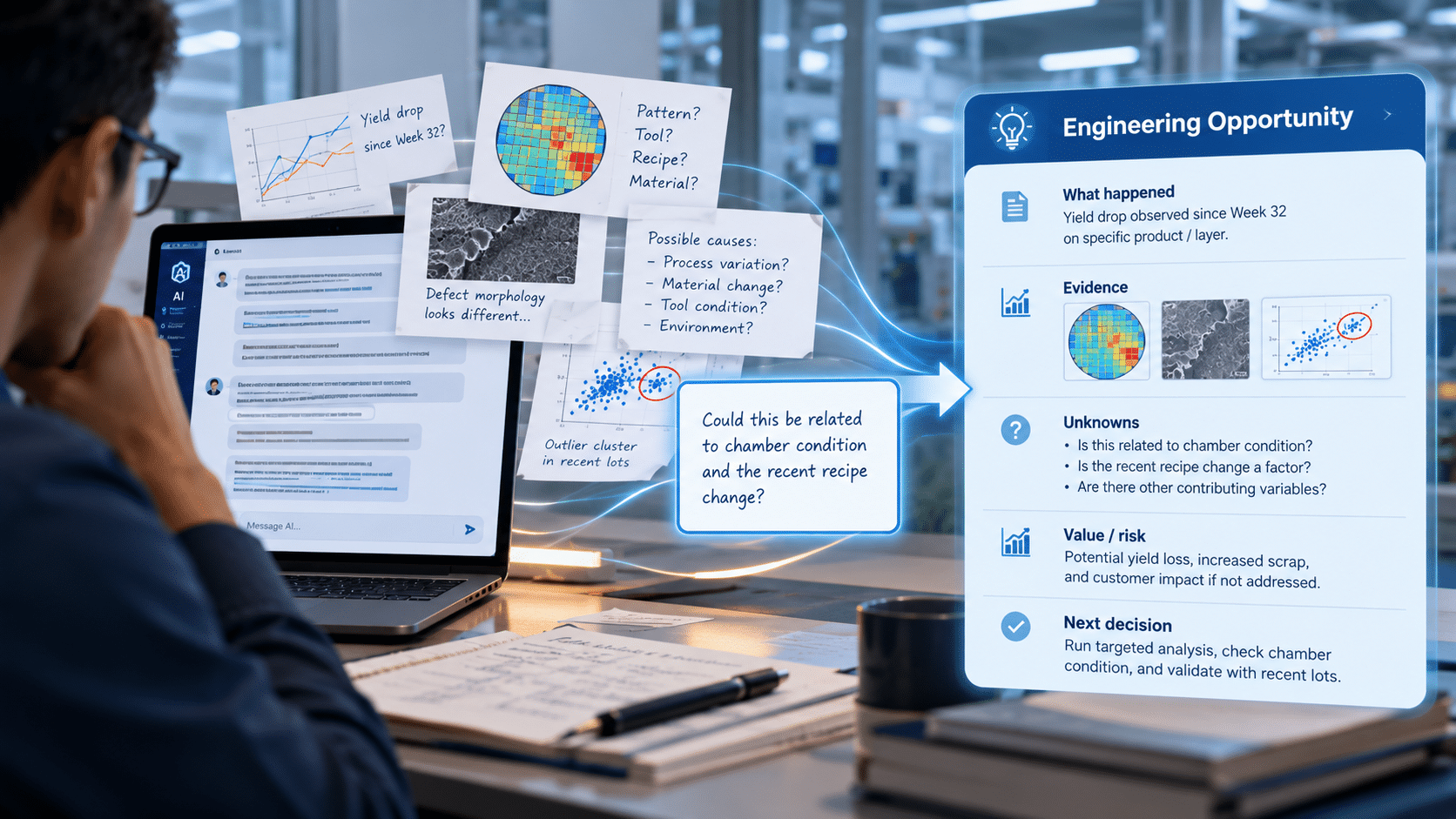
Last week’s AI conversation may have been genuinely useful. This morning, someone asks what the team should do about it. Suddenly the answer is harder than it ought to be: the useful lead is buried among forty minutes of reasoning, much of which was speculative or quickly abandoned.
The engineer remembers where the discussion turned. A colleague who was not there needs a clear starting point and a reason to pursue it. The full transcript rarely provides either in a form that helps the next decision.
Keep the freedom to explore with AI. When something worth pursuing emerges, carry it into an engineering workflow where other people can examine it and decide what happens next.
HOW CAN ENGINEERS TURN AI CONVERSATIONS INTO ENGINEERING ACTION?
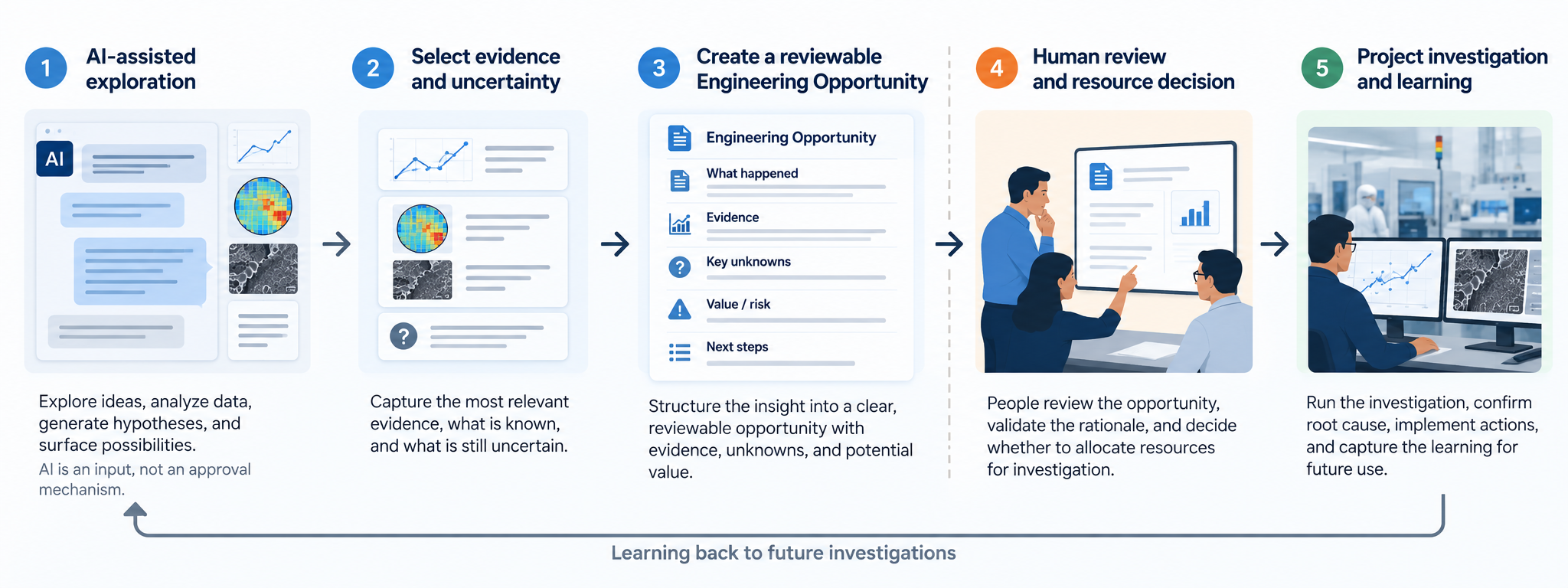
Capture the observation and the source evidence behind it. Record the interpretation as a hypothesis, with the uncertainty that still needs testing. Then make the next decision explicit: what should be checked, and why does the potential value justify attention? A short, reviewable Engineering Opportunity gives colleagues a basis for action without requiring them to read the entire AI conversation.
A conversation has a history. It wanders through explanations, challenges assumptions, and occasionally doubles back. That wandering has value for the person doing the work, especially when the underlying technical situation is unfamiliar. Someone picking up the investigation tomorrow needs a more stable starting point.
Start with the condition that was observed. If a process parameter shifted, specify what changed and cite the record that confirms it. Keep the proposed explanation distinct; an AI-generated hypothesis may be worth exploring well before sufficient evidence exists to rely on it. The other two essentials follow naturally from this separation. Identify what remains unknown, preferably as a question that a measurement or comparison could resolve. Explain why the answer matters. A modest clarification effort may be worthwhile if it keeps an expensive investigation from heading in the wrong direction.
These four elements—observation, interpretation, uncertainty, and reason to act—are enough to preserve a useful lead. The supporting chat can remain available as background, but the engineering record should make sense without it.
Consider intermittent particle excursions appearing after scheduled maintenance. The team’s attention has settled on one chamber because several affected lots passed through it. An engineer asks an AI assistant to help arrange the sequence of events and challenge that assumption.
During the discussion, a different line of inquiry develops: do the excursions follow that chamber, or the maintenance activity performed across several tools? It is a subtle shift. The first question encourages a chamber-specific explanation. The second opens the possibility of a common mechanism that the initial view could miss.
The AI can suggest comparisons. The engineer still needs to examine the authoritative process and maintenance records, including unaffected runs. If the relationship disappears under that comparison, the idea can be set aside. If it holds, the investigation has a better starting point.
Imagine handing this over to the next shift. A detailed AI-generated summary may sound convincing, but convincing wording does not guarantee that the underlying mechanism is accurate. NIST’s guidance on generative AI explicitly cautions against confident false claims, which may be accompanied by misleading explanations or citations[1]. This risk is especially significant when a plausible hypothesis starts being repeated as if it were a confirmed fact.
The useful handoff is consequently restrained: the observed particle trend, why the maintenance history merits comparison, and the check that could clarify the connection. A colleague can take it forward, question it, and continue the work, and the original conversation has served its purpose.
For a manager, the real challenge starts once an engineer says, “We might be approaching this incorrectly.” How significant is the exposure? Is another team already examining a similar issue? Could a single quick check clear up the uncertainty, or does the situation call for an entire project?
That is the moment to shape an Engineering Opportunity: a reviewable proposal describing the technical situation, the available evidence and the potential value of pursuing it. In the particle example, the proposal could focus on testing whether recurring excursions share a maintenance-related mechanism, with the production exposure made visible to the reviewer. It leaves room for the eventual evidence to overturn the hypothesis.
Now scale that scenario across a large engineering department. Reviewing an archive of everyone’s AI conversations would be challenging, and deciding what to prioritize would be even more difficult. A curated stream of clearly framed opportunities gives leadership a manageable perspective on emerging work. Some ideas will require clarification, while others will duplicate ongoing investigations or provide too little value to justify pursuit. Making those decisions transparently is part of the benefit.
Urgent containment still follows the organization’s established safety and production procedures. The opportunity review provides a separate, deliberate decision about further investigative resources.
PRIZ provides a structured workflow for this handoff. With Shape Investigation, a user can paste selected investigation context, including material from an AI conversation. PRIZ uses that context to prepare a draft Problem Candidate. The engineer reviews and edits the draft before saving it. The engineer decides what is accurate enough to enter the shared record.
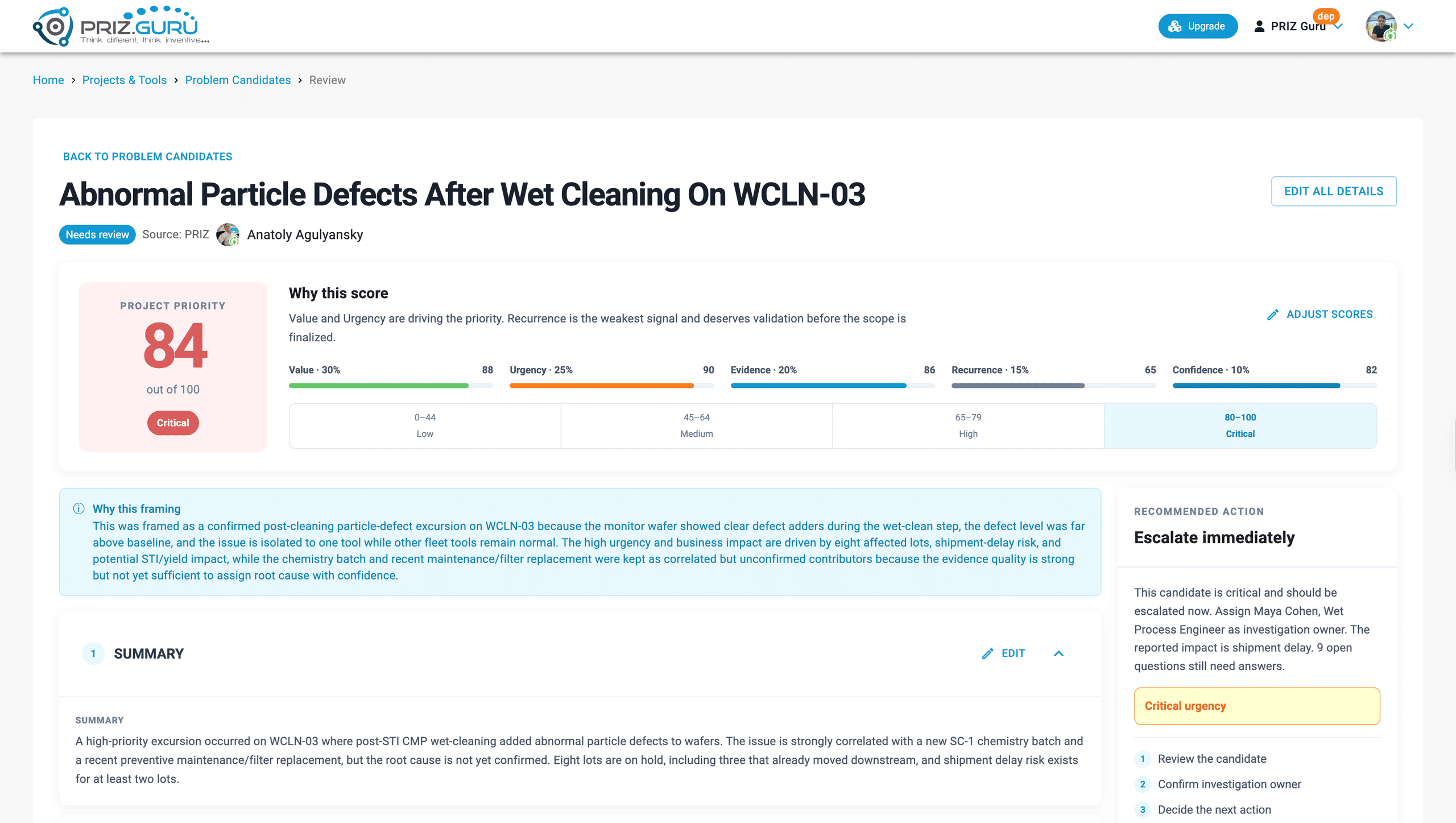
The term Problem Candidate describes the product record for a potential Engineering Opportunity. In the Problem Candidate Inbox, reviewers can request clarification, merge related candidates, or decide on their disposition. Approval makes a candidate eligible for a separate conversion into a PRIZ project.
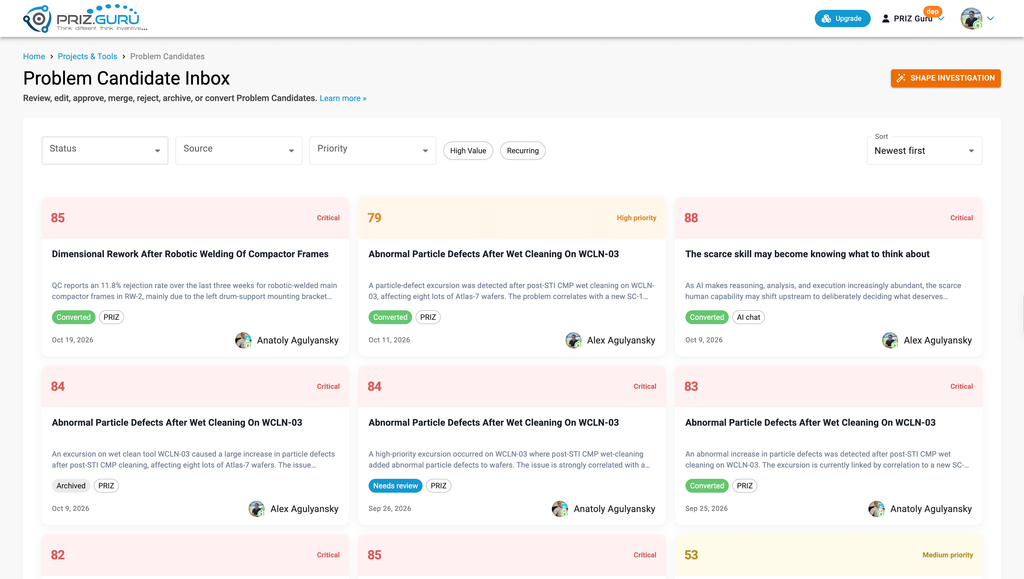
Once work is approved, PRIZ enables the more detailed engineering investigation and learning that come next. Process systems and measurement records continue to serve as the authoritative sources of manufacturing evidence. Root causes still must be confirmed through engineering work. A reviewable candidate helps the team approach that work with more clearly defined questions.
This also respects the tools engineers already use. The current Shape Investigation path involves pasting selected context into PRIZ when the capability is enabled for the workspace, where the actual work begins.
Before closing a conversation, ask: Did we uncover something another person should be able to investigate or decide on?
On most days, the answer will be no. A useful explanation, an improved email or a quick calculation can stay in the conversation. The selective approach matters because collecting everything would create another queue that nobody has time to read.
When the answer is yes, take a few minutes to capture the finding while the reasoning is fresh. Link to original records where permissions allow, and follow the organization’s rules for customer and proprietary information. If a decision is needed, place the opportunity in front of the appropriate reviewer. That small handoff can save someone else from reconstructing the entire line of thought later.
Managers can reinforce the habit by asking what changed because of the investigation. Did the team eliminate a weak hypothesis? Choose a more discriminating test? Recognize a risk early enough to respond? Those are more meaningful signals of progress than the volume of AI material produced.
The most valuable part of an AI-assisted investigation may be a single question. When it remains in a transcript, its significance depends on one person remembering why it mattered. Placed in a shared engineering workflow, it becomes something colleagues can review, refine and act upon.
Keep the tools that make exploration productive. When an idea has earned a closer look, carry it into the organization with enough context for someone else to make the next decision.
[1] National Institute of Standards and Technology. “Artificial Intelligence Risk Management Framework: Generative Artificial Intelligence Profile,” NIST AI 600-1 (2024), Section 2.2, Confabulation. https://doi.org/10.6028/NIST.AI.600-1