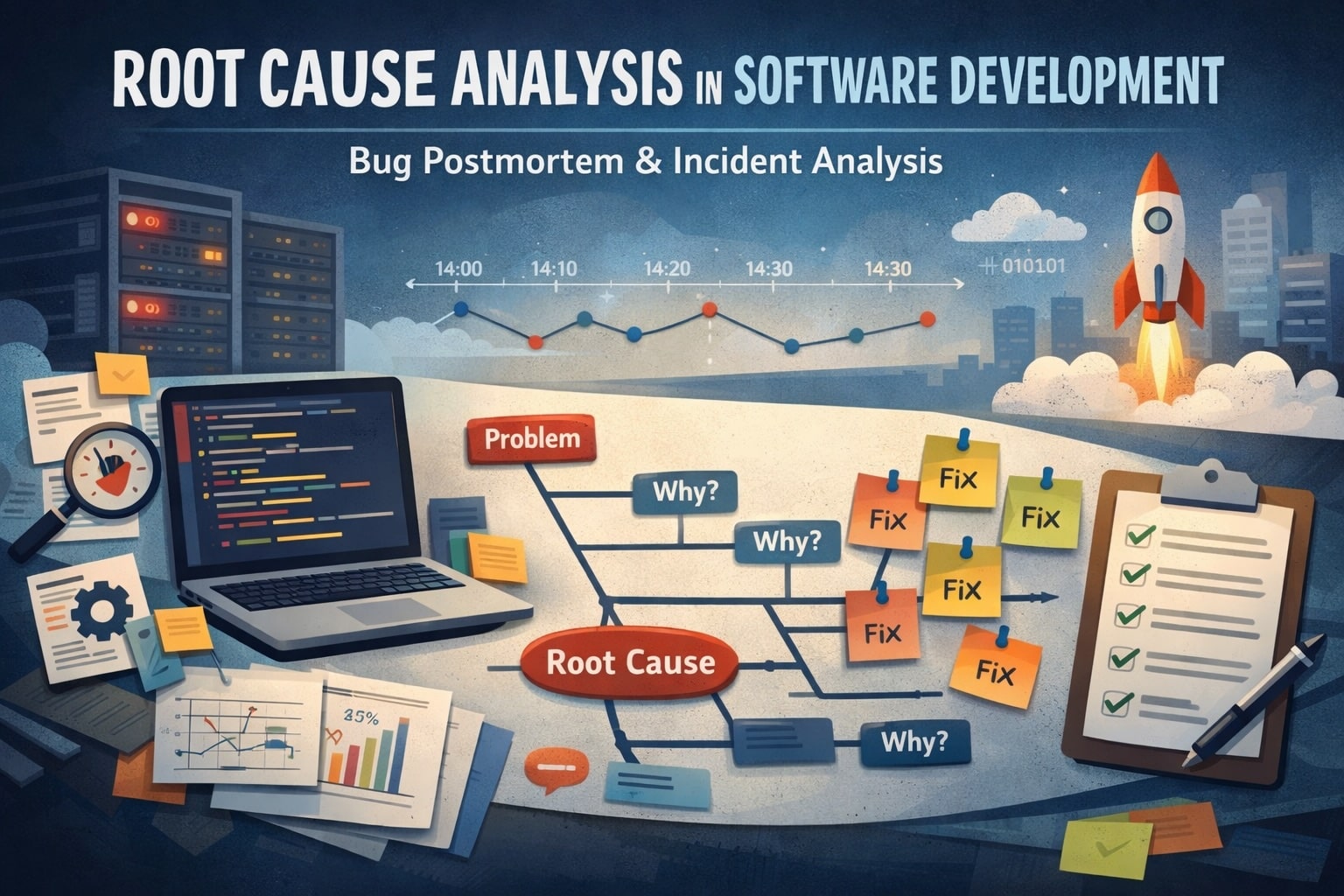
Most teams know the 5 Whys technique. Someone writes a problem on a whiteboard, the group asks “why?” five times, and at the bottom of the chain, they proudly circle a “root cause.”
Sometimes that works. But really produces real value.
As systems get more complex, five questions often aren’t enough. Real-world failures rarely have a single neat cause; they’re tangled in processes, incentives, constraints, and design decisions. If we stop too early, we don’t reach the levers that actually change outcomes.
This is where 5+ Whys analysis comes in: a more flexible, structured, and honest way to do iterative why analysis, as implemented in PRIZ’s 5+ Whys tool.
Table of Contents
A quick refresher on the classic 5 Whys technique
The 5 Whys technique was originally developed at Toyota by Sakichi Toyoda and later popularized inside the Toyota Production System as a simple way to get past symptoms to deeper causes.
The idea is straightforward:
Describe the problem.
Ask “Why did this happen?”
Turn the answer into a new question.
Repeat until you believe you’ve reached a root cause (traditionally after about five iterations).
Many guides frame “five” as the typical depth you need to peel away layers of symptoms and reach the underlying issue, but even traditional sources acknowledge that you may need fewer or more than five whys depending on the problem.
For simple issues – a misconfigured thermostat, a missing spare part, a mislabeled form – this approach is fast, intuitive, and sometimes good enough.
Where the 5 Whys works well
Used in the right context, the 5 Whys technique is still a powerful tool:
Simple, linear problems. When there’s a clear, single line of failure (for example, a maintenance task that was never scheduled), a short why-chain can quickly reveal what to fix.
Low-criticality issues. For smaller problems, you want a light-weight tool that doesn’t require weeks of data analysis. Five Whys is low-cost and accessible.
Teaching systems thinking. It encourages people to look beyond the person who “pushed the wrong button” and into processes, training, design, and management systems.
But the same simplicity that makes it appealing is exactly why it often fails for complex problems.
The hidden limitations of the classic 5 Whys
As 5 Whys escaped the Toyota context and became a universal recipe for root cause analysis (RCA), its weaknesses started to show. Practitioners and researchers have documented several recurring problems.
1. Oversimplification and “single root cause” thinking
Most 5 Whys sessions follow a single linear chain: one cause leads to another, and another, until we arrive at a single “root cause” box.
Real systems rarely behave that way. Equipment failures, safety incidents, quality escapes, and software outages typically involve multiple contributing factors. A linear chain encourages teams to choose one convenient culprit instead of mapping the real web of causes. Studies and practitioners have warned that 5 Whys tends to oversimplify issues and is not well-suited for complex, multi-factor problems.(EasyRCA)
2. Dependence on facilitator skill and bias
Because 5 Whys is mostly verbal, the quality of the analysis heavily depends on the knowledge, experience, and biases of the people in the room. Different teams can perform 5 Whys on the same incident and arrive at different “root causes,” which makes results hard to reproduce and easy to politicize.
If participants already believe “the operator is careless”, the why-chain easily collapses onto that belief. Confirmation bias then drives the answers instead of evidence.
3. Stopping at the fifth why
The biggest trap is right in the name.
Many teams treat “five” as a rule rather than a guideline, stopping once they’ve filled the fifth box even if the last answer is still shallow (“because the operator made a mistake”). Critics have pointed out that this arbitrary cutoff can halt analysis before you reach the system-level issues that actually drive repeated failures.
Traditional training materials do say you may need more or fewer iterations, but in practice, the brand “5 Whys” anchors expectations: people expect to be done at five.
4. Weak linkage to countermeasures
Finally, most 5 Whys worksheets end with a single box labeled “root cause” and a free-form space for “corrective action.” There is little structure for:
Exploring multiple intervention points along the chain.
Evaluating which actions actually help today’s problem versus only future ones.
Comparing several possible solutions objectively.
This is exactly the gap PRIZ’s 5+ Whys analysis is designed to close.
Iterative why analysis: why “five” isn’t the point
If we strip away the brand name, the underlying idea is simple:
Keep asking “why?” until further questions no longer produce useful, actionable insight.
Multiple respected sources emphasize that five is a rule of thumb, not a magic number. Training materials in healthcare and engineering note that you may need fewer or more iterations, and modern guides explicitly tell practitioners to keep going beyond five when problems are complex.
That’s the heart of iterative why analysis: the value lies not in the count of whys, but in the quality and depth of the reasoning.
The question, then, is how to make that depth systematic and practical.
From 5 Whys to 5+ Whys analysis in PRIZ
PRIZ takes the classic idea and turns it into a more rigorous, software-supported method: 5+ Whys.
On the surface, you still build a chain of causes. But there are three important extensions.
1. The chain can be as long or short as needed
In the PRIZ 5+ Whys tool, there is no artificial limit of five steps. You build a chain from the observable failure downward, and you stop only when you hit a cause that you can’t influence in the context of the current problem, or when further whys add no useful leverage.
Sometimes that’s three steps. Sometimes it’s eight or ten.
2. ARP vs FRP: distinguishing today’s fix from tomorrow’s
PRIZ adds a crucial distinction between the two types of reasons in the chain:
Auxiliary Reason of the Problem (ARP). Any cause in the chain that, if removed, would fix or significantly reduce the current problem. There can be many ARPs.
Fundamental Reason of the Problem (FRP). The last cause in the chain: the “dead end.” It usually represents a structural constraint (a regulation, a technological limit, a market expectation). Changing the FRP might prevent future problems, but it often won’t fix the incident you’re dealing with right now.
This distinction is powerful. It lets you:
See where you can act immediately (ARP level).
See what you might want to change strategically in the long run (FRP level).
Avoid the unrealistic expectation that “fixing the root cause once and for all” is always possible.
3. Turning analysis into decisions
Once you’ve built the 5+ Whys chain, PRIZ pushes you one step further. For every ARP, the tool prompts you to list possible solutions or countermeasures. It then lets you evaluate and rank these options (for example, using PRIZ’s Round-Robin Ranking tool) so you can decide which interventions to implement first.
In other words, 5+ Whys is not just about naming the root cause. It’s about systematically connecting causes to actionable, prioritized solutions.
Example 1: Going seven whys deep in manufacturing
Let’s walk through a simplified but realistic 7-level 5+ Whys analysis in a manufacturing environment.
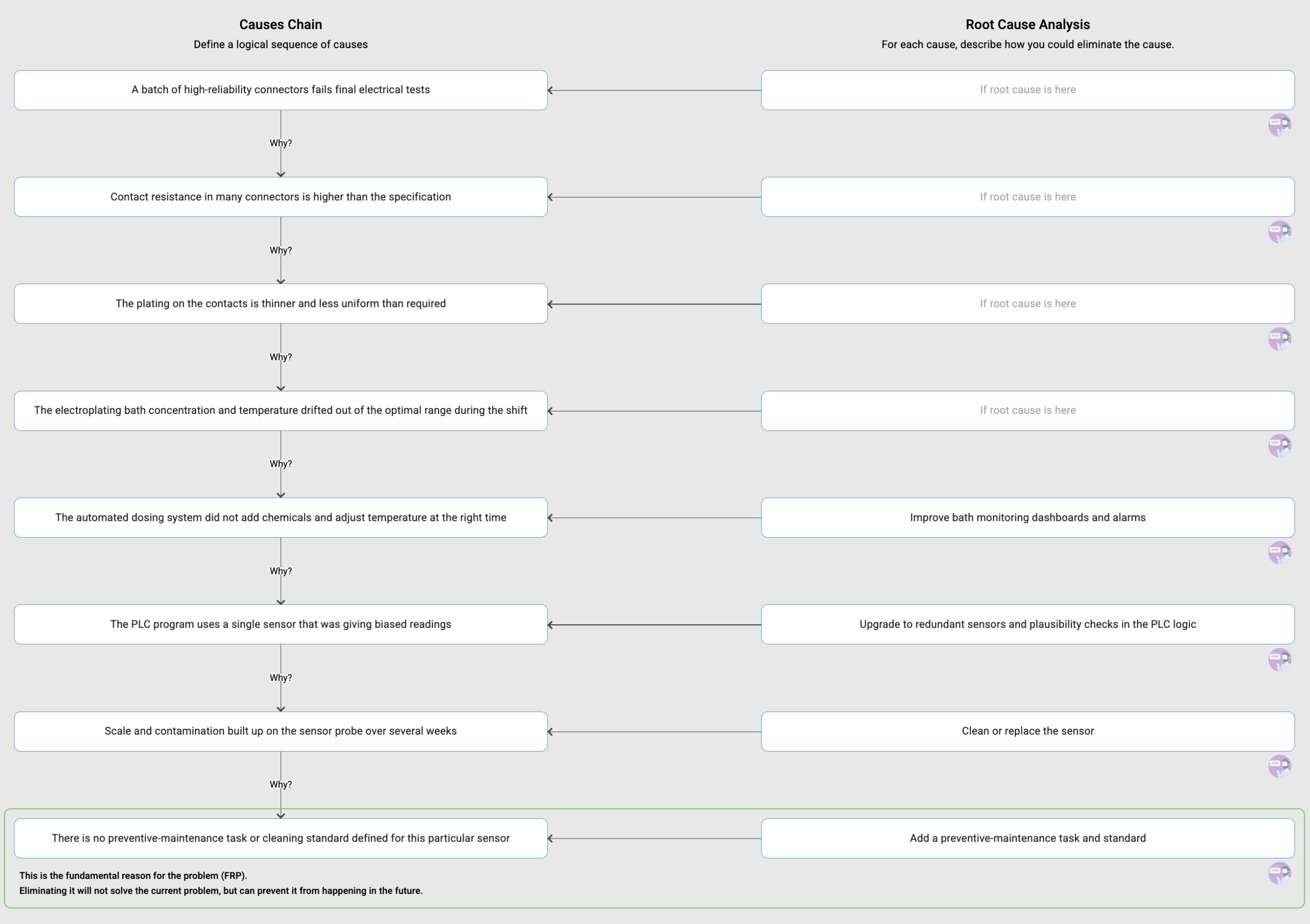
Problem (Failure): A batch of high-reliability connectors fails final electrical tests.
Why did the batch fail tests? Because the contact resistance in many connectors is higher than the specification.
Why is the contact resistance too high? Because the plating on the contacts is thinner and less uniform than required.
Why is the plating too thin and uneven? Because the electroplating bath concentration and temperature drifted out of the optimal range during the shift.
Why did the bath parameters drift? Because the automated dosing system did not add chemicals and adjust temperature at the right time.
Why did the dosing system fail to adjust? Because the PLC program uses a single sensor that was giving biased readings.
Why was the sensor reading biased? Because scale and contamination built up on the sensor probe over several weeks.
Why was the sensor allowed to become contaminated? Because there is no preventive-maintenance task or cleaning standard defined for this particular sensor.
At this point, you have multiple potential intervention points:
Clean or replace the sensor (ARP at level 6).
Add a preventive-maintenance task and standard (ARP at level 7).
Upgrade to redundant sensors and plausibility checks in the PLC logic (ARP at level 5).
Improve bath monitoring dashboards and alarms (ARP at level 4).
If you keep going beyond seven, you might reach an FRP like “The current plating line design has no built-in cleaning mechanism for sensors.” Redesigning the line would help future robustness but won’t save the current batch.
In PRIZ terminology:
Levels 1–7 are all Auxiliary Reasons of the Problem — remove any of them and today’s defect rate drops.
The deeper design limitation (line architecture) is the Fundamental Reason of the Problem. Changing it is a strategic project.
That is already more nuanced than circling a single “root cause: no maintenance” box after five questions.
Example 2: Eight whys in a service/software context
5+ Whys analysis is not just for factories. Consider a SaaS company that suffers a painful outage during a big feature launch.
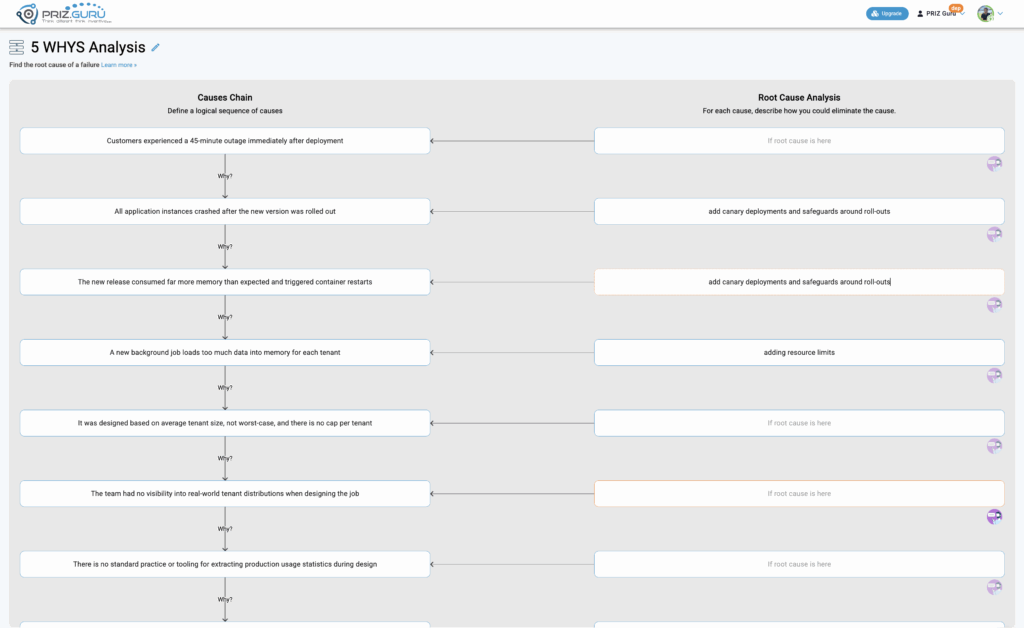
Problem: Customers experienced a 45-minute outage immediately after deployment.
Why did customers lose service? Because all application instances crashed after the new version was rolled out.
Why did the instances crash? Because the new release consumed far more memory than expected and triggered container restarts.
Why was memory consumption much higher? Because a new background job loads too much data into memory for each tenant.
Why does the job load too much data? Because it was designed based on average tenant size, not worst-case, and there is no cap per tenant.
Why was it designed on averages only? Because the team had no visibility into real-world tenant distributions when designing the job.
Why didn’t they have that data? Because there is no standard practice or tooling for extracting production usage statistics during design.
Why is there no such practice? Privacy/security concerns around production data lead teams to avoid pulling it for analysis.
Why are privacy concerns blocking even anonymized statistics? Because there is no clear policy or approved pattern for safe, anonymized telemetry analysis.
Once again, we see different layers:
ARPs include redesigning the job (level 4), adding resource limits (level 3), and adding canary deployments and safeguards around roll-outs (an ARP you might add at level 2).
The FRP might be a deeper organizational pattern: “The company lacks a security-approved, productized way to use anonymized telemetry for design decisions.”
That FRP won’t be fixed overnight, but recognizing it shapes long-term investments. Meanwhile, you can still act immediately on the ARPs.
How to run a 5+ Whys session in practice
You don’t have to be inside PRIZ to think in 5+ Whys terms, but the platform helps your team do it consistently.
A practical flow looks like this (phrased in prose to keep it human):
Start by writing a clear, observable failure at the top — not “our culture is bad,” but something like “Batch #142 failed leakage test” or “Customer onboarding emails were never sent.” Then, ask “Why?” and write down a factual, evidence-based answer, not a guess.
Repeat this: for each new cause, ask “Why did that happen?” and add another node to the chain. Pull in data, logs, photos, process maps; don’t rely only on memory. When the chain splits, don’t force it back into one line; it might be a candidate for a richer tool like a cause-and-effect chain.
As your chain grows, mark which causes are ARPs, points where a change would directly help this incident, and look for the FRP, the dead-end that you probably can’t change quickly (things like regulations, standard technology limits, or deep market constraints). In PRIZ’s 5+ Whys tool, you explicitly tag that last node as FRP so the system knows where the chain ends.
Finally, for each ARP, list possible countermeasures. Avoid judging too early; crazy ideas are allowed at this stage. Only after you have a list do you evaluate which actions give the best trade-off of impact, risk, and cost, something PRIZ supports with integrated solution-ranking tools.
At the end, you have:
A transparent cause chain that can be audited and revisited.
A set of potential interventions at different depths.
A prioritized action plan, not just a circled “root cause.”
When should you stop asking “why”?
Practically, you stop your iterative why analysis when:
The next answer would be so broad that it no longer leads to concrete actions (for example, “society values short-term profit”).
You reach an FRP that is either outside your sphere of control for this incident or would require a long-term transformation.
Additional whys just rephrase the same idea instead of uncovering new mechanisms.
Traditional materials say to stop when further whys no longer “turn up anything useful”. In PRIZ’s 5+ Whys, that moment is captured by marking the last node as FRP and shifting energy from analysis to solution design.
The key is to be honest: if you still haven’t found any actionable ARPs by the time you hit five, you probably need to keep going.
5+ Whys inside a complete root cause analysis ecosystem
5+ Whys analysis isn’t meant to stand alone. It fits inside a broader root cause analysis toolkit:
For simple problems, 5+ Whys may be all you need.
For complex issues with many branches, it pairs naturally with PRIZ’s Cause & Effect Chain and Functional Modeling tools.
Within structured frameworks like 8D, it strengthens the D4 (root cause analysis) step by clarifying both ARPs and FRP before you move on to corrective and preventive actions.
Bringing it back to your team
If your current root cause analyses routinely stop at “human error,” “lack of training,” or “the operator didn’t follow the procedure,” you’re leaving a lot of insight and money on the table.
Try this instead:
Keep the spirit of the 5 Whys technique, but drop the rigid “five.”
Adopt 5+ Whys analysis: build longer, evidence-based chains, explicitly separate Auxiliary and Fundamental reasons, and connect each ARP to concrete countermeasures.
Use tools (like the PRIZ Innovation Platform) that support this deeper, structured, and collaborative iterative why analysis.
You’ll still be asking the same small question, “Why?”, but you’ll finally be using it at the depth today’s complex systems demand.
Go one level beyond “why”, and decide where to act.
Build a 5+ Whys chain in PRIZ, distinguish actionable root problems from deeper fundamental root problems, and turn the analysis into action.
What is the 5 Whys technique in root cause analysis?
The 5 Whys technique is a simple problem-solving method where you repeatedly ask “why?” (typically five times) to move from a visible problem down through deeper causes. Each answer becomes the next “why” question, helping you look beyond symptoms to uncover underlying issues.
Why is the classic 5 Whys technique sometimes not enough?
The classic 5 Whys can oversimplify complex problems by forcing everything into a single, linear chain. It often stops too early (at the fifth why) and may miss multiple contributing factors, systemic issues, or deeper constraints that actually drive recurring failures.
What are the Auxiliary Reason of the Problem (ARP) and the Fundamental Reason of the Problem (FRP)?
In PRIZ’s 5+ Whys, ARP (Auxiliary Reason of the Problem) is any cause in the chain that, if removed, can directly help solve or reduce the current problem. FRP (Fundamental Reason of the Problem) is the last “dead-end” cause—usually a deeper structural or contextual constraint that, if changed, mainly prevents future problems rather than fixing today’s incident.
How many “whys” should we ask in practice?
There’s no magic number. You keep asking “why?” until further answers stop producing useful, actionable insight—typically when you hit a cause you cannot realistically influence in the current context or when new answers just restate existing ones. In 5+ Whys, that’s when you mark the FRP and shift focus to countermeasures.
Can I have multiple root causes in 5+ Whys analysis?
Yes. 5+ Whys explicitly acknowledges that several causes along the chain can be meaningful “root” points for intervention (the ARPs). Instead of chasing a single magical root cause, you identify a set of leverage points and then decide which combination of actions gives the best impact.
Is 5+ Whys only for manufacturing problems?
Not at all. The method works for manufacturing, software, service operations, healthcare, logistics—any domain where cause-and-effect can be traced. The examples in this article (production defects, software outages, process issues) show how the same iterative why analysis can be applied across industries.
How does the PRIZ Innovation Platform support 5+ Whys analysis?
The PRIZ Innovation Platform provides a visual 5+ Whys tool where you build the cause chain step by step, mark ARPs and the FRP, and attach solution ideas to each cause. It then integrates with other tools (like ranking and functional modeling), so your root cause analysis flows naturally into decision-making and implementation, not just documentation.
Contains information related to marketing campaigns of the user. These are shared with Google AdWords / Google Ads when the Google Ads and Google Analytics accounts are linked together.
90 days
__utma
ID used to identify users and sessions
2 years after last activity
__utmt
Used to monitor number of Google Analytics server requests
10 minutes
__utmb
Used to distinguish new sessions and visits. This cookie is set when the GA.js javascript library is loaded and there is no existing __utmb cookie. The cookie is updated every time data is sent to the Google Analytics server.
30 minutes after last activity
__utmc
Used only with old Urchin versions of Google Analytics and not with GA.js. Was used to distinguish between new sessions and visits at the end of a session.
End of session (browser)
__utmz
Contains information about the traffic source or campaign that directed user to the website. The cookie is set when the GA.js javascript is loaded and updated when data is sent to the Google Anaytics server
6 months after last activity
__utmv
Contains custom information set by the web developer via the _setCustomVar method in Google Analytics. This cookie is updated every time new data is sent to the Google Analytics server.
2 years after last activity
__utmx
Used to determine whether a user is included in an A / B or Multivariate test.
18 months
_ga
ID used to identify users
2 years
_gali
Used by Google Analytics to determine which links on a page are being clicked
30 seconds
_ga_
ID used to identify users
2 years
_gid
ID used to identify users for 24 hours after last activity
24 hours
_gat
Used to monitor number of Google Analytics server requests when using Google Tag Manager