If you’ve spent time in quality engineering, you’ve seen the cycle: a defect appears, containment is rushed in, production resumes, and then the defect returns; sometimes with a new nickname that lets everyone pretend it’s a different problem.
8D was created to stop that loop. It’s a disciplined, cross-functional method designed to move teams from reaction to resolution and then to prevention. But 8D only works when one step is treated as more than paperwork: D4, root cause analysis. When D4 is shallow, the rest of the 8D is just a well-formatted way to repeat the same mistake.
This article explains the 8D methodology, focuses on D4 as the hinge point, and shows how classic 8D problem-solving tools like 5 Whys and cause-and-effect diagrams should be used inside 8D. You’ll also see how PRIZ Guru supports the full cycle so teams can collaborate, document evidence, and produce an 8D report that holds up under scrutiny.
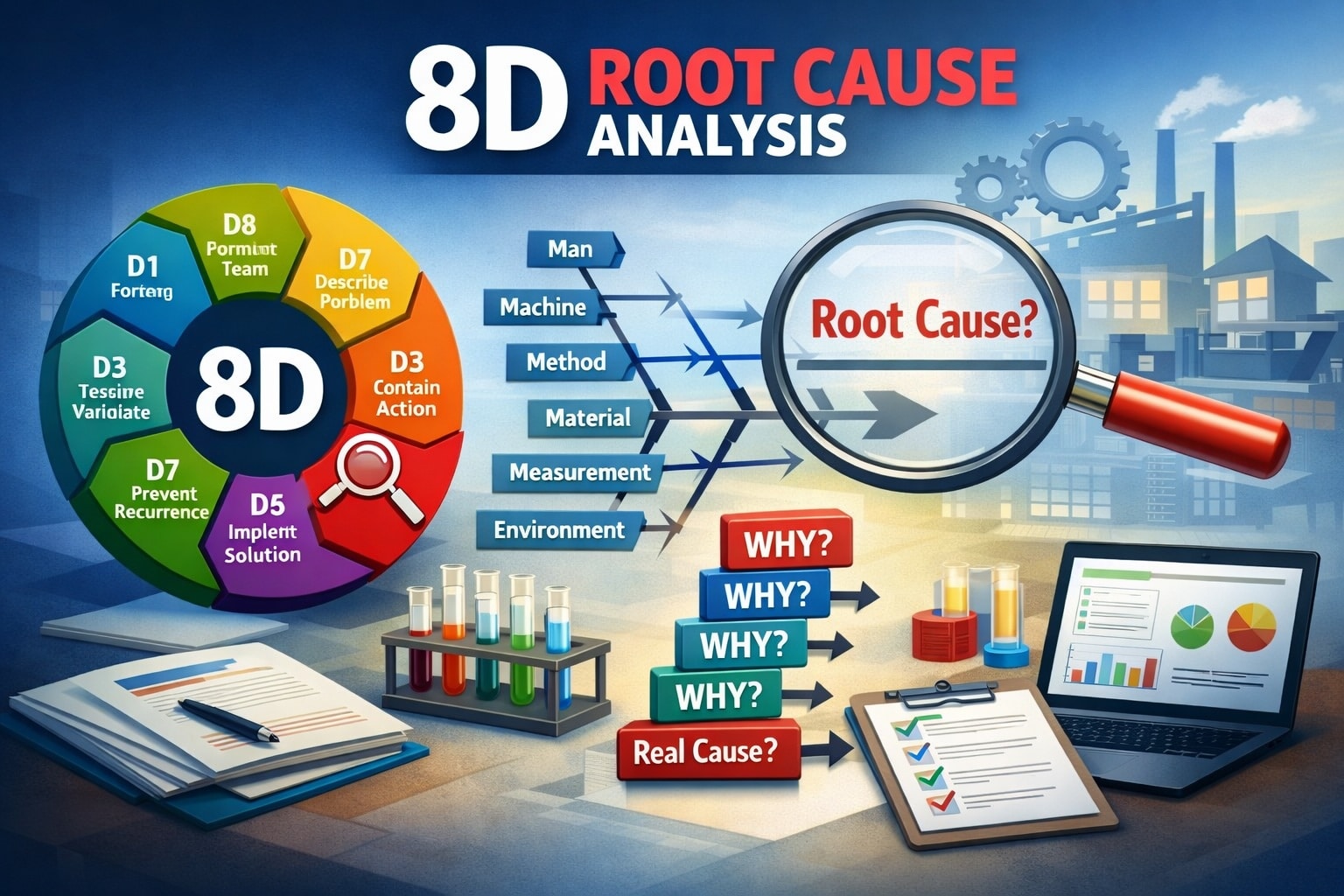
8D (Eight Disciplines) is a structured approach for solving non-trivial problems, especially recurring defects, customer escapes, yield losses, and failures that require multiple disciplines to resolve. It’s popular in manufacturing-heavy industries because it’s both practical and auditable: it creates a trail from problem definition to containment to verified causes to validated corrective actions.
The key benefit is not the template. The benefit is the forced logic: 8D makes you prove you understand the problem before you claim you fixed it.
Think of 8D as a story that must make sense from beginning to end.
You start with D1, assembling a cross-functional team that has real knowledge and authority, not just “available people.”
In D2, you describe the problem precisely enough that it can be tested and measured, not just complained about.
D3 is where you protect the customer and stabilize operations through containment.
Then comes D4: root cause analysis, where you identify why it happened and verify that claim with evidence.
From there, D5 is selecting permanent corrective actions that directly address verified causes,
D6 is implementing and validating them under real conditions,
D7 is preventing recurrence by updating the system (controls, standards, training, specs), and
D8 is recognition and closure, so the organization learns, not just the spreadsheet.
That’s the intended flow. In real life, most failed 8Ds fail because D4 is treated like a checkbox rather than the engineering core.
A lot of “8D root cause analysis” collapses into something like this: brainstorm a plausible cause, agree it sounds reasonable, choose an action, and move on.
But D4 has a higher standard. A root cause in 8D is a claim that must survive verification.
Even more important: D4 should produce two kinds of causes, not one:
Teams that skip escape cause analysis don’t eliminate recurrence—they just change where it shows up.
A cause-and-effect diagram is useful because it prevents tunnel vision. It helps a team lay out hypotheses across categories and quickly notice when they’re obsessing over one area.
The failure mode is when the fishbone becomes a parking lot of opinions. If your diagram is just a list of “maybe it was…” statements, it’s not a causal model yet.
For complex problems, many teams need a cause-and-effect chain style approach instead of a “category board.” Real failures often unfold as a sequence: condition → mechanism → intermediate failure → observed defect. If you can’t explain the mechanism, you’re not at the root cause.
5 Whys works well inside 8D when it’s used as a disciplined drill-down from a well-defined effect (from D2), and when each step is backed by evidence.
Where it goes wrong is predictable: people stop at “operator error,” they force a single linear chain even when multiple mechanisms are plausible, or they treat the fifth “Why” as automatically true because it’s the fifth.
In practice, good D4 often uses “Whys” in more than one branch. Complex systems don’t fail politely in a single-file line.
Verification can take different forms: controlled reproduction, teardown confirmation, metrology evidence, designed experiments, and removal-and-confirmation trials. But the principle is the same: a root cause must be testable and tested.
If the team can’t clearly say what evidence would confirm or refute a cause, it’s still a hypothesis.
The escape cause is where mature 8D teams separate themselves from everyone else.
If the defect reached the customer, or even reached downstream operations, something in your controls failed. Maybe the inspection method can’t detect the failure mode, maybe sampling is too weak, maybe the test conditions don’t activate the defect, maybe measurement is unstable, maybe standards are ambiguous, maybe everyone normalized the drift.
Without escape analysis, you’ll often “fix” the process but keep the same blind spot, meaning the next defect walks right through the same open door.
Most organizations don’t struggle with knowing what 8D is. They struggle with executing it consistently across teams.
In practice, evidence gets scattered across emails and chats. Logic gets lost in meetings. Containment actions blur into corrective actions. Ownership becomes vague. Reporting happens at the end, assembled backwards, with missing links between cause and action.
PRIZ Platform supports the full 8D workflow by keeping problem definition, hypotheses, causal logic, evidence, actions, and validation connected in one place. Teams can collaborate across disciplines while preserving traceability: which causes were considered, what evidence verified them, which corrective actions map to which verified causes, and what validation proved effectiveness. That combination, collaboration plus traceable logic, is what turns 8D from “a template we fill in” into “a repeatable way we actually solve problems.”
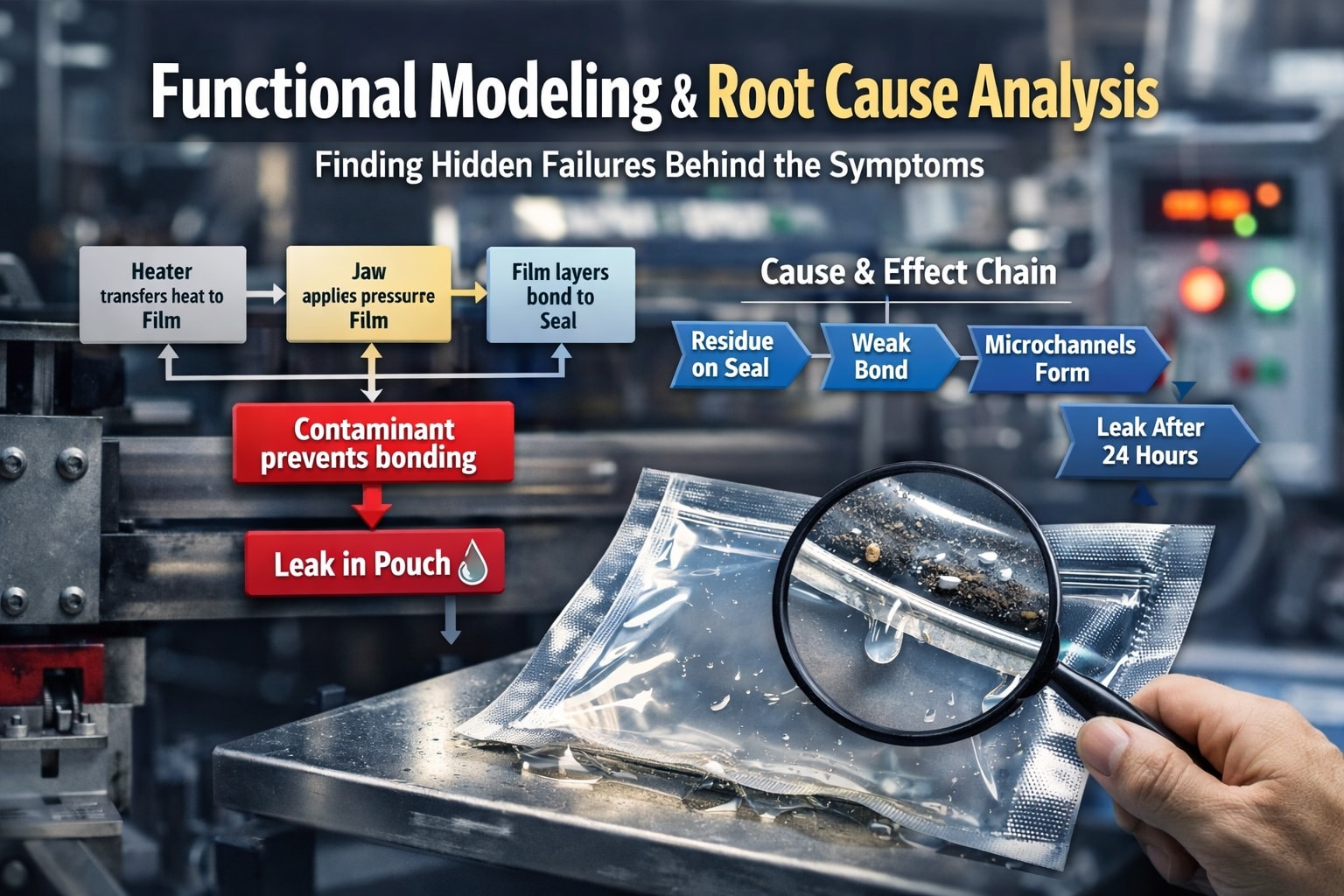
Imagine intermittent leaks in a valve assembly after thermal cycling. The team writes a clean D2 statement, which contains the issue with quarantines and additional testing, and then enters D4.
A superficial D4 might stop at “seal problem” and swap suppliers. A stronger D4 model with multiple branches (material, surface finish, torque, contamination, thermal mismatch) drills down using Whys and then verifies.
The team discovers the occurrence cause is a residue mechanism that reduces seal stability under thermal expansion. Then they find the escape cause: the leak test was only performed at ambient conditions, so the failure mode wasn’t activated, and the defects passed undetected.
Now D5 and D6 become straightforward: change the cleaning process and update test conditions to activate the failure mode. D7 locks it in by updating standards, control plans, and training so the organization doesn’t silently drift back.
That’s what “integrated 8D root cause analysis” means in practice: verified occurrence cause plus verified escape cause, followed by actions that map directly to both.
Containment gets treated like a fix. Causes get selected for plausibility instead of verification. Teams force a single root cause even when reality has multiple contributors. Escape analysis gets skipped. Corrective actions aren’t explicitly linked to verified causes. The report looks complete, but the logic isn’t.
A simple self-check helps: if an action doesn’t clearly map to a verified cause, it isn’t corrective—it’s hopeful.
8D is a discipline. D4 is the truth serum. If you treat D4 as a verification-driven engineering activity, not a checkbox, you stop recurrence instead of just managing it.
And when your team can execute that logic consistently, you don’t just produce an 8D report. You build a repeatable problem-solving system.