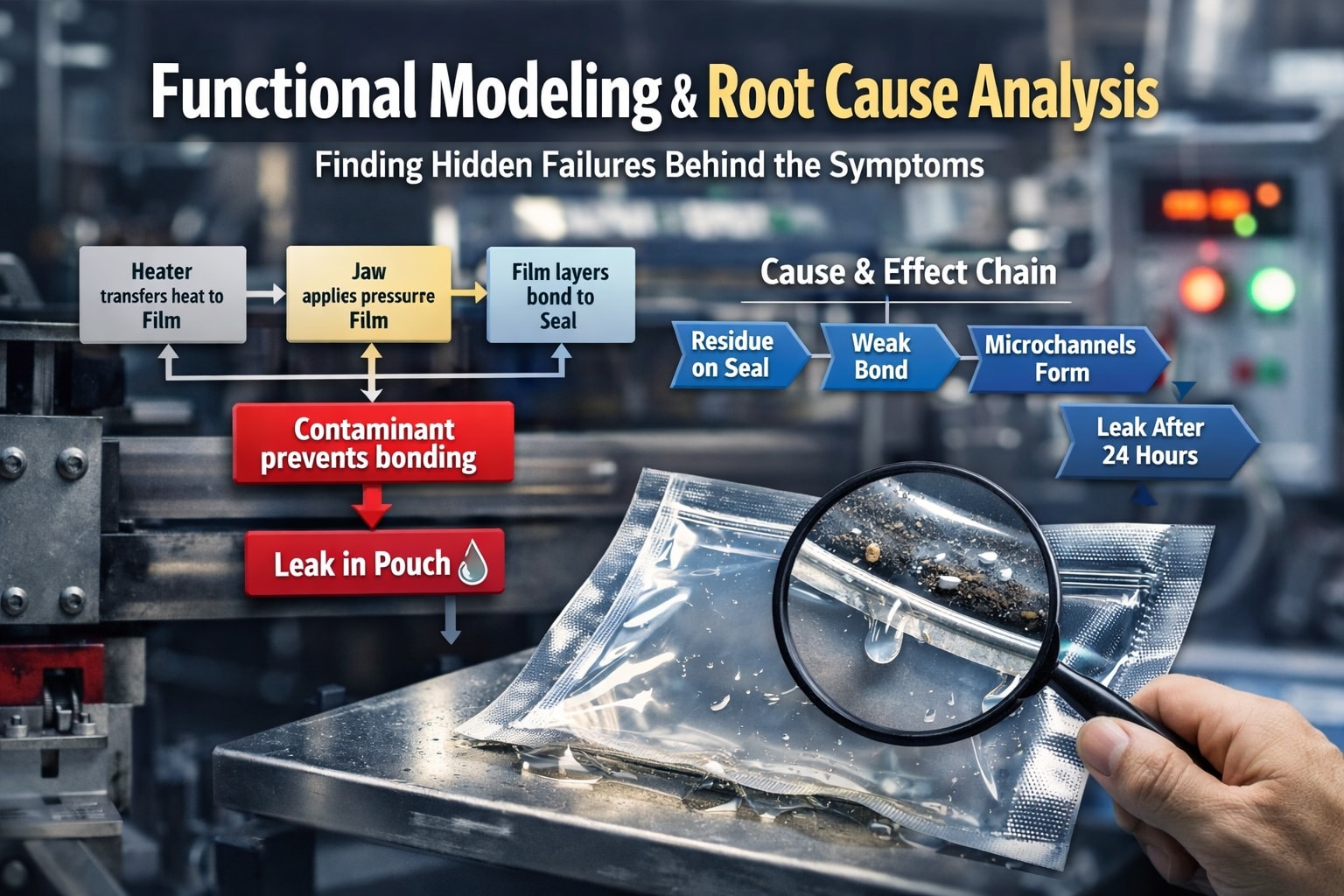
Walk into almost any modern plant, and you will hear the same ambitions: less scrap, fewer stoppages, smoother flow, better delivery. Most organizations talk about continuous improvement, yet many teams find themselves solving the same problems again and again. Scrap returns, the same machine keeps tripping, and customer complaints reappear under new labels.
The gap is rarely a lack of effort. It is usually a lack of structured thinking about why problems happen in the first place. That is where root cause analysis becomes essential to continuous improvement, particularly in Lean and Kaizen environments. Root cause analysis (RCA) gives teams a disciplined way to move beyond quick fixes and redesign processes so issues do not return.
In this article, we will look at how root cause analysis supports continuous improvement and Kaizen, what RCA looks like in daily manufacturing and operations work, and how a platform like PRIZ Guru can help you document and track analyses over time. Along the way, we will keep a clear focus on root cause analysis in continuous improvement and RCA in Lean manufacturing, so you can see exactly how these ideas connect in practice.
Kaizen is often translated as “change for the better” or simply “continuous improvement.” In Lean manufacturing, however, it is a way of running the organization. Everyone, from machine operators to senior management, is expected to look for small, practical ways to make processes safer, more reliable, and more efficient and effective.
Rather than waiting for rare, large transformation projects, Kaizen encourages frequent, incremental improvements. A small adjustment in how a fixture is loaded, a clearer work instruction, a better check at shift change. These changes add up over time and make the system more stable.
However, for Kaizen to deliver lasting value, teams must understand why the current process behaves the way it does. Otherwise, changes may only mask symptoms or even introduce new problems elsewhere. That is where root cause analysis becomes the engine inside the continuous improvement system.
Root cause analysis is a family of methods used to understand the underlying reasons why a problem or deviation occurs. In manufacturing and operations, RCA is used to investigate quality defects, equipment failures, safety incidents, delivery delays, and other disruptions to stable flow. Instead of asking only “what went wrong,” RCA pushes teams to ask “what in the process allowed this to happen, and why does that condition exist?”
Continuous improvement programs often highlight RCA as one of their core tools, along with techniques like 5S, value stream mapping, standardized work, and visual management. Training providers and quality organizations consistently present RCA as a way to move from firefighting to prevention and from isolated fixes to systemic learning.
When root cause analysis is embedded into daily work, every deviation becomes a structured learning opportunity rather than just another incident to close. That is exactly the mindset required for a genuine Kaizen culture.
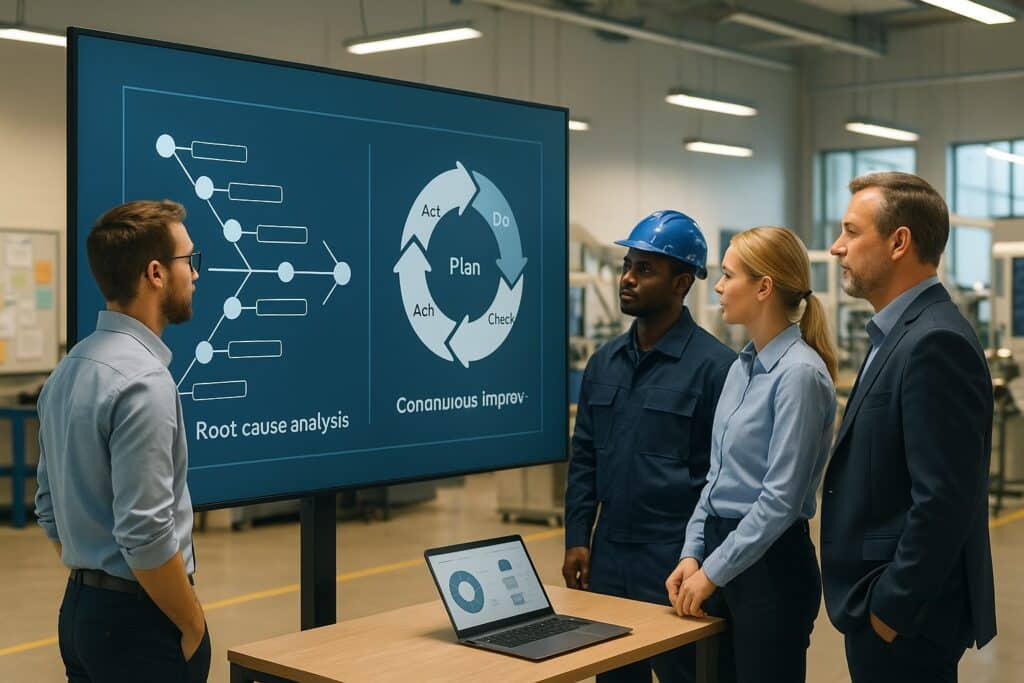
Most Lean and Kaizen initiatives use the PDCA cycle (Plan, Do, Check, Act) as their core structure for change. The idea, popularized by Shewhart and Deming, is to treat improvement as an ongoing experiment: plan a change, try it on a small scale, check the results, and then act to standardize or adjust.
In this cycle, root cause analysis belongs primarily in the Plan step. Before a team decides what to change, it needs a clear understanding of the problem and its causes. If the plan is built on guesswork or vague labels like “operator error” or “machine issue”, the PDCA loop will still turn, but the change will be based on weak assumptions. The team may have to repeat the cycle many times, wasting time and energy, or they may think they have solved the issue only to see it return later.
When root cause analysis is used properly, the Plan phase becomes much stronger. The problem is defined clearly and quantitatively. Causes are mapped and tested rather than assumed. Countermeasures are designed to address specific conditions instead of acting as generic bandages. As a result, PDCA cycles become more effective, and fewer iterations are needed to achieve stable improvement.
Kaizen happens at two different speeds.
On one side, there are daily improvements, where operators and supervisors adjust small things in their work area. On the other, there are Kaizen events or workshops, where cross-functional teams spend a few days focused on a particular problem, such as a bottleneck process, a chronic quality issue, or a painful changeover.
Root cause analysis has a role in both.
In daily improvement, teams can use lightweight RCA techniques such as a brief “five whys” discussion at the line, combined with a quick review of relevant data or patterns. For example, if a packing line frequently stops due to sensor misreads, the team can look at when it happens, under what conditions, and why those conditions occur. Each small improvement is still guided by the idea of cause and effect, even if the analysis is not formally documented.
In larger Kaizen events, teams often deal with more complex, chronic problems. Here, a more structured RCA is needed. Cause–effect diagrams, detailed chains of contributing factors, and data-backed hypotheses become essential. The team may draw an Ishikawa (fishbone) diagram to explore all potential causes across categories like methods, machines, materials, and environment, then use data and observation to narrow down which factors truly matter.
In both cases, root cause analysis is what keeps Kaizen grounded in reality. It prevents teams from jumping straight to favorite solutions and pushes them to understand how the process actually behaves.
Continuous improvement programs often teach several RCA methods, but most of them follow a similar logical flow. The exact tool you choose — five whys, cause–and–effect chains, fishbone diagrams — is less important than the discipline in how you apply it.

Below is a narrative view of a typical RCA flow that fits well into Lean and Kaizen initiatives.
The first step is to turn vague complaints into a precise problem statement. Instead of saying “the line is unreliable” or “there is too much scrap”, the team expresses the issue in measurable terms. For example, they may define that “over the last four weeks, Line 3 has produced an average of 3.2 percent scrap on Product X due to surface cracks, compared to a target of 0.5 percent”.
This kind of definition ties the problem directly to business impact, makes the deviation visible, and gives the team a baseline for measuring improvement. It also fits well with Lean’s focus on quality, cost, and delivery.
Lean thinking emphasizes going to the real place, at the real time, to see the real process. That principle, often called “go to the Gemba”, and it is crucial for root cause analysis as well. The team visits the line when the problem tends to occur, observes the process, and gathers relevant data. They may look at cycle times, temperatures, pressures, material batches, maintenance histories, and operator actions. They may take photos or video and keep samples of good and defective parts for comparison.
The goal here is to understand the context of the problem rather than relying on memory or assumptions. Good RCA in continuous improvement is always grounded in direct observation and accurate data.
Only after the problem is clearly defined and data has been collected does the team start to model causes. A simple way to start is by asking “why” repeatedly and writing down the answers. Each answer becomes the basis for the next question, gradually moving from visible symptoms to deeper process conditions.
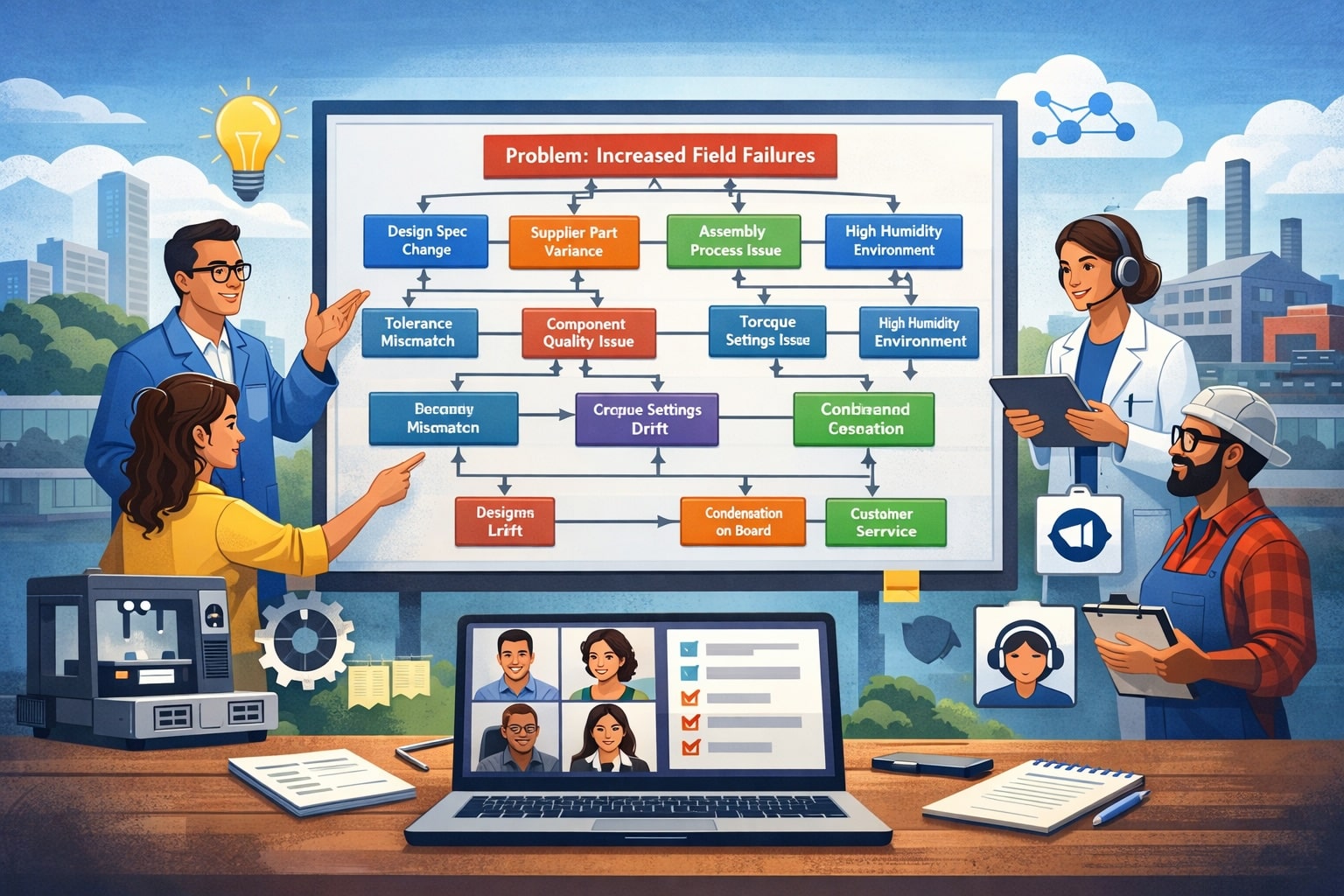
For more complex issues, teams can build cause–effect chains or diagrams. They identify an effect, such as a defect type, then link it backwards to immediate physical causes, then to process conditions, and further to systemic factors such as training, maintenance practices, or design choices. Fishbone diagrams are often used at this stage to ensure that potential causes from multiple categories are considered, not only the ones that are obvious or comfortable to discuss.
The key is that every proposed cause remains a hypothesis until it is supported by evidence.
Many RCAs fail because teams stop too early and treat the first plausible explanation as the root cause. A more disciplined approach requires testing.
Once several candidate causes have been identified, the team checks them against the data and the reality they saw at the Gemba. They ask whether the problem can occur without that condition, whether there is a clear mechanism connecting cause and effect, and whether there is any pattern in the data that supports or contradicts the hypothesis.
In some cases, they design small experiments or trials. They might adjust a set-up parameter, change a component, modify a work instruction, or run a different material batch, then observe whether the defect rate or downtime pattern changes. This is where RCA and PDCA intersect directly: the “Check” step validates whether the analysis was correct.
By the end of this stage, the team has a small set of validated root causes rather than a long list of possibilities.
With validated root causes in hand, the focus shifts from analysis to design. The team now looks for solutions that will remove or control the root causes in a sustainable way.
In many continuous improvement case studies, the most effective countermeasures either eliminate a risky condition altogether or make it very difficult for the error to occur. Examples include redesigning a part to be symmetrical so it cannot be installed the wrong way, changing a fixture to ensure correct positioning, automating a critical check, or updating a process parameter window with better controls. When elimination is not possible, teams look for ways to detect problems earlier or reduce their impact.
In Lean manufacturing, this design work is closely tied to standardization. Countermeasures are not considered complete until they are built into standard work, training materials, maintenance routines, and process documentation.
Finally, the outcome of the root cause analysis is integrated into the broader continuous improvement system.
The problem statement, the analysis, the chosen countermeasures, and the results are documented. The team communicates what they have learned to other lines, shifts, or plants that might face similar conditions. Follow-up checks are scheduled to verify that the solution is holding and that no new side effects have appeared.
At this point, the RCA has done more than just close a single issue. It has added a new piece of knowledge to the organization’s collective understanding of its processes. Over time, a well-run continuous improvement program accumulates many of these small insights, which makes future RCA easier and faster.
One of the most powerful aspects of root cause analysis in continuous improvement is the way it reveals patterns across different incidents.
When multiple RCA records are available, operations leaders can compare them and look for recurring themes. Several seemingly unrelated quality issues might trace back to a common training gap. A mix of downtime events across different machines might share a link to the same maintenance policy or spare-parts strategy. Repeated near-misses and minor safety incidents almost always expose a systemic design flaw in workstations or material flow.
Modern research on manufacturing RCA increasingly highlights the value of combining human expertise with structured methods and digital tools. When teams can link cause–and–effect patterns across large volumes of historical cases, they can move from local fixes to truly systemic improvements.
In a Kaizen culture, this is exactly what you want: each RCA becomes not only the end of one problem, but also a small step toward a more robust system.
Tools alone do not create continuous improvement. Culture matters.
A Kaizen culture treats problems as valuable signals, not as personal failures. When something goes wrong, people are encouraged to raise it quickly and honestly. Leaders respond by asking what in the process allowed the issue to occur, rather than immediately searching for someone to blame.
Root cause analysis fits naturally into this way of working. It gives everyone a shared language and structure for discussing problems. Instead of saying “be more careful,” the conversation shifts to “what conditions led to this mistake, and how do we change those conditions?” Instead of closing an incident report with a vague commitment to “retrain operators”, the team describes the specific causes identified and the concrete changes made to the process.
Over time, this approach builds trust. Operators see that when they speak up, their input leads to real analysis and meaningful changes. Engineers and managers see that investing time in RCA reduces repeat issues and firefighting. The organization becomes more stable and more capable of learning.
Doing root cause analysis well is demanding. It requires structured thinking, access to data, collaboration across roles, and robust documentation. That is where a dedicated platform can make a significant difference.
PRIZ Guru is designed to help engineering, quality, and operations teams run systematic RCA and other problem-solving methods as part of their continuous improvement and Kaizen work.
Within the PRIZ Platforms, each problem becomes a project. Teams can define the issue clearly, collect evidence, and build structured cause–and–effect models rather than leaving their analysis scattered across emails or one-time slides. Methods that are common in Lean manufacturing, such as extended “five whys,” cause–and–effect chains, and functional modeling, are supported directly in the platform’s tools. This makes it easier to explore multiple branches, test hypotheses, and link causes to data instead of relying on memory.
Because everything is captured in a structured way, completed root cause analyses form a searchable knowledge base. When a new incident occurs, teams can quickly find similar problems, review how they were solved, and avoid reinventing the wheel. That is a very practical way to connect root cause analysis with continuous improvement: each RCA adds to an accumulated memory that supports future Kaizen efforts.
The platform also helps with communication. Well-structured RCA records are easier to share with leadership, auditors, and customers, and they can be aligned with existing frameworks such as CAPA, 8D, or internal problem-solving standards. Over time, the PRIZ process becomes a backbone for RCA in Lean manufacturing: it supports disciplined analysis, continuous learning, and traceable improvement.
Continuous improvement and Kaizen are powerful ideas, but they can easily become buzzwords if they are not supported by strong problem-solving practice. Root cause analysis provides the missing structure. It turns each deviation into a chance to understand the process more deeply and to design changes that prevent recurrence rather than simply hiding symptoms.
When RCA is integrated into PDCA cycles, Kaizen events, and daily improvement routines, manufacturing and operations teams move from constant firefighting to deliberate, cumulative progress. Problems become learning opportunities. Solutions become more robust. The system becomes more stable.
Platforms like PRIZ Guru make this practical at scale by giving teams a place to run, document, and reuse root cause analysis. In that way, every solved problem contributes not just to today’s metrics, but to a stronger continuous improvement culture tomorrow.